Transmission cooling options

You know once you install the filter, the fluid will be cleaner overall. So there wont be crud to clog the cooler. I chose to install the filter after the cooler primarily to make sure the last leg of the fluid path was filtered before re-entering the transmission. But also to add a slight back pressure to the fluid to allow the fluid to stay longer in the cooler to extract more heat. It works for my truck.

In hindsight, I would have installed the filter in front of the radiator close to the aux cooler instead of behind the radiator. Having to drop the aftermarket skid plate to gain access is a real PITA.

I know what you mean about those aftermarket skid pans. When I recently helped [MENTION=102606]infamousRNR[/MENTION] renew all the fluids on his truck, his heavy aftermarket skid pans made it quite a bit harder to do the job. I don't plan on doing any serious rock crawling with mine so the stock skid pans work fine.
 

Ford uses this filter when they rebuild Superdutys with the 4R100 transmission. If you buy a factory reman, they WILL NOT WARRENTY it if the filter is not plumed AFTER the coolers and before the transmission. I would guess that they have some sort legitimate reason.

I know for a FACT that it is a great addition and my fluid was way cleaner at 25,000 miles even towing 9000 lbs.

It should work VERY well on our transmissions.
 
Ford uses this filter when they rebuild Superdutys with the 4R100 transmission. If you buy a factory reman, they WILL NOT WARRENTY it if the filter is not plumed AFTER the coolers and before the transmission. I would guess that they have some sort legitimate reason.

I know for a FACT that it is a great addition and my fluid was way cleaner at 25,000 miles even towing 9000 lbs.

It should work VERY well on our transmissions.

That's interesting they specify it has to be after the coolers. Whether the filtering takes place before the coolers or after shouldn't make a difference, but like you said, there's got to be some sort of reason for it. Mine is in-between the stock radiator cooler and the external B&M 70264 cooler so I'm half right according the Ford.

Doing a little research, one possible reason to put the filter after the coolers and before the transmission is to prevent any debris already in the coolers from getting back to the transmission. Since I put in a new radiator and a new external cooler, maybe my installation location choice between the two coolers is perfectly fine. Anyway, my trans temps have been good, and the trans is shifting well, so maybe everything is copacetic.
 
Last edited:
Doing a little research, one possible reason to put the filter after the coolers and before the transmission is to prevent any debris already in the coolers from getting back to the transmission. Since I put in a new radiator and a new external cooler, maybe my installation location choice between the two coolers is perfectly fine. Anyway, my trans temps have been good, and the trans is shifting well, so maybe everything is copacetic.

I suspect your right. I just found it interesting when I replaced my transmission how specific they were about the filter. But that transmission build tremendous heat too. I think that as long as you have a filter, you are ahead of the game.
 
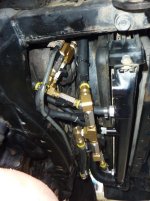
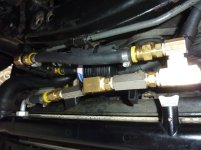
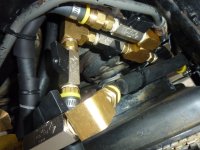
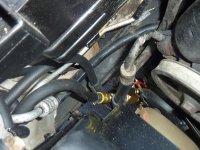
So I installed the external cooler last weekend with the valves and such. Installed a Magnefine filter on the return line before it goes back into the transmission. Might look a little "busy" but there's really only one place I made a 180 turn just to be able to add and locate the filter properly. Nothing shakes around at all. Temps haven't gone over 200* which was my primary goal. I'm gonna run it like this for my trip down to Florida then I might run it just through the cooler on the way back. Added a few more pieces of hose (which aren't pictured) so there's no rubbing like in the 3rd picture between the valve and brass elbow contacting the PS line.
 

Attachments

  • 021.jpg
    021.jpg
    129.9 KB · Views: 264
  • 022.jpg
    022.jpg
    124.9 KB · Views: 302
  • 023.jpg
    023.jpg
    133.1 KB · Views: 261
  • 025.jpg
    025.jpg
    136.1 KB · Views: 303
So I installed the external cooler last weekend with the valves and such. Installed a Magnefine filter on the return line before it goes back into the transmission. Might look a little "busy" but there's really only one place I made a 180 turn just to be able to add and locate the filter properly. Nothing shakes around at all. Temps haven't gone over 200* which was my primary goal. I'm gonna run it like this for my trip down to Florida then I might run it just through the cooler on the way back. Added a few more pieces of hose (which aren't pictured) so there's no rubbing like in the 3rd picture between the valve and brass elbow contacting the PS line.

That's a whole lot of fittings. Those fittings, especially anywhere the fluid is forced through a 90 degree is going to increase friction loss and drop the pressure of the fluid. A rubber tube making a gradual curve is going to have way less friction loss than a series of fittings accomplishing the same thing. Whether or not it's going to create any issues for you remains to be seen. It is an impressive set-up and it will be interesting to hear how it works for you over time.
 
[MENTION=120071]mtbtim[/MENTION] I know you have recently swapped your radiator, thermostat and added a trans cooler. I just did this myself, but I am experience something odd now that its done. I am getting a 10 degree temp swing. Sometimes up to 15*. I will be driving at high way speeds or even just sitting still It'll start to rise and then drop back down. When I'm sitting still it doesn't fall as fast, sometimes it will continue to climb. I know everything is done correctly and the little tickler is at the top, I have even attempted to burp the system twice. No idea what could be causing this.

Any idea's or suggestions?
 
That's a whole lot of fittings. Those fittings, especially anywhere the fluid is forced through a 90 degree is going to increase friction loss and drop the pressure of the fluid. A rubber tube making a gradual curve is going to have way less friction loss than a series of fittings accomplishing the same thing. Whether or not it's going to create any issues for you remains to be seen.

Agreed.

Also folks let's remember that if the water temp is reading 210* or whatever, that's at the engine, and the temp of the water in the radiator will (hopefully) be much less.

I ran a huge Tru-Cool fluid cooler on my F250 4x4 Diesel, and the transmission was still going strong at 250k miles when I sold it. Even towing to Moab from Vegas, the temps never got over 190*.

I vote for trans-external cooler-radiator for best method, and a minimum amount of connections and fittings.
 
[MENTION=120071]mtbtim[/MENTION] I know you have recently swapped your radiator, thermostat and added a trans cooler. I just did this myself, but I am experience something odd now that its done. I am getting a 10 degree temp swing. Sometimes up to 15*. I will be driving at high way speeds or even just sitting still It'll start to rise and then drop back down. When I'm sitting still it doesn't fall as fast, sometimes it will continue to climb. I know everything is done correctly and the little tickler is at the top, I have even attempted to burp the system twice. No idea what could be causing this.

Any idea's or suggestions?

I'm guessing you're talking coolant temps and not trans temps. I have not experienced what you're talking about. My coolant temps rise to around the 190 range and hold there unless I'm pushing the rig up hills and then the temp can climb to around 195. Sounds like something funky is happening with your thermostat. Following the FSM, I put my thermostat jiggle valve at the 6 0'clock position, pointing down towards the ground.

Did you use an OEM replacement for the thermostat? If not, I'd go back in and replace it with an OEM one and put the jiggle valve at the 6 o'clock position. Maybe check again that the system is burped. I've never had a problem with a cooling system. I just drain the coolant, fill the radiator back up and start the engine waiting until the thermostat opens up. I'll add more if needed, put the cap back on and top off the reservoir if needed. I'll drive it, let it cool off and then recheck the reservoir to see if the level has dropped.

Maybe run the engine with the heater on and recheck the level in the radiator. It's possible trapped air in the system is causing this.
 
So I installed the external cooler last weekend with the valves and such. Installed a Magnefine filter on the return line before it goes back into the transmission. Might look a little "busy" but there's really only one place I made a 180 turn just to be able to add and locate the filter properly. Nothing shakes around at all. Temps haven't gone over 200* which was my primary goal. I'm gonna run it like this for my trip down to Florida then I might run it just through the cooler on the way back. Added a few more pieces of hose (which aren't pictured) so there's no rubbing like in the 3rd picture between the valve and brass elbow contacting the PS line.

Wow, that is busy. But if it works, no problem. I just wouldn't have the patience to do such.

I have to ask if you aren't concerned about what the Jersey winters will do to such a set up.
 
I'm guessing you're talking coolant temps and not trans temps. I have not experienced what you're talking about. My coolant temps rise to around the 190 range and hold there unless I'm pushing the rig up hills and then the temp can climb to around 195. Sounds like something funky is happening with your thermostat. Following the FSM, I put my thermostat jiggle valve at the 6 0'clock position, pointing down towards the ground.

Did you use an OEM replacement for the thermostat? If not, I'd go back in and replace it with an OEM one and put the jiggle valve at the 6 o'clock position. Maybe check again that the system is burped. I've never had a problem with a cooling system. I just drain the coolant, fill the radiator back up and start the engine waiting until the thermostat opens up. I'll add more if needed, put the cap back on and top off the reservoir if needed. I'll drive it, let it cool off and then recheck the reservoir to see if the level has dropped.

Maybe run the engine with the heater on and recheck the level in the radiator. It's possible trapped air in the system is causing this.

Sorry for posting radiator stuff in this thread. I meant to do it in another one.
I used part number 90916-03075 thermostat. Also used a denso radiator. I was unaware that was supposed to go facing down. I really hope its just air and will come out when I burp it yet again. Its just so odd that it goes from 191* to as high as 204* then will come right back down.
 
That's a whole lot of fittings. Those fittings, especially anywhere the fluid is forced through a 90 degree is going to increase friction loss and drop the pressure of the fluid. A rubber tube making a gradual curve is going to have way less friction loss than a series of fittings accomplishing the same thing. Whether or not it's going to create any issues for you remains to be seen. It is an impressive set-up and it will be interesting to hear how it works for you over time.

I hear ya. I definitely didn't want to starve the return back to the transmission because that's were it's most critical. I took that into consideration when doing this. I examined the loss coefficients for all the fittings in the different positions. That's why in any final valve position there's only two 90 degree turns and the 180 turn for the filter, plus some drag in the lines too although the line size throughout this setup is all around larger. The 90s are larger in bore to lessen the restriction too. We use these when we install air systems which cut down the restriction, which for high pressure air and liquid is calculable. In this setup, there losses are negligible, maybe even non existent with the larger diameter.

Also, as I previously mentioned, this is only temporary. Just a little too much to leak as opposed to just two rubber hoses. I hope to provide some good feedback for running a cooler in series with the radiator as opposed to just an external cooler or just a radiator.
 
Quick and related question. I have a manual transmission and know that the pink milkshake is not a problem. However, it still radiates a lot of heat and that's not good for lubricant. It looks like there's a supplemental cooler on the radiator, which I plan to replace soon and is why I was reading this thread. My question is, what are my options for cooling and monitoring a manual transmission?

Sent from my Nexus 6 using Tapatalk
 
Quick and related question. I have a manual transmission and know that the pink milkshake is not a problem. However, it still radiates a lot of heat and that's not good for lubricant. It looks like there's a supplemental cooler on the radiator, which I plan to replace soon and is why I was reading this thread. My question is, what are my options for cooling and monitoring a manual transmission?

Sent from my Nexus 6 using Tapatalk

The cooler in front of the radiator is the AC condensor. Have you changed the gear oil in the trans?
 
The cooler in front of the radiator is the AC condensor. Have you changed the gear oil in the trans?

Ah, that makes sense. And crap, it needs to be replaced too. PO was in a fender bender and it's bent along with the radiator. Fortunately neither leak. Changing the trans gear oil is on the to-do list, just haven't got to it yet.
 
Some useful information in this thread, posting so I can keep eyes on it. Although my transmission is fine and the fluid looks clean it wouldn't hurt to install an additional transmission cooler just for pink-milkshake down the road as well.
 
Ah, that makes sense. And crap, it needs to be replaced too. PO was in a fender bender and it's bent along with the radiator. Fortunately neither leak. Changing the trans gear oil is on the to-do list, just haven't got to it yet.

Does the AC work? If your replacing the condenser, you'll need to do a vac and refill and also replace the filter/drier ( the thing in front of the condenser with the sight glass) Some special tools/gauges are required.
 
Sorry for posting radiator stuff in this thread. I meant to do it in another one.
I used part number 90916-03075 thermostat. Also used a denso radiator. I was unaware that was supposed to go facing down. I really hope its just air and will come out when I burp it yet again. Its just so odd that it goes from 191* to as high as 204* then will come right back down.

Yep, that's the same thermostat I put in my rig. I'm starting the think that jiggle valve position doesn't mean a thing since the one I pulled out of my rig was at the 3 o'clock position and [MENTION=115590]StreetCreeper[/MENTION] recently pulled his out and his was at the 1-1:30 position.

If after attempting to burp the system you're still having the same issues, I guess it couldn't hurt to pull the thermostat and try the jiggle valve at the 6 o'clock position to see if that changes things. You could just drain the coolant into 1 or more clean containers, like old antifreeze containers or a milk jug and then add it back when you're done. I found that around 2 gallons drains out of the radiator. Since you've already done it, removing the lower radiator hose and the elbow the thermostat sits behind shouldn't be a big deal.

Hope you get it figured out.
 
Does the AC work? If your replacing the condenser, you'll need to do a vac and refill and also replace the filter/drier ( the thing in front of the condenser with the sight glass) Some special tools/gauges are required.

The AC kinda works, not great. I have a manifold set but no vacuum, and I'm not buying one. I'm thinking now I'll order all the parts (Asin/Denso) and just take it somewhere to have the work done, even though I hate paying labor it'll probably be cheaper than buying all the necessary tools.
 
I hear ya. I definitely didn't want to starve the return back to the transmission because that's were it's most critical. I took that into consideration when doing this. I examined the loss coefficients for all the fittings in the different positions. That's why in any final valve position there's only two 90 degree turns and the 180 turn for the filter, plus some drag in the lines too although the line size throughout this setup is all around larger. The 90s are larger in bore to lessen the restriction too. We use these when we install air systems which cut down the restriction, which for high pressure air and liquid is calculable. In this setup, there losses are negligible, maybe even non existent with the larger diameter.

Also, as I previously mentioned, this is only temporary. Just a little too much to leak as opposed to just two rubber hoses. I hope to provide some good feedback for running a cooler in series with the radiator as opposed to just an external cooler or just a radiator.

Sounds like you know what you're talking about and have done the research on the potential friction loss. I was basing my comment on my own understanding of friction loss from my firefighter/engineer training where we have to calculate friction loss based off the coefficients in different hose diameters, friction loss in fittings and friction loss due to the pump pressures you're running.

Looking forward to hearing about your feedback once you have all the data compiled.
 

Members online

Forum statistics

Threads
278,310
Messages
3,554,080
Members
248,016
Latest member
Advally Service

Trending content

Back
Top