5-speed clutch pedal sticks on floor in morning (three days in a row)

Status
Not open for further replies.
A clutch spring from an 80s 2wd toyota pickup. Pretty much the same set up. Have had it in place for about 3 years. I found it in a junk yard.

I have to agree with you that the clutch spring seems about the right length.

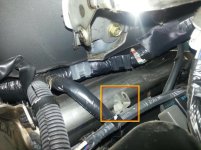
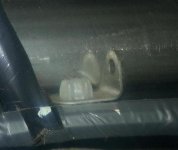
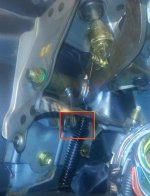
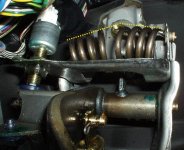
As everyone had said, there are already the two attachment points, one of which is a tab which is apparently snapped onto the dash with a plastic fitting, the other of which is a brass nipple on the clutch pedal lever as shown below.

Slipping the clutch spring onto the tab and nipple was so easy that I was surprised since some had said it was difficult; but it was child's play.
 

Attachments

  • clutch_pedal_torsion-to-tension_spring003.jpg
    clutch_pedal_torsion-to-tension_spring003.jpg
    71.7 KB · Views: 1,480
  • clutch_pedal_torsion-to-tension_spring004.jpg
    clutch_pedal_torsion-to-tension_spring004.jpg
    41.1 KB · Views: 1,288
I used a Toyota brake pedal spring. i had an extra one when I did my transmission swap and it is working fine after a couple years.

The brake pedal return spring is appreciably shorter in length than the clutch pedal return spring, being almost exactly one inch shorter, while the diameter is appreciably larger, with the length of the coil section being less drastically different.

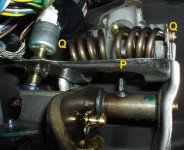
I mainly opted for the smaller diameter clutch-pedal return spring because I knew, from research, that there were potentially two contact points, one at the bracket and the other at the P-tab on the clutch pedal.

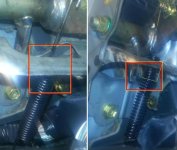
The current setup hits slightly at the P-tab, but not at the bracket, as shown below in the side-by-side comparison, with the pedal extended, and then depressed (left to right).
 

Attachments

  • side_by_side_clutch_spring.jpg
    side_by_side_clutch_spring.jpg
    57.3 KB · Views: 6,654
Just for the record, I mounted the SHORT end of the spring to the upper mounting tab, and I put the LONG end of the spring attached to the clutch pedal pivot point.

The 2.075 inches from the coils to the curved end on the clutch pedal was enough, apparently, to keep the coils themselves from striking the clutch pedal bracket when the clutch pedal was depressed (whereas the larger diameter brake spring might have contacted the bracket as others have found).
 

Attachments

  • clutch_pedal_torsion-to-tension_spring005.jpg
    clutch_pedal_torsion-to-tension_spring005.jpg
    78.4 KB · Views: 1,441
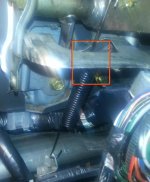
However, I think this clutch pedal return spring is the WRONG spring for this application, since it does hit the clutch pedal P-mounting tab when the clutch pedal is depressed to the floorboards.

I counted that there were about 10 coils too many (about an inch in length) when the pedal was depressed.

Given that, a BETTER spring geometry would be if the coils were moved down by an inch.

That would give us something like the following:
BETTER Clutch Pedal Return Spring Toyota PN unknown:
  • Length inside hooks unloaded = 5.610"
  • Length of body coils = 1.545"
  • Coil inside diameter = 0.413"
  • Coil outside diameter = 0.637
  • Wire diameter = 0.0555
  • Distance from the last coil to the inside curve of the hook (long end) = 2.075" 3.075"
  • Distance from the last coil to the inside curve of the hook (short end) = 1.960" 0.960"

That is, if we're limited to a spring about five and a half inches in total length, the closer the coil is to the one end, the better.

Said another way, we don't want the coil in the middle - we want it about an inch from the one end and about three inches from the other end.
 

Attachments

  • clutch_pedal_torsion-to-tension_spring006.jpg
    clutch_pedal_torsion-to-tension_spring006.jpg
    77 KB · Views: 1,503
I gave the 4runner back to the owner, who says it feels "different" than before, but, even if I had put the OEM torsion spring & bushings back, it would have felt different, simply because that torsion spring had been gouging into the clutch pedal P-tab for a long time.

How long do you think it was chafing metal on metal?
I'd say years.

And, do you know if that half-sized rubber insert is directional?
What end of the spring is the insert supposed to go into?

As for the spring, the owner didn't notice, but I don't like that the P-tab touches the spring, but it's minor enough that I'll let it slide for now - but - in the future, I recommend a similarly sized about 5 inch spring but which has a 3 inch long end.

You don't want it as wide as the brake pedal return spring since it will then hit the clutch pedal bracket, so, you kind of want a similar diameter as the clutch-pedal return spring - but with the main change being a 3-inch long arm.

Since something like 99% of the return travel is from the back pressure of the pressure plate, I wonder if the pedal-return spring is mostly for the last quarter inch of travel, where you want firm contact on the cruise control switch?

So that the next person starts where we left off, we should collectively come up with a better set of spring choices that people can buy which do NOT hit the clutch pedal or the clutch pedal bracket!

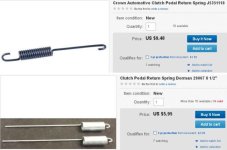
Notice that there are two kinds of long-arm pedal return springs:
a. The type where the arm is already formed
b. The type where you apparently form the arm yourself.

For example:
 

Attachments

  • types_of_long_arm_springs.jpg
    types_of_long_arm_springs.jpg
    29.1 KB · Views: 1,330
All day I have been troubled by the results learned in this process of modifying the Toyota OEM clutch pedal return mechanism.

It shouldn't be working so well.
That means something just isn't right.

FIRST OBVIOUS NAGGING QUESTION:
Why would Toyota spend the money to place both spring end tabs on the vehicle if they didn't put a tension spring connecting to those two tabs?

I can understand it better if, maybe, they re-use the clutch pedal in other vehicles that do have the tension spring. But do they?

Even if they do re-use the clutch pedal in vehicles which use the tension spring, there's still no reason for attaching that tab at the top of the dashboard, which surely must be a separate (needless) part.

SECOND OBVIOUS NAGGING QUESTION:
There must have been a good reason for the complex spring mechanism!
But what?

Given how beefy that torsion spring is, and given the complex highly engineered shape, what the heck does it really do, when it can be replaced with (a) nothing, or (b) a simple tension spring.

While I get torsion springs need to be thicker to perform the same task that extension springs perform, the question is what on earth is the reason Toyota engineers designed such a complex double-coil QPQ-bushing mechanism? My first hunch fell apart when I tested the pedal feel without any spring, because the first hunch was that the torsion spring "moderated" the pedal force just like a garage door torsion spring changes its force over the travel distance.

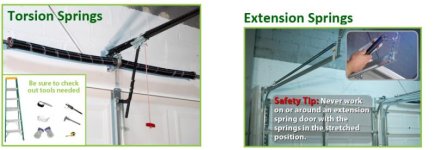
A garage door torsion spring does not open the door (the door opener opens the door); the torsion spring mostly just balances the door.

More specifically:
a. At the door half-way position, a garage door torsion spring is wound to provide a force slightly greater than the weight of the door (plus friction).
b. As the garage door closes from that mid point, the torsion spring is wound further, creating a slightly greater opening force (but not much).
c. As the garage door opens from the mid point, the slight extra torsion spring force slowly ebbs away as the garage door reaches the top of its travel.

The reason a torsion spring works well with a garage door is that the door weighs the most (so to speak) when it's vertical.
And the garage door weighs the least (so to speak) when it's horizontal.
So the torsion spring compensates for that change in weight!

Let's say a garage door has 5 panels, each of which weighs 20 pounds.
a. When the door is open mid way, 50 pounds are vertical and 50 pounds are horizontal - so the door 'weighs' only 50 pounds.
b. When the door is fully closed, 100 pounds are vertical and 0 pounds are horizontal - so the door 'weighs' 100 pounds.
c. When the door is fully open, 0 pounds are vertical and 100 pounds are horizontal - so the door 'weighs' 0 pounds.

The garage door torsion spring is designed to compensate for that change in weight during the change in travel.

Said another way which takes into account the different compensations at the different points of travel:
a. At the mid point of the garage door travel, the torsion spring is pre-wound such that it cancels out the 50-pound weight of the door (plus friction).
b. At the point where the garage door is closed, the torsion spring is wound the most it will be (resulting in 50 pounds of slightly extra energy stored in the coils).
c. At the point where the garage door is open, the torsion spring is unwound the most it will be (resulting in the 0 pounds of excess energy stored in the coils).

But does the clutch-pedal return torsion spring work the same way?

Does the complex mechanism actually do anything that the simpler mechanism doesn't do?

For example, does it better protect the vehicle in case of clutch failure?
There must have been a good reason for the complex spring mechanism!
 

Attachments

  • second_spring_location.jpg
    second_spring_location.jpg
    87.3 KB · Views: 12,704
Last edited:
There is a reason behind the fancy Toyota coil spring design.

If you drove the 2 set ups back to back, you would notice that the clutch is much lighter in the original configuration. It is stiffer to push now with the linear spring. Why the difference? Surely not just the little linear spring.

The original spring lifts the pedal up in the pedal up position. But once you push the pedal down past a certain point the spring assists you in pushing the clutch down. This results in a very light clutch feel. I discovered this while bleeding the clutch. The original clutch spring will actually hold the pedal to the floor while you are bleeding the fluid. You have to lift it back up.

So I think it is a clever design. Assists in both directions. The new linear clutch spring will feel stiffer and take a bit of getting used to.

Of course this is just my observation and thoughts. Could be complete crap.
 
If you drove the 2 setups back to back, you would notice that the clutch is much lighter in the original configuration. It is stiffer to push now with the linear spring. Why the difference? Surely not just the little linear spring.

Intuitively, I know you must be correct because Toyota engineers (and the bean counters) knew that a linear spring would be far cheaper, especially for a part that seems ubiquitous in the 4Runner, Tacoma, and apparently in the Tundra.

Since the problem also exists in the other models, Toyota must be aware of this, so, what would be useful to get into "what were they thinking" headspace, is what they did about it in the LATER models to FIX this problem.

Does anyone here know what they used in the later model 4Runners, Tundras, and Tacomas?
 

Attachments

  • qpq_bushings.jpg
    qpq_bushings.jpg
    84 KB · Views: 7,314
Last edited:
So almost exactly 2 years from restoring my pedal setup to factory with all new stuff. I got in my runner today and pushed the clutch in and got a squeak. Crawled under and my bushing from the center of the torsion springs is gone. but the side bushings seem to be intact. I plan on pulling the pedal assembly and and putting in a nylon bushing. I will take photos and document better this time. Thank you for all the info.
 
I have installed the #70 hardware store spring on 3 different 4Runners or Tacomas. It's worked well for several years in all cases. As to interference with the clutch pedal's tab, I bent it out of the way if the tab was only mildly gouged out by the original spring, or I cut it off if deeply gouged. The clutch pedal is mild steel; I think it could be bent back and re-used if you later wanted to use the original setup.

I believe Toyota's intent on the original design was to maintain a near constant, gentle push of the clutch throughout its range of motion. This is accomplished by changing the length of the lever - the tab - in relation to the arc of the spring's motion. You'd have to see an engineering side-view, with pivot points and arcs shown, to see this in action.

Granted, the #70 spring modification eliminates this constant linear effort: the clutch pedal does get more stiff through its range of motion now. A smaller driver might prefer the original setup.

The idea of changing the length of a lever that moves a spring is an old one. Read this Wikipedia article for a very old application:

https://en.wikipedia.org/wiki/Fusee_(horology)
 
So almost exactly 2 years from restoring my pedal setup to factory with all new stuff. I got in my runner today and pushed the clutch in and got a squeak. Crawled under and my bushing from the center of the torsion springs is gone. but the side bushings seem to be intact. I plan on pulling the pedal assembly and and putting in a nylon bushing. I will take photos and document better this time. Thank you for all the info.

Thank you for this information, as you were instrumental in helping me figure out what the problem was, as was your picture, which clued me in, for the first time, as to what to look for under the dash (especially because I was looking for something that no longer existed).

Given the little I know about this, I think the P bushing goes very quickly, but even if we looked monthly, when it's in place, I wonder if one could "see" any wear?

Can you see wear?
Or, it is there one day, and just gone the next?

What happens, I surmise, is:
a. Center P bushing breaks apart (maybe resulting in squeaks, maybe not)
b. Years later, the spring geometry finally changes
c. At that later stage, pedal sticking & Q-bushing damage occurs

So, the real problem is that center P bushing failing rather quickly.
I think.

What would be nice is a photo of a P bushing after one year.
 

Attachments

  • p-bushing.jpg
    p-bushing.jpg
    50.3 KB · Views: 2,028
I have installed the #70 hardware store spring on 3 different 4Runners or Tacomas. It's worked well for several years in all cases.

The problem with the #70 spring is that it almost certainly will contact in one or two places.
a. The clutch-pedal bracket
b. The clutch-pedal tab

I agree the touching is a minor problem, but, the springs are cheap, so, all we really need to do is find a good part number that doesn't hit at those two points.

I think the SIZE needed is simply these three rough estimates:
1. About 4-1/2 to about 5 inches long
2. The long end is at least 3 inches long
3. Coil diameter is smaller than a typical Toyota brake-pedal return spring

As to interference with the clutch pedal's tab, I bent it out of the way if the tab was only mildly gouged out by the original spring, or I cut it off if deeply gouged. The clutch pedal is mild steel; I think it could be bent back and re-used if you later wanted to use the original setup.

I agree with you.

The clutch pedal is toast anyway, since the hard brittle plastic OEM P spring will be destroyed within days if we re-use the old clutch pedal (according to what I read, even the *brass* retrofits broke in some cases).

Nylon stands a better chance of conforming to the irregular hole, but there is apparently a lot of very specifically focused force at that junction of the P bushing and the double-coil torsion spring - so that's why I say the old pedal is toast.

Since its' toast, it doesn't matter if you simply cut off the P tab or grind it away or bend it to the side, or whatever. You've got nothing to lose.
 

Attachments

  • spring_angle.jpg
    spring_angle.jpg
    83.9 KB · Views: 1,324
Last edited:
I believe Toyota's intent on the original design was to maintain a near constant, gentle push of the clutch throughout its range of motion.

I've been pondering the torsion spring setup, since I've wound my own garage door springs, which are somewhat similarly set up, LEFT to RIGHT across a center bushing.

A garage door spring "moderates" the opening force by giving the beginning of the opening of the door more force than the end of the opening of the door, with a gradual releasing of energy dependent upon the dimensions of the spring and the number of coils.

I think the same idea was intended by Toyota here, although the lever geometry is entirely different in the clutch pedal than in a rather simple garage door, so I could easily be wrong.

But if I'm right, the reason for the double-coil torsion spring is merely to provide more return force at the beginning of the pedal-return stroke than at the end of the pedal return stroke, releasing all that pent-up force predictably and gradually.

Of course, when you STEP on the pedal, the same thing happens in reverse, where to give it less and then more and more force, in order to push the pedal to the floor (clutch pressure plate springs notwithstanding).

Given the complexities, the simplest I can figure out is that they wanted the torsion spring to GRADUALLY accept your pedal force, and to gradually give it back.

Although, I agree, all the other geometries surrounding the spring (and the springs in the clutch pressure plate) could make all that moot.

This is accomplished by changing the length of the lever - the tab - in relation to the arc of the spring's motion. You'd have to see an engineering side-view, with pivot points and arcs shown, to see this in action.

I agree. It's complex. The angles are horrendous.

Who knows what the Toyota engineers were thinking, but, isn't it odd that they put the upper tab inside the dash, when it connect to absolutely nothing?

Granted, the #70 spring modification eliminates this constant linear effort: the clutch pedal does get more stiff through its range of motion now. A smaller driver might prefer the original setup.

If I assume the complex angles aren't involved, then I think the torsion spring and the extension spring do exactly the same thing.

That is, both, I think, give your more force resistance as you press further down on the clutch pedal, and both, I think, return that force gradually, in reverse.

Maybe I'm wrong, but I think the effect, in the end, is the same whether we use a torsion or extension spring. Just like on a garage door, I think.
 

Attachments

  • garage-door-spring-replacement.jpg
    garage-door-spring-replacement.jpg
    33 KB · Views: 1,403
To enable more efficient one-stop shopping, there was very useful information imparted by Matt (aka slomatt) into this thread earlier today.

TI'm not sure there is a perfectly sized nylon bushing available for sale. I purchased two different sizes, picked the one that was the closest fit, and then modified it to work. Here are some suggestions.

1) Pick a nylon bushing with an outer diameter larger than the notch in your clutch fork. This will vary depending on how worn your fork is. The inner diameter should be slightly smaller than the diameter of the spring.

2) Use calipers to measure the diameter of the spring and drill out the inner hole of the bushing to that size.

3) Cut an opening into the bushing so that it "snaps" over the spring.

4) Use a file to cut notches into the sides of the bushing so that it fits into the fork.

5) Cut the bushing to length so that it fits on the flat part of the spring without binding.

Nylon bushings are inexpensive so you can always buy a couple sizes to try out.

- Matt

Since the nylon bushings will be needed by others in the future, it behooves us to find a suitable sized replacement.

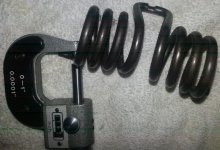
To that end, I measured the spring I replaced to be 0.1975 inches thick, which is essentially 5.0 mm, so that's the internal bore needed for all three QPQ bushings.

Now we need the external diameter of the three QPQ nylon bushings, which are probably best measured by the next person who performs an OEM replacement.
 

Attachments

  • coil_thickness.jpg
    coil_thickness.jpg
    67.5 KB · Views: 8,613
I think the two critical pieces of information we don't yet have are dimensions of a "better" tension spring (that doesn't touch anything during the pedal travel), and the dimensions of the OEM P & Q bushings (so we can source nylon replacements more easily).

I ask the NEXT person who attempts this repair to help us in either of those measurements.

I've scoured this web site and I can't find ANYONE who has listed the measurements needed.

This is the best we have, for example, for the nylon replacement sizes.
Squeaky clutch pedal

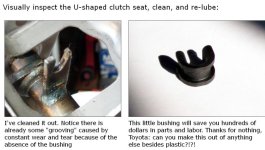
Anyone considering replacing the $3 plastic horseshoe is wasting their time IMO. Once the original is gone and the spring starts to eat into the pedal (causing the squeak), the plastic horseshoe insulator no longer fits in the pedal groove as intended. It's made of hard plastic and will break and fall out again before it distorts to fit (like my custom nylon special does).

If you can get tubular (cored) nylon, it should be sized so the ID fits around the spring and the OD drops into the pedal groove - roughly 1/8" wall or less going by memory, except I made mine from larger stock on the lathe spur-o-the-moment-style.

With a razor blade or sharp knife, cut it lengthwise so you can fit it over the spring. I also greased the spring/nylon so the spring slides inside the nylon and the OD of the nylon just crushes into the pedal slot. Be sure to thoroughly debur the spring or it will eat up the new part.
 
Has anyone since this writeup MEASURED the OEM PQ bushings?

Anyone yet have a good part number for a Toyota clutch-pedal return spring (that has a 3 inch arm and a 1 inch arm and a 1 inch long 1/2 inch wide coil)?

The reason the OEM measurements for the PQ bushings are needed is that the nylon replacements are problematic.

The reason an exact P/N for a suitable spring is because all springs described to date in this forum (as far as I can tell) hit (slightly) in one or two places.
 
Found this just now with a search.

A few days ago I wrote a post about suggested bushing sizes, but it seems to have dissapeared which is strange.

The summary is that I think I used a bushing with a 3/16" inner diameter that I drilled out to 13/64" to fit over the spring. The outer diameter will depend on how big the hole in the fork is, I think 5/16" is a common OD for these bushings. Length depends on what will fit on the flat part of the spring, I went with about 1/2".

You can find nylon bushings at https://www.mcmaster.com/# or Amazon.

- Matt

It's a good start, but we still need the next person who buys OEM PQ bushings to just measure them for us so the next person starts off with that critical information.
 
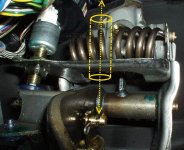
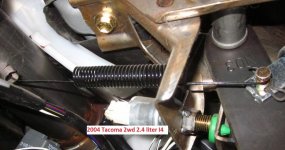
I have the answer to the existence of the seemingly unneeded tab for the upper end of a linear clutch pedal spring. The first photo below is of my 2002 2WD Tacoma with the 2.4 liter engine. (The 2004 annotation in the photo is wrong. Should be 2002. My typo.)

I bought the vehicle new, so I know this isn't a post-factory mod.

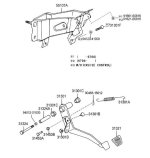
The second picture is the parts diagram for that same vehicle.

The metal tube across and behind the dash, to which the small tab is attached, is likely common, at some point during manufacturing, to 4Runners and Tacomas. The 2.4 liter 2RZ engine, which never appears in a 4WD vehicle, has a clutch that will face less load than the 3RZ or the 5VZ engines.

Thus, the clutch cover has weaker springs and thus, no need for fancy engineering tricks to give the clutch pedal a softer feel. Also, Toyota had to figure out ways of keeping the 2WD Tacoma cheaper. That odd spring this thread's been discussing, with bushings and whatever, has to be more expensive to make.

Digression: another way the 2RZ is kept less expensive than the 3RZ is the elimination of the engine's balance shafts.

The part number for that spring in the second picture, item 31301A, is 90507-14030. I don't know its length. It's under $4. Note that the large bracket, too, 55107A, is different from the bracket for the 3RZ and 5VZ clutches.

Could one visit a junkyard, find a 2WD Tacoma, and move its entire clutch pedal assembly to a 4WD Tacoma or 4Runner and then forget about this spring & bushing business forever more? Good question.

So, Toyota has given its blessing to using that tab for a linear clutch spring, and blessed linear clutch springs as well.
 

Attachments

  • 2002Tacoma2wd_1024x768.jpg
    2002Tacoma2wd_1024x768.jpg
    76.9 KB · Views: 3,622
  • 2002TacomaClutchPedal2.4.JPG
    2002TacomaClutchPedal2.4.JPG
    35.8 KB · Views: 1,833
  • Like
Reactions: foo
I have the answer to the existence of the seemingly unneeded tab for the upper end of a linear clutch pedal spring.

Wow. There is so much good information in your post that I would nominate it for one of the best and most informative, since you've addressed more than a few puzzles that the rest of us have just been guessing about!

The first photo below is of my 2002 2WD Tacoma with the 2.4 liter engine. (The 2004 annotation in the photo is wrong. Should be 2002. My typo.)
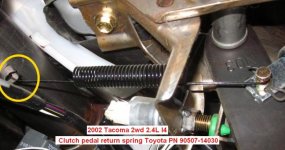
If you don't mind, I have taken the liberty to update your excellent photo, bearing in mind that it's extremely rare to find a photo of the setup with BOTH ends of the spring shown (the angle has to be just right for your cellphone).

I bought the vehicle new, so I know this isn't a post-factory mod.
This is good to know, as the Toyota I am working on also is on the first owner, so, in both cases (your Tacoma where it's actually used and my 4Runner, where it's vestigial) the upper tab is a factory installation.

The second picture is the parts diagram for that same vehicle.

The metal tube across and behind the dash, to which the small tab is attached, is likely common, at some point during manufacturing, to 4Runners and Tacomas.
I agree with you. The only viable explanation is that they share a part, and in the case of the 3rd-gen 4Runner, that shared part has this vestigial tab which we make use of to hang a clutch-pedal return spring on.

The 2.4 liter 2RZ engine, which never appears in a 4WD vehicle, has a clutch that will face less load than the 3RZ or the 5VZ engines.
This is an interesting hypothesis, which is that the Tacoma you have doesn't need the far-more-complex double-coil torsion spring to lighten the load (or, it could be that Toyota figured the Tacoma owner could handle a bit more clutch feel than the 4Runner owner?).

Thus, the clutch cover has weaker springs and thus, no need for fancy engineering tricks to give the clutch pedal a softer feel.
If the Tacoma clutch-plate springs are weaker, this would make sense.

Also, Toyota had to figure out ways of keeping the 2WD Tacoma cheaper. That odd spring this thread's been discussing, with bushings and whatever, has to be more expensive to make.
We agree that it's crazy expensive to make the double-coil torsion spring with bracket and bushings and pedal centerpoint than it is to just hook a linear extension spring onto the two tabs, so, Toyota must have had what they felt was a VERY GOOD REASON for all that expense for nothing.

The reason I say it's all that expense for nothing is that most people here (including me) have said they can't tell the difference between the old feel with the torsion spring and the new feel with the linear spring.

I'm sure Toyota had their reasons, but pedal feel doesn't seem to be a biggie if we can't feel the pedal feel being any different. Maybe it IS different though, as buttmeters are highly unreliable after all...

The part number for that spring in the second picture, item 31301A, is 90507-14030. I don't know its length. It's under $4.

This is GREAT information! Part numbers are everything when we're trying to match geometries. Looking at your photo, the spring seems to be symmetric, which I had not expected, but probably because the bracket is different between the 4Runner and the Tacoma, they get away without the spring hitting in the two spots it normally hits in the 4Runner.

Note that the large bracket, too, 55107A, is different from the bracket for the 3RZ and 5VZ clutches.
I can't tell but does the PEDAL on the Tacoma also have that middle u-shaped brazed-on tab?

Could one visit a junkyard, find a 2WD Tacoma, and move its entire clutch pedal assembly to a 4WD Tacoma or 4Runner and then forget about this spring & bushing business forever more? Good question.
I suspect that, while it would probably work, it seems like too much effort since the spring DOES work, even as it does hit in one or two places during pedal travel.

So, Toyota has given its blessing to using that tab for a linear clutch spring, and blessed linear clutch springs as well.

That's the good news. We know that Toyota has designed SOME vehicles with the pedal return spring, so, we're safer in assuming that it will work for us!

Thank you very much for all the great detail!

 

Attachments

  • 2002Tacoma2wd_1024x768.jpg
    2002Tacoma2wd_1024x768.jpg
    53 KB · Views: 3,864
Status
Not open for further replies.

Members online

No members online now.

Forum statistics

Threads
278,315
Messages
3,554,104
Members
248,016
Latest member
Advally Service

Trending content

Back
Top