
You are using an out of date browser. It may not display this or other websites correctly.
You should upgrade or use an alternative browser.
You should upgrade or use an alternative browser.
5-speed clutch pedal sticks on floor in morning (three days in a row)
- Thread starter foo
- Start date
- Status
- Not open for further replies.

foo
Banned
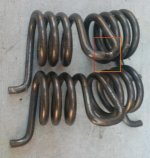
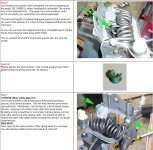
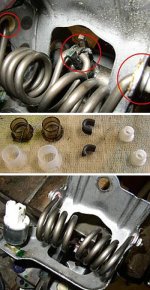
Since there are strong springs and the space is limited under the dash, it's imperative to have a DIY that covers all the steps, so I started searching and found this, which may be useful.
Replacing the Clutch Pedal Bushing
Date: 1/4/2004, By: Bob_98SR5
4Runners.org - Replacing the Clutch Pedal Bushing
Replacing the Clutch Pedal Bushing
Date: 1/4/2004, By: Bob_98SR5
4Runners.org - Replacing the Clutch Pedal Bushing
Attachments
foo
Banned
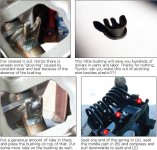
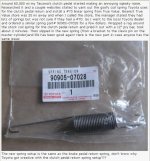
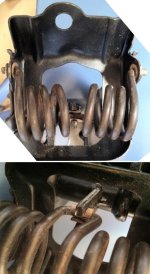
Here's another article that shows the old and new clutch pedal bracket "U" shaped hollow and the old an new spring:
http://www.toyota-4runner.org/3rd-gen-t4rs/208970-clutch-pedal-issue-97-sr5-226k.html
http://www.toyota-4runner.org/3rd-gen-t4rs/208970-clutch-pedal-issue-97-sr5-226k.html
Attachments
foo
Banned
Dunno if it's true or if it's a myth, but this thread implies you can adjust the post to the clutch master cylinder to make the pedal return higher:
http://www.toyota-4runner.org/3rd-gen-t4rs/72896-clutch-question.html
If I need to replace the whole pedal assembly, this thread has some suppliers of used parts:
http://www.toyota-4runner.org/3rd-g...-clutch-brake-pedal-assembly.html#post2046971
http://www.toyota-4runner.org/3rd-gen-t4rs/72896-clutch-question.html
You can also re adjust the master cylinder so it has more tension on the pedal. The thing that attaches to the pedal, it can be adjusted.
If I need to replace the whole pedal assembly, this thread has some suppliers of used parts:
http://www.toyota-4runner.org/3rd-g...-clutch-brake-pedal-assembly.html#post2046971
used parts links i have accumulated
Toyota Truck Dismantlers: body parts/axles etc
The Toy Man (newberg, OR) http://www.thetoyotaman.com/
MazToy (troutdale, OR)maztoy.com
A1 Light Truck parts (PDX) http://www.a-1truckparts.com/index.htm
Davez Off Road: Dave'z Off Road Performance - Specializing in Toyota Trucks
Yotayard (colorado) Yota Yard - Used Toyota Parts
Jim's Got Parts (Denver, CO) Jim's Used Toyota Truck Parts
California Mini Trucks (Cali) California Mini Truck
Rancho Toyota Truck Dismantler (Cali) Used OEM Toyota Auto, Truck and Suv Parts Recycling
toy truckc (CA) http://www.toytruckscalifornia.com/
Toy Connection (CA) http://www.toyconnection4x4.com/home.html
All Toyota Truck and SUV (CA) All Toyota Truck & SUV Parts
ToyoKings (FLA) Toyo Kings, Inc.
Yotatech Classifields :YotaTech Classifieds - YotaTech Forums
TTORA Classifieds: Panjo Marketplace
Pirate classifieds: Classifieds - Pirate4x4.Com : 4x4 and Off-Road Forum
Parts Locators: Auto Parts Locator >> Used Auto Parts, Engines, Transmissions, Car/Truck Body Parts (Junkyard & Salvage Yard Parts)
Find Used Auto Parts, Car Parts
Marlin Crawler classifieds: Parts For Sale
DeNaples (Dunmore, PA) DENAPLES.COM
foo
Banned
I'm still lining up my ducks, because I hate to shoot blind...
This thread says we can "re-engineer" the 4Runner u-shaped spring to use a linear spring instead, presumably from the tacomas, but maybe not:
http://www.toyota-4runner.org/3rd-gen-t4rs/188611-tacoma-clutch-pedal.html
This thread has pictures of the re-engineered linear springs used by one re-designer:
FIXED!! Stupid PLASTIC clutch pedal bushing - YotaTech Forums
And this thread shows how to adjust the clutch pedal height when done:
http://www.toyota-4runner.org/3rd-gen-t4rs/183679-clutch-has-go-floor-shift.html
This thread says we can "re-engineer" the 4Runner u-shaped spring to use a linear spring instead, presumably from the tacomas, but maybe not:
http://www.toyota-4runner.org/3rd-gen-t4rs/188611-tacoma-clutch-pedal.html
The Tacos have a linear spring and the T4Rs have a horseshoe/ "U" spring. The linear spring is upgradeable on the 4Runner pedal.
-Chuckles89
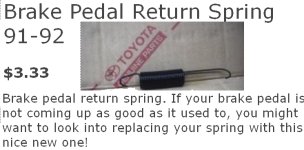
From what I can find online, Tacomas had the same radial spring as 4runners, but quite a few guys remove them and replace with the linear spring similar to the brake pedal.
The radial spring is more than a return spring though, so it makes operating the clutch different. The swap is mostly done due to the annoying creak and constant wear of the plastic spring-retaining bushings.
I think I can use the Tacoma guts on a 4Runner bracket ordered through the dealer or other OE outlet, but a confirmation of that would be awesome.
This thread has pictures of the re-engineered linear springs used by one re-designer:
FIXED!! Stupid PLASTIC clutch pedal bushing - YotaTech Forums
And this thread shows how to adjust the clutch pedal height when done:
http://www.toyota-4runner.org/3rd-gen-t4rs/183679-clutch-has-go-floor-shift.html
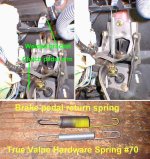
FSM Clutch specs (from my paper '99 4Runner FSM):
1. CHECK THAT PEDAL HEIGHT IS CORRECT
Pedal Height above Floor Panel: 175 - 185mm
Pedal Height above Asphalt sheet: 172 - 182mm
2. IF NECESSARY, ADJUST PEDAL HEIGHT
Loosen the lock nut and turn the stopper bolt until the height is correct. Tighten the locknut.
3. CHECK THAT PEDAL FREEPLAY AND PUSH ROD FREEPLAY ARE CORRECT
Push in on the pedal until the beginning of clutch resistance is felt.
Pedal freeplay: 5.0 - 15.0mm
Gently push on the pedal until the resistance begins to increase a little.
Push rod freeplay: 1.0 - 5.0mm
4. IF NECESSARY, ADJUST PEDAL FREEPLAY AND PUSHROD FREEPLAY.
a) Loosen the lock nut and turn the pushrod until freeplay and the pushrod play are correct.
b) Tighten the locknut.
c) After adjusting the pedal freeplay, check the pedal height.
d) Connect the air duct and install the lower finish panel.
5. CHECK CLUTCH RELEASE POINT
a) Pull parking brake and install wheel stopper.
b)Start engine and idle the engine
c)Without depressing the clutch pedal, slowly shift the shift lever until the gears contact.
d)Gradually depress the clutch pedal and measure the stroke distance from the point the gear noise stops (releae point) up to the full stroke end position.
Standard distance: 25mm (0.98in) or more (From pedal stroke end position to release point)
If the distance is not as specified, perform the following operation.
-Check pedal height
-Check push rod play and pedal freeplay
-Bleed the clutch line
-Check the clutch cover and disc.
Attachments
Last edited:
foo
Banned
Thanks to your advice which pinpointed the problem, I was able to show the owner the the problem, and so I gave the 4runner back this morning for temporary use.
The owner asked WHY that little bit of broken plastic would cause the clutch pedal to either stay on the floorboards in the morning, or to not come back all the way up the rest of the time.
I don't know. Maybe friction?
The owner asked what the remedy is, and I said I'd talk to you guys to ask whether I should add the brake-spring retrofit or replace the clutch pedal and bushings.
I don't even see *how* the brake-spring retrofit works but I guess it just pulls up the clutch pedal just like my foot did when I was testing it out.
I'm usually inclined to just replace the bad parts with OEM parts (unless you think otherwise), which despite being plastic, did last almost 20 years.
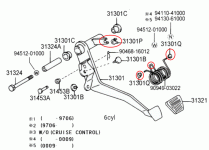
I think all I need to order from Toyota is:
a. The clutch pedal
b. The one plastic U-shaped "P" spring-middle bushing
c. The two plastic round "Q" spring-end bushings
d. The double-coil "horseshoe" return spring
Do you recommend anything else?
The owner asked WHY that little bit of broken plastic would cause the clutch pedal to either stay on the floorboards in the morning, or to not come back all the way up the rest of the time.
I don't know. Maybe friction?
The owner asked what the remedy is, and I said I'd talk to you guys to ask whether I should add the brake-spring retrofit or replace the clutch pedal and bushings.
I don't even see *how* the brake-spring retrofit works but I guess it just pulls up the clutch pedal just like my foot did when I was testing it out.
I'm usually inclined to just replace the bad parts with OEM parts (unless you think otherwise), which despite being plastic, did last almost 20 years.
I think all I need to order from Toyota is:
a. The clutch pedal
b. The one plastic U-shaped "P" spring-middle bushing
c. The two plastic round "Q" spring-end bushings
d. The double-coil "horseshoe" return spring
Do you recommend anything else?
Attachments

Coward
New member
Here's another article that shows the old and new clutch pedal bracket "U" shaped hollow and the old an new spring:
http://www.toyota-4runner.org/3rd-gen-t4rs/208970-clutch-pedal-issue-97-sr5-226k.html
I like this post! I have had a few clutch issues with mine over the years. Including clutch replacement due to normal wear. Hydraulics due to wear. the 2nd clutch when the clutch fork actual broke in half (for a few months the clutch was funny before it snapped). AND I have always had the squeaky pedal (dealer fixed once at 30k miles). But this picture made me look at the center of the spring again. My pedal had issues for a few years where it was always short of returning to the top. No issues it was just loose for the first inch or so of travel. I adjusted the input rod on the master cylinder to correct this issue. Looking at my spring to day I see where the pivot point on my pedal assembly is worn almost completely thru! Guess I need to fix that before it breaks in half!
foo
Banned
I am not familiar with the 2.4 but I run my 3.4 without a spring all together.
Wow. That means we "can" remove the spring altogether and not even need the "P" and "Q" bushings!
Thank you for that data point because it takes no brains to throw parts at a problem, but it does take intelligent thought (and some risk) to mod an existing design, which, in your case, is to forgo the spring.
So the fact that it works fine without the spring is good to know, because you took the risk - while I get to benefit from you taking that risk.
I had been wondering all along how effective the linear spring workaround was, because I thought they used *both* the double-coil horseshoe spring PLUS the linear spring - but maybe they were talking about REPLACING the double-coil horseshoe spring with just the single linera spring?
I'll have to doublecheck the references, as that thought only occurred to me based on what you said, so maybe I misread the workaround references yesterday.
The great news is that you say it works fine even without a spring!
Given that, then the linear spring workaround has a much greater chance of actually working (in that it just brings up the pedal that last inch).
Since we're talking about redesigning the pedal-return mechanism, one thought stuck in my mind is HOW the pedal is brought back once the clutch is engaged.
Is 90% of the pedal return caused by BACK PRESSURE from the hydraulic system as the pressure plate springs push back, with only 10% of the clutch pedal return governed by the double-coil horseshoe spring?
Or, is 100% of the clutch pedal return governed by the double-coil horseshoe spring?
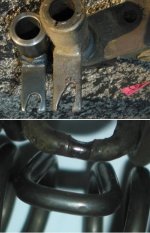
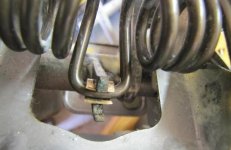
(Photo below is from a Tacoma home-made bronze redesign of the horseshoe spring "P" bushing.)
https://www.tacomaworld.com/threads/clutch-pedal-squeak-new-bushing-design.76599/
Attachments
foo
Banned
AND I have always had the squeaky pedal (dealer fixed once at 30k miles).
Thank you for adding your experience to the topic because I am striving to as completely understand this issue as anyone can understand it, and once I understand it, I can redesign, myself, or use someone elses' redesign, if warranted.
You just brought up a topic that got me angry with the dealer in that the owner had complained to the dealer about the clutch squeaking on return, and they said it was highly unusual for a Toyota clutch pedal to squeak and that they couldn't figure out why it did that.
I'm not sure where the squeak comes from, but they must know since Toyota engineers designed this thing and they must fix it all the time.
One question in my mind is whether the squeak is an indication that the clutch-return double-coil horseshoe "P" or "Q" bushings are so far gone that there is metal on metal, or, if the squeak even happens when the "P" and "Q" pedal return spring bushings are still intact?
Our counterparts over on the Tacoma side have had similar problems, so here's a nice writeup for the next person who has this problem to benefit from.
Toyota Tacoma: Clutch Pedal Bushing Replacement
Welcome to LIEBLWEB.com's Toyota Tacoma Clutch Petal Bushing Replacement Write-Up!
Troubleshooting: On Toyota Tacoma trucks equipped with manual transmissions, a squeak or grind is often heard when pushing down on the clutch pedal. This squeak or grind can also be confused with another clutch related problem - so please make sure you are performing the proper repair for the problem you are encountering. Take time to read the information below- and you should be able to take a look at your current clutch pedal turnover bushing and make a decision if it needs to be replaced.
Attachments
foo
Banned
As we did in the case of the Prothane bushings, where we solved the problem for EVERYONE simply by digging deeper than most people go, and by doing so, getting the MANUFACTURERS to FIX their bushings, at this point, I'm starting to put together enough information into this one thread so that all that is known about how to identify and fix this problem, is available as a one-shot-thread (at least if people click on the links provided).
The first goal is so that the next person starts at a better (easier) place than I started on this problem.
Sometimes we get further than that, by finding an engineering solution to the problem that is better than OEM.
And, sometimes we get the manufacturers to FIX the problem (this is rare, I agree - but it worked with the Prothane bushings, didn't it!).
http://www.toyota-4runner.org/3rd-g...er-part-under-my-4runner-makes-noise-now.html
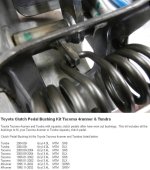
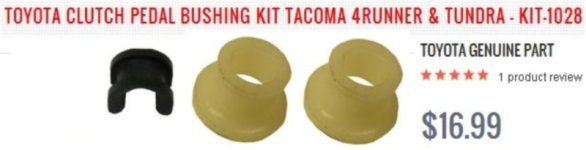
To that end, I'll state that it seems that the problem appears to transcend models from Tacoma to Tundra to 4Runner, as shown by this site below:
Toyota Clutch Pedal Bushing Kit Tacoma 4runner & Tundra - KIT-1028
Here's a similar clutch pedal squeak repair modification on the tacoma side:
Clutch squeak Linear Spring swap (TW how to)
Noisy Tacoma Clutch Pedal
The first goal is so that the next person starts at a better (easier) place than I started on this problem.
Sometimes we get further than that, by finding an engineering solution to the problem that is better than OEM.
And, sometimes we get the manufacturers to FIX the problem (this is rare, I agree - but it worked with the Prothane bushings, didn't it!).
http://www.toyota-4runner.org/3rd-g...er-part-under-my-4runner-makes-noise-now.html
To that end, I'll state that it seems that the problem appears to transcend models from Tacoma to Tundra to 4Runner, as shown by this site below:
Toyota Clutch Pedal Bushing Kit Tacoma 4runner & Tundra - KIT-1028
Here's a similar clutch pedal squeak repair modification on the tacoma side:
Clutch squeak Linear Spring swap (TW how to)
Noisy Tacoma Clutch Pedal
Attachments
Last edited:

Myrunr2010
New member
They said it was highly unusual for a Toyota clutch pedal to squeak and that they couldn't figure out why it did that.
Thats BS! I've owned 3 manual toyotas (95 4Runner, 2011 Tacoma and 97 4Runner) and all three of them squeaked! I bought the Tacoma brand new too.
foo
Banned
Since this Toyota had a squeak that the dealer couldn't fix under warranty, the reason for the squeak might actually be inherent, somehow, in the design.
This thread implies that the torsion spring itself is the cause of the squeak (and not bushing wear!) perhaps due to metal-on-metal rubbing of the horseshoe-shaped-spring coils?
Clutch squeak Linear Spring swap (TW how to)
https://www.tacomaworld.com/threads/clutch-squeak-linear-spring-swap-tw-how-to.159429/page-5
This thread implies that the torsion spring itself is the cause of the squeak (and not bushing wear!) perhaps due to metal-on-metal rubbing of the horseshoe-shaped-spring coils?
Clutch squeak Linear Spring swap (TW how to)
https://www.tacomaworld.com/threads/clutch-squeak-linear-spring-swap-tw-how-to.159429/page-5
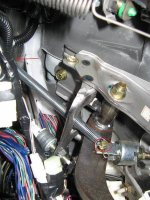
I mostly did it to get rid of the horrendous squeak the torsion spring made.
Added bonuses = better contact with the CC switch and better clutch pedal feel (IMO).
And FWIW, the brake pedal return spring I used (highly recommend this over the spring used in the OP - even the OP eventually made the switch to the brake return spring) has a little bit of wiggle room at the top.
Attachments
foo
Banned
Thats BS! I've owned 3 manual toyotas (95 4Runner, 2011 Tacoma and 97 4Runner) and all three of them squeaked! I bought the Tacoma brand new too.
I don't disagree with you, as I know the owner of this 4Runner intimately, and there is absolutely no way she'd ever even tell a fib, and she bought the 4Runner new, and said the dealer was unhelpful about the squeak.
Seems to me, the more I read about this bushing issue in order to understand how to solve the problem with a re-engineered solution perhaps, is that the problem seems pretty universal - so for the dealer to claim ignorance is, as you said, BS by the dealer.
The one problem I have now is that people are saying the squeak is solved by DIFFERENT methods, so, I'm not sure yet exactly what is causing the squeak.
For example, this article clearly says the squeak is due to the bushings!
Replace Your Clutch Pedal Bushings
Tech Knowledgebase - Replace Your Clutch Pedal Bushings
So, if you're like me, you wait until the squeal from your clutch pedal is driving you absolutely insane then you do something about it. Replacing the clutch pedal bushings is a fairly straight forward project. It also seems to be a near annual event for my truck. You will need the new bushings, a few tools, and an hour or so to complete the replacement.
Toyota Part Numbers for Replacement Bushings:
90386-05018 - 2 ea (Round for the sides of the spring)
90389-05017 - 1 ea (U-shaped for the center of the spring/pedal groove)
90386-13007 - 2 ea (Round for the center pivot tube of the clutch pedal)
90386-08002 - 1 ea (fork plunger through pin bushing)
90949-03022 - 1 ea (spring)
Tools used:
3/8 ratchet
Various ratchet extensions
14mm, 12mm, 10mm sockets
14mm wrench
Philips/Standard screwdriver
Channel locks
Grease
Brute strength
BTW, notice they have MORE bushings identified to replace than just the P/Q bushings I've seen until now.
Do we, on the 4Runner, have those additional bushings?
Attachments
Last edited:
foo
Banned
It looks like there have been a few different redesigns that attempt to solve both the problem of the chronic pedal-return squeak, and the frequent wearing out of the plastic bushings.
This guy replaced all the associated plastic bushings, not just the P/Q bushings, with bronze.
Tacoma Bronze Clutch Pedal Spring Bushing Replacement (PICS)
Tacoma Bronze Clutch Pedal Spring Bushing Replacement (PICS) - TTORA Forum
This guy replaced all the associated plastic bushings, not just the P/Q bushings, with bronze.
Tacoma Bronze Clutch Pedal Spring Bushing Replacement (PICS)
Tacoma Bronze Clutch Pedal Spring Bushing Replacement (PICS) - TTORA Forum
Them plastic bushings keep failing on me and there like $4.00ea at the stealership so I decided to make this a permanent fix. Cost me About $7.00 to replace all the bushings and took about 30min to make them fit right.
Attachments
foo
Banned
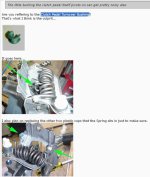
While I have been referring to the U-shaped bushing as the clutch return torsion spring "P" bushing, this thread calls it the "Clutch Pedal Turnover Bushing", so that may be a more proper search term in the future.
Throwout Bearing issues
Throwout Bearing issues - TTORA Forum
Throwout Bearing issues
Throwout Bearing issues - TTORA Forum
Attachments
foo
Banned
A lot of people just replace stuff, and some just take the suggested redesigns on faith, but for the people who research the many attempted redesigns, this particular thread is perhaps one of the best - because this guy tried them all - and he - like me - tries to help others by simply documenting what he found out in his experiments!
So we all benefit from people like him!
Grumble grumble stupid clutch bushing grumble (pictures)
http://www.ultimateyota.com/showthr...umble-stupid-clutch-bushing-grumble-(pictures)
This guy confirmed what the other articles merely implied, which is that you remove the factory spring and replace it with the linear spring:
However, it didn't work for long. So he replaced the u-shaped "P" bushing with bronze, and replaced the pedal-return torsion spring and the two "Q" bushings on each end of the torsion spring.
Unfortunately ...
His redesign was DIFFERENT than all the previous redesigns:
He then fabricated a new bronze bushing, but ...
Since no good deed goes unpunished...
But he kept trying...
Finally coming up with a NYLON bushing workaround:
So we all benefit from people like him!
Grumble grumble stupid clutch bushing grumble (pictures)
http://www.ultimateyota.com/showthr...umble-stupid-clutch-bushing-grumble-(pictures)
Anyone with a 5spd 3rd gen 4Runner knows that Toyota dropped the ball with their design of the clutch pedal assist/return spring. Last week I entered round three of my battle with this little issue, and I would like to share my current solution in case it helps others.
This guy confirmed what the other articles merely implied, which is that you remove the factory spring and replace it with the linear spring:
I pulled out the factory spring and replaced it with a linear spring, which was the popular solution at the time.
However, it didn't work for long. So he replaced the u-shaped "P" bushing with bronze, and replaced the pedal-return torsion spring and the two "Q" bushings on each end of the torsion spring.
Unfortunately ...
Things worked fine for about a year, and then during a recent trip to Oregon the bronze bushing broke and wound up in my floor mat. Awesome.
His redesign was DIFFERENT than all the previous redesigns:
I don't have a welder, so I used some metal epoxy to glue on steel side plates and to fill in the worn out area. My idea was to increase the surface area so it wouldn't wear through so quickly.
He then fabricated a new bronze bushing, but ...
I then made a new bronze bushing and put it in place and re-installed the spring (after the epoxy cured overnight). Conveniently this new bushing failed after about 20s of testing on the bench, so the spring came back out. And to make things more fun the spring pressure was strong enough that it popped the new side plates off. Crap.
Since no good deed goes unpunished...
I needed the truck the work the next day so out came more tools. I drilled a hole through the side plates and bolted them in place. And since I had one sitting around I put a factory plastic bushing in place. It failed after about 15s of testing on the bench.
But he kept trying...
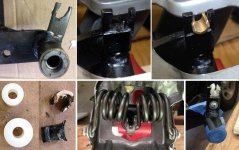
For those keeping score we are now at spring 2 and Matt 0. I was going to make another bronze bushing, but bronze is very fragile and as soon as it deforms due to pressure it crumbles. After a quick trip to the hardware store I came home with some thick wall nylon spacers. Here are the spacers and the remains of the bronze and plastic bushings.
Finally coming up with a NYLON bushing workaround:
At this point I decided that I would probably have to replace the clutch pedal, so it was time to have some fun. I used a file to widen the notch, and then machined the nylon bushing to fit, attempting to keep as much wall thickness as possible. This nylon is very tough and a pain to machine, which is a good sign.
Attachments
foo
Banned
I'm not sure yet if I'm gonna risk the redesigns but if I did, I'd opt for the NYLON bushings, so if anyone has a SOURCE for them at a big box store (e.g., Home Depot, Lowes, OSH, etc.), let me know what part number you used, and what size, as that's where the risk and effort lies.
As for OEM replacement, I called a few local dealers, and none had the entire set in stock, but the prices quoted, just FYI, were as follows:
a. Pedal = $90 to $110
b. Spring = $27 to $30
c. Bushing P = $5
d. Bushing Q = $10 to $24 (per set)
BTW, this article offers a NEW diagnostic test, for the spring, anyway:
Pedal Assembly Recon
Pedal Assembly Recon - Toyota Nation Forum : Toyota Car and Truck Forums
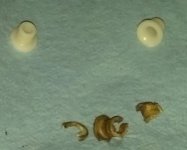
Since in the 4runner that I'm trying to retrofit, the P bushing is gone, and the Q bushings are so badly trashed that I don't know what the original shape was, this photo in that thread is potentially useful for trying to find a big-box store NYLON replacement for these two P & Q bushings that we all could benefit from!
As for OEM replacement, I called a few local dealers, and none had the entire set in stock, but the prices quoted, just FYI, were as follows:
a. Pedal = $90 to $110
b. Spring = $27 to $30
c. Bushing P = $5
d. Bushing Q = $10 to $24 (per set)
BTW, this article offers a NEW diagnostic test, for the spring, anyway:
Pedal Assembly Recon
Pedal Assembly Recon - Toyota Nation Forum : Toyota Car and Truck Forums
If you take a look at your spring while attached to your pedal assembly; press the clutch down with your hand and note how much the spring flexes and forms a "V" (and rubs its coils). Some springs, once removed can be "bent" back. Some should be replaced and some folks don't care about a little tiny squeek.
In either case, these main bushings are largely responsible for a lot of the "slop" in your pedal. The spring is one source of squeaks (at least inside).
Since in the 4runner that I'm trying to retrofit, the P bushing is gone, and the Q bushings are so badly trashed that I don't know what the original shape was, this photo in that thread is potentially useful for trying to find a big-box store NYLON replacement for these two P & Q bushings that we all could benefit from!
Attachments
Last edited:

Falonious
New member
Since this Toyota had a squeak that the dealer couldn't fix under warranty, the reason for the squeak might actually be inherent, somehow, in the design.
This thread implies that the torsion spring itself is the cause of the squeak (and not bushing wear!) perhaps due to metal-on-metal rubbing of the horseshoe-shaped-spring coils?
Clutch squeak Linear Spring swap (TW how to)
https://www.tacomaworld.com/threads/clutch-squeak-linear-spring-swap-tw-how-to.159429/page-5

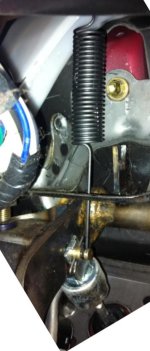
I did this on mine...removed the torsion spring altogether. Why they designed something so complex for that application is beyond me.
No more noise and pedal pressure is fine. Best 15-20 minutes I've spent on the runner.
foo
Banned
hremoved the torsion spring altogether. Why they designed something so complex for that application is beyond me.[/QUOTE]
It's great that you provide experimental experience, since those of us merely contemplating the move, need to know the ramifications.
The suggestion to ditch the torsion spring in favor of the linear spring still brings up a question that I would LOVE if someone could answer.
[B]In the OEM setup, what exactly forces the pedal to return?[/B]
a. Is it a combination of the pressure plate plus the torsion spring?
b. Or is it just the torsion spring?
If it's just the torsion spring, and not the pressure plate working "backwards" (somehow, through the hydraulics???), then it seems that "any" spring that works, should work exactly the same; so the method below stands a chance, conceptually, of being exactly equal to the torsion spring. Is that correct?
Hence my question ...
Attachments
- Status
- Not open for further replies.


