
You are using an out of date browser. It may not display this or other websites correctly.
You should upgrade or use an alternative browser.
You should upgrade or use an alternative browser.
04 4runner V8 Sport 2uz-fe timing belt failure, aftermath and the repair
- Thread starter Streetfighter
- Start date
All the belts replaced was with the oem Mitsubishi belt. 2nd and 3rd change
Aisin water pumps come with a metal gasket with a thin Brown silicon edge, please don't trust this and use gray silicone.
The timing belt that exploded was wet and brittle. Felt like rubber drenched in oil.
This is after 4 to 5 years of knowing the leak.
No matter what this engine is amazing.
OP, this may sound like a dumb question but what were the symptoms of the coolant leak? Were there visual signs of coolant on the front of the engine? Could you smell it? Or was coolant simply disappearing from the system necessitating refill?
Wow! I've been looking high and low for a 4th gen V8 because the price/performance on a 5th gen left me very unimpressed but this right here has me scared of buying a 4th gen V8.
I've even heard of a bad pulley causing a V8 to become trash.
I'm sure the chances of this happening are probably 1 in a 1000 but in my head that 1 will happen to me.
What was Toyota even thinking making this an interference engine?
Sent from my XT1650 using Tapatalk
Some people have really pushed the limit on an oem belt going almost 150k. Since there is 4 valves per cylinder and a high compression ratio, there is almost no other way to have your cake and eat it too. They would have to add a step in the pistons to make clearance, which adds cost and lowers compression, or change cam lift and duration. All so they can say it doesn't interfere. That's not going to happen. Older dodge and ford (maybe more) V8 engines used nylon teeth on a steel crank pulley for their timing chain. It made it quieter, probably cheaper too. Worked only long enough til the teeth started falling out and would help clog the oil pump pickup screen. They need you to service your engine like any other whether it's a belt or a chain. I'm surprised the OP's belt lasted this long soaked in coolant for many years.
Last edited:

Streetfighter
New member
OP, this may sound like a dumb question but what were the symptoms of the coolant leak? Were there visual signs of coolant on the front of the engine? Could you smell it? Or was coolant simply disappearing from the system necessitating refill?
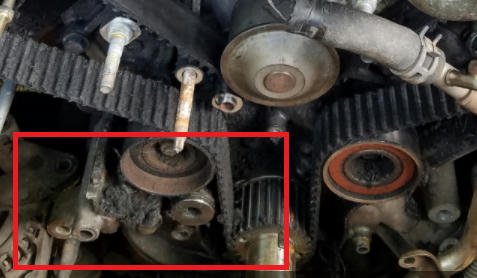
4 years ago I saw a drip under the engine when i was changing the oil, then saw it coming from the covers behind the fan. then the second year I started topping off the coolant more frequently. 3rd, it over heated once...and now it started to leak from where the thermostat housing mounts to the pump. I was dumb and used Orange sealant. I heard Orange isnt as good as gray. by the 4th year, it was always a little wet around the steering rack and area. I knew I had to change it soon. then BAM...this happened. The belt was so brittle when I held it in my hands, Rubber powder build up was everywhere inside the covers, strands of belt everywhere as well.
This pic shows the buildup of Rubber

Last edited:
4 years ago I saw a drip under the engine when i was changing the oil, then saw it coming from the covers behind the fan. then the second year I started topping off the coolant more frequently. 3rd, it over heated once...and now it started to leak from where the thermostat housing mounts to the pump. I was dumb and used Orange sealant. I heard Orange isnt as good as gray. by the 4th year, it was always a little wet around the steering rack and area. I knew I had to change it soon. then BAM...this happened. The belt was so brittle when I held it in my hands, Rubber powder build up was everywhere inside the covers, strands of belt everywhere as well.
This pic shows the buildup of Rubber
Gnarly. I guess it was pretty obvious... I just wanna make certain there aren't any hard-to-spot things I need to keep an eye on. Doesn't seem like it. Glad to hear your repair wasn't catastrophic

green_manalishi
New member
Good post; thanks for sharing.
This is further proof that the 2UZ-FE is non-interference. There are multiple examples on ih8mud of blown timing belts and none have had valve or piston damage.
This is further proof that the 2UZ-FE is non-interference. There are multiple examples on ih8mud of blown timing belts and none have had valve or piston damage.

V8Man
Member
I'm glad your engine is ok. This is good tech info but I have some questions since it's hard to go out on a limb and say there is no interference when so much data suggests that it is an interfering eng. You had to physically rotate the drivers cam to line everything up? A true 180*? Maybe I'm blind but I see belt teeth throughout the whole belt. But something made it run like poop, so it jumped teeth? If it jumped teeth, this would immediately retard valve timing. This increases the piston to valve clearance for the intake valves and decreases the clearance for the exaust. Intake valves are always larger than exhaust valves so they are at the most risk. Say you jumped 180 on the driver cam, this will retard the cam, and cause all your symptoms, but since the cam is retarded, there is more intake valve clearance. This only works out in your favor if the cam didn't spin 360 or more. And you may have kissed valve to piston anyways. Hot steel valves vs hot aluminum can put a good mark in the piston but still leave the valves and piston relatively ok, it all depends on how much interference there is. You can check by scoping through the spark plug hole. Some people get lucky when a belt snaps in half because all the valves stop and aren't at max lift. Let's fully diagnose this before we call this 2uz-fe interference engine a myth.
Not following your logic on the intake valves having more clearance. The two cams on each head are geared together driven by the one cogged pulley. Clearance or lift will not change.
I'm glad your engine is ok. This is good tech info but I have some questions since it's hard to go out on a limb and say there is no interference when so much data suggests that it is an interfering eng. You had to physically rotate the drivers cam to line everything up? A true 180*? Maybe I'm blind but I see belt teeth throughout the whole belt. But something made it run like poop, so it jumped teeth? If it jumped teeth, this would immediately retard valve timing. This increases the piston to valve clearance for the intake valves and decreases the clearance for the exaust. Intake valves are always larger than exhaust valves so they are at the most risk. Say you jumped 180 on the driver cam, this will retard the cam, and cause all your symptoms, but since the cam is retarded, there is more intake valve clearance. This only works out in your favor if the cam didn't spin 360 or more. And you may have kissed valve to piston anyways. Hot steel valves vs hot aluminum can put a good mark in the piston but still leave the valves and piston relatively ok, it all depends on how much interference there is. You can check by scoping through the spark plug hole. Some people get lucky when a belt snaps in half because all the valves stop and aren't at max lift. Let's fully diagnose this before we call this 2uz-fe interference engine a myth.
Scoping would be a really good idea. Someone who is doing this job or has their engine apart for some reason should do that and put this question to rest for good. I too keep reading conflicting information on this subject. That would be a great help to all of us V8 owners!
Not following your logic on the intake valves having more clearance. The two cams on each head are geared together driven by the one cogged pulley. Clearance or lift will not change.
It's not logic, it's just engine dynamics. Lift will not change, yes. However, it is the duration and timing that the valve is open is what can cause clearance issues. At the end of the exhaust stroke when the piston is at top dead center and the intake stroke is beginning, there is a moment where the exhaust valve is closing and the intake is opening. They are both slightly open. This is called overlap. This is where valve clearance is critical. Because both valves are open and the piston is at its highest point. So imagine you were to retard this timing event significantly of the exhaust valve closing and the intake valve opening. The piston is rising on the exhaust stroke but since it is retarded in time, it opens say, half way up the exhaust stroke and continues to be open even after the piston has completed the stroke. Now the exhaust is open at the pistons highest point and is still open but beginning to close on the pistons intake stroke. When you retard the intake valve events (the same amount as the exhaust, because yes, they are connected by geartrain) the intake valve begins to open late. It will open late on the intake stroke and close on the compression stroke. So, the exhaust valve is at risk of hitting the piston if the valve events are retarded since the valve will be opening when the piston is at TDC. But the exhaust valves are small so I would imagine in the worst case scenario, they would still clear the piston. If the belt slips so much that it retards timing beyond 360* crank rotation, it would be considered that the valve timing is waaaaay advanced, instead. This would open the intake valve sooner, and risk damage since the valve is opening during the pistons exhaust stroke. The valve is larger in diameter and likely has more lift in design so it is at the highest risk. Timing would have to be retarded so much (a belt slipping or jumping time can only retard cam time) that it is advancing the cam events to put the engine at risk. Sounds like the OPs cam didn't jump time very far to risk damage. I've built a few high performance V8s and degreeing the cam is critical and a step in that is to check piston to valve clearance. Advancing cam time even 3* crank rotation or having a cam that has more overlap can allow the piston to strike the intake valve so when installing a new cam, this clearance must be checked. Whew!

BlackWorksInc
New member
I would say it doesn't disprove what Toyota themselves state. But it does muddy the waters a bit because it could be more realistic that the VVTi vehicles have a tighter combustion chamber. It's hard to say, I've seen a 2UZ-FE that blew a belt and bent valves and I currently have a 2000 LC100 in my stall that broke a belt (non-Toyota) that we're gonna try throwing a belt on and seeing how the compression looks.
This reminds me of the whole nebulous and still unverified (one way or the other) "Japanese 2UZ rods are stronger than US ones." For every "I got lucky and it didn't total my motor" there's "well the belt broke and now I'm out an engine." Even modern "non-interference" engines with chains have such tight clearances that if a chain did break while at a good enough speed it could conceivably impact a piston (actually have seen that on a non-Toyota engine that was supposedly non-interference)
I would say there's no reason to be afraid of owning a V8, if your doing your maintenance properly with quality parts, you're probably never going to break a belt.
Also it's Mistuboshi who makes our belts, not Mistubishi (I made the same mistake for a while until someone corrected me and I actually read the belt label properly. lol)
This reminds me of the whole nebulous and still unverified (one way or the other) "Japanese 2UZ rods are stronger than US ones." For every "I got lucky and it didn't total my motor" there's "well the belt broke and now I'm out an engine." Even modern "non-interference" engines with chains have such tight clearances that if a chain did break while at a good enough speed it could conceivably impact a piston (actually have seen that on a non-Toyota engine that was supposedly non-interference)
I would say there's no reason to be afraid of owning a V8, if your doing your maintenance properly with quality parts, you're probably never going to break a belt.
Also it's Mistuboshi who makes our belts, not Mistubishi (I made the same mistake for a while until someone corrected me and I actually read the belt label properly. lol)
Last edited:
I would say it doesn't disprove what Toyota themselves state. But it does muddy the waters a bit because it could be more realistic that the VVTi vehicles have a tighter combustion chamber. It's hard to say, I've seen a 2UZ-FE that blew a belt and bent valves and I currently have a 2000 LC100 in my stall that broke a belt (non-Toyota) that we're gonna try throwing a belt on and seeing how the compression looks.
This reminds me of the whole nebulous and still unverified (one way or the other) "Japanese 2UZ rods are stronger than US ones." For every "I got lucky and it didn't total my motor" there's "well the belt broke and now I'm out an engine." Even modern "non-interference" engines with chains have such tight clearances that if a chain did break while at a good enough speed it could conceivably impact a piston (actually have seen that on a non-Toyota engine that was supposedly non-interference)
I would say there's no reason to be afraid of owning a V8, if your doing your maintenance properly with quality parts, you're probably never going to break a belt.
Also it's Mistuboshi who makes our belts, not Mistubishi (I made the same mistake for a while until someone corrected me and I actually read the belt label properly. lol)
^ This is all the evidence anyone needs to know that the 2uz-fe is an interference engine. Not to mention Toyota themselves say the valves could strike piston. It may not happen to everyone or every timing belt failure, but it could and it is a warning. The OP really showed us the integrity of the belt because it was bathed in hot water and glycol for 4 years and only jumped time a bit.
OP, please edit your posts on this thread to not suggest that this engine is not an interference engine. A few folks have already ran away with the idea. God knows what kind of neglected maintenance may arise without the fear of total engine fubar. I shouldn't talk, we have 110k on the original belt lol. But again, these time change intervals are also to protect toyota and their warranty.
BlackWorksInc
New member
So just for those of you curious on the outcome. Threw a new Timing Belt and Water Pump on that LC100 with 170k on it. She's choochin' pretty skookum so far. Rather surprised, thought she was going to have a bent valve or something, but she checked okay when we did the compression check and she ran good once I got her back together today. Customer got lucky.
Anyways, the main take-away here is that Toyota specifies that the 2UZ-FE is an Interference Motor. That's it, there's no questioning it, no doubt, no nebulous delineation. The designer, builder, and manufacturer of the engine has specified that the engine is an interference design. They would not waste the effort to plaster that warning for almost 2 decades in every FSM, training manual, ect. unless they believed it to be a potential issue.
Now, notice I italicized "potential". It seems that the 2UZ-FE is not as grenade-prone as say Honda engines are when a belt breaks, but rather there's a potential for the valves to nick the pistons when it's free-running without a belt to time things. I'm guessing that means that somewhere in the valve travel there's a point where they could possibly smack a piston if it were out of time, which was more than enough for Toyota to label it an interference motor.
So, bottom line. I you have a broken belt and she turns over and doesn't sound like something's done broken. Throw a belt on there and do a compression check to see if you got lucky.
Anyways, the main take-away here is that Toyota specifies that the 2UZ-FE is an Interference Motor. That's it, there's no questioning it, no doubt, no nebulous delineation. The designer, builder, and manufacturer of the engine has specified that the engine is an interference design. They would not waste the effort to plaster that warning for almost 2 decades in every FSM, training manual, ect. unless they believed it to be a potential issue.
Now, notice I italicized "potential". It seems that the 2UZ-FE is not as grenade-prone as say Honda engines are when a belt breaks, but rather there's a potential for the valves to nick the pistons when it's free-running without a belt to time things. I'm guessing that means that somewhere in the valve travel there's a point where they could possibly smack a piston if it were out of time, which was more than enough for Toyota to label it an interference motor.
So, bottom line. I you have a broken belt and she turns over and doesn't sound like something's done broken. Throw a belt on there and do a compression check to see if you got lucky.
Only a guess but somewhat educated. I think an engine subject to the momentum "shock" of breaking a timing belt at high RPM might be likely to experience some valve float due to the sudden shift in load. Could help explain the some do-some don't.So just for those of you curious on the outcome. Threw a new Timing Belt and Water Pump on that LC100 with 170k on it. She's choochin' pretty skookum so far. Rather surprised, thought she was going to have a bent valve or something, but she checked okay when we did the compression check and she ran good once I got her back together today. Customer got lucky.
Anyways, the main take-away here is that Toyota specifies that the 2UZ-FE is an Interference Motor. That's it, there's no questioning it, no doubt, no nebulous delineation. The designer, builder, and manufacturer of the engine has specified that the engine is an interference design. They would not waste the effort to plaster that warning for almost 2 decades in every FSM, training manual, ect. unless they believed it to be a potential issue.
Now, notice I italicized "potential". It seems that the 2UZ-FE is not as grenade-prone as say Honda engines are when a belt breaks, but rather there's a potential for the valves to nick the pistons when it's free-running without a belt to time things. I'm guessing that means that somewhere in the valve travel there's a point where they could possibly smack a piston if it were out of time, which was more than enough for Toyota to label it an interference motor.
So, bottom line. I you have a broken belt and she turns over and doesn't sound like something's done broken. Throw a belt on there and do a compression check to see if you got lucky.
An interesting regaled aside, according to Toyota records my 04 was towed in at about 40k for a non- start condition. Turned out the belt jumped a tooth. 13+ years old, 3rd owner, 195k, 3rd belt, runs great no issues.
I do however have to at some point address the spark plugs that have been in for "who knows how long" and I'm thinking the next belt (about 30k from now) would be a good time. Anyone know the signs of weak plugs on these engines?
Only a guess but somewhat educated. I think an engine subject to the momentum "shock" of breaking a timing belt at high RPM might be likely to experience some valve float due to the sudden shift in load. Could help explain the some do-some don't.
An interesting regaled aside, according to Toyota records my 04 was towed in at about 40k for a non- start condition. Turned out the belt jumped a tooth. 13+ years old, 3rd owner, 195k, 3rd belt, runs great no issues.
I do however have to at some point address the spark plugs that have been in for "who knows how long" and I'm thinking the next belt (about 30k from now) would be a good time. Anyone know the signs of weak plugs on these engines?
Bob, valve floats comes from when valve springs aren't strong enough to close the valve on time. Happens at high rpm where the cam lobe starts dropping off but the spring can't shut it properly because rpm is so fast. Can also happen to aftermarket cams where the cam lobe lift and ramp is very aggressive and the springs can't handle the job. I doubt an overhead cam engine with a redline of 5k can float the valves, but I suppose it's possible if the springs are weak.
Engines that sit for long periods of time without running (many years) can weaken the springs that are being held open. This is why I cringe when I see a FB post about a barn-find that has been sitting for 30 years, they "service it" and fire it up and think everything is ok. Springs can break in those cases. A lot of hot rod guys, during their winterize checklist, take the rockers off to close all the valves after fogging the engine with wd-40. Just so some springs don't sit open and the cylinders remain oiled with no exposure to atmosphere.
As far as spark plugs go, as the electrodes erode, the gap becomes larger. It's harder for spark to jump this gap when rpm is high (less spark energy) and when cylinder pressures are at their maximum (high load/full throttle/towing/etc). So you'll likely see a misfire, worst case.
BlackWorksInc
New member
I'm curious if there's a possibility of the valves at higher speeds being pushed down a little bit by inertia. Theoretically the spring should act as a "shock" and provide enough resistance to absorb that inertia, but realistically there's nothing stopping the valve from over-extending into the engine besides the spring being fully compressed (which under normal operating conditions it isn't.) So I'm wondering if at a high RPM/Load that a belt breaks could the valve be in a point where it travels a fractionally small amount more than it would turned by hand?
More of a question/thought experiment than a reason.
More of a question/thought experiment than a reason.

toyo
Member
To check if an engine is interference is pretty straightforward once the belt is off. Put the cam shaft in various positions, rotate the crankshaft slowly and you will be able to feel the piston and valves start to touch each other. Do this without the spark plugs installed for easier/more control as it wont have compression. If you feel any resistance simply back the crank off a little and align your marks up.
This is a procedure that's been used for many many years.
This is a procedure that's been used for many many years.
Bob, valve floats comes from when valve springs aren't strong enough to close the valve on time. Happens at high rpm where the cam lobe starts dropping off but the spring can't shut it properly because rpm is so fast. Can also happen to aftermarket cams where the cam lobe lift and ramp is very aggressive and the springs can't handle the job. I doubt an overhead cam engine with a redline of 5k can float the valves, but I suppose it's possible if the springs are weak.
Engines that sit for long periods of time without running (many years) can weaken the springs that are being held open. This is why I cringe when I see a FB post about a barn-find that has been sitting for 30 years, they "service it" and fire it up and think everything is ok. Springs can break in those cases. A lot of hot rod guys, during their winterize checklist, take the rockers off to close all the valves after fogging the engine with wd-40. Just so some springs don't sit open and the cylinders remain oiled with no exposure to atmosphere.
As far as spark plugs go, as the electrodes erode, the gap becomes larger. It's harder for spark to jump this gap when rpm is high (less spark energy) and when cylinder pressures are at their maximum (high load/full throttle/towing/etc). So you'll likely see a misfire, worst case.
Like blackworks ponders in the post below yours. Or maybe? Think of it like a world class bicycle sprinter coming I clipped at full power. One of the worst solo crashes a rider can have. Inertia. Also no more compression holding some valves back. I know what valve float is but thanks anyway. There are more than one or two causes. Can you imagine the forces produced inside one of these engines at full throttle at maybe 5k rpm? In the old days, before interference engines. it was easy to push a valve throung a piston by missing a power shift. Yes foot off the gas but when you missed a gear and let out the clutch things could and too often on the track would spin with a bit more energy or thrust then when under load valve into piston nearly new heavy duty valve springs: bang.

Stuffman
New member
So just for those of you curious on the outcome. Threw a new Timing Belt and Water Pump on that LC100 with 170k on it. She's choochin' pretty skookum so far. Rather surprised, thought she was going to have a bent valve or something, but she checked okay when we did the compression check and she ran good once I got her back together today. Customer got lucky.
Anyways, the main take-away here is that Toyota specifies that the 2UZ-FE is an Interference Motor. That's it, there's no questioning it, no doubt, no nebulous delineation. The designer, builder, and manufacturer of the engine has specified that the engine is an interference design. They would not waste the effort to plaster that warning for almost 2 decades in every FSM, training manual, ect. unless they believed it to be a potential issue.
Now, notice I italicized "potential". It seems that the 2UZ-FE is not as grenade-prone as say Honda engines are when a belt breaks, but rather there's a potential for the valves to nick the pistons when it's free-running without a belt to time things. I'm guessing that means that somewhere in the valve travel there's a point where they could possibly smack a piston if it were out of time, which was more than enough for Toyota to label it an interference motor.
So, bottom line. I you have a broken belt and she turns over and doesn't sound like something's done broken. Throw a belt on there and do a compression check to see if you got lucky.
I agree that the 2UZ-FE is an interference motor. Last year I had the water pump explode and cut the timing belt at 80 mph. I had to get another Engine. You can see photos of the old engine in my photo album.
Like blackworks ponders in the post below yours. Or maybe? Think of it like a world class bicycle sprinter coming I clipped at full power. One of the worst solo crashes a rider can have. Inertia. Also no more compression holding some valves back. I know what valve float is but thanks anyway. There are more than one or two causes. Can you imagine the forces produced inside one of these engines at full throttle at maybe 5k rpm? In the old days, before interference engines. it was easy to push a valve throung a piston by missing a power shift. Yes foot off the gas but when you missed a gear and let out the clutch things could and too often on the track would spin with a bit more energy or thrust then when under load valve into piston nearly new heavy duty valve springs: bang.
Can you elaborate on this? You lost me at "bicycle"


