Hi guys, this post is what made me join this forum. Thank you so much for starting this thread and the great write up Jon and mbtim for the fantastic (and timely) video and everyone else for the added advice. I'm pretty much a novice at this stuff and you guys saved me $400. I also had the Haynes manual for kicks and it helped too. I just called Toyota and they quoted me $780 including tax and 4.5 hours shop time. I bought everything OEM except felpro for the plenum gaskets (convenience). $$ are Canadian so take 70% or so for US dollars, say $450 USD?
I was changing spark plugs and noticed I had both valve cover gaskets leaking and also 4 of the plug tube seals. I will probably have to do one of the coils too because it's rubber is soft. After looking this stuff up I found this post and you guys gave me the confidence to do it myself. It took me about 8-10 hours worth of work just tinkering away 1/2 hour here and there in the evening when the kids were in bed. I was methodical, if there's a next time, 4-5 hours I think, by myself.
I did:
Denso spark plugs ($3 each) valve cover gaskets ($50 each), camshaft plugs ($35 each I think) valve cover bolt washer seals x16 ($2 each), tube seals ($6 each), PCV valve ($20!) and grommet ($20!), plenum gaskets ($20 each) plug Toyota FIPG ($20 tube) all about $400 including 15% tax. I reused my aluminum half-moon plugs. Had to buy a new in-lb torque wrench, throttle body cleaner, Mass Air Flow cleaner, dielectric grease. I imagine it would have been cheaper with non-OEM and order online, but I felt better with mostly OEM.
I read 4RUN0326’s comment about whether the halfmoons and camshalft plugs really need to come out. My two cents is that no, probably not, but when you take out the valve cover gasket the little bit of FIPG that is on the joints of the half moons and plugs might come loose, when you put some more FIPG in there it might not get in the little cracks so your better off doing it once and doing them than finding out later you should have. I still reused my aluminum half-moons though.
Saw a question on why you need the washer seals. I believe it’s because otherwise you’ll be cranking down aluminum to aluminum to steel bolts and doing it in a pattern for flatness. You need these little guys to protect this stuff from cracking and to get a nice even seal.
Some things I ran into.
I don't like that wiring harness (you knew I was going to say that), but that duct tape (the real foil stuff for actual ducts) wrapped all around it really came in handy when it did break on me on the drivers side. The little tabs that have the bolt holes broke just by turning the bolts!

One thing, there's a single wire, mid engine at the back of the harness, you can barely see it. You can reach in and pull it straight up to detach (it doesn't have a clip). This will help you lift the harness up quite high so you can get both valve covers off. Also carefully detach two electrical clips passenger side front, under the timing belt cover thingy.
I did disconnect my negative battery cable so my ECM would reset, seems to run nicely now so I don’t know if that helped. I’d do it anyway so I wouldn’t zap something, or myself.
I did not put any anti-seize on the spark plugs. Denso says don't put it on because then the threads will slide more easily if you have it on, and will go in further than they were meant to with the same torque. This makes lots of sense. Says the plugs already have some kind of metal, (nickel or something) on the threads that help with this. It said if you do use anti seize lower the torque to 2/3rds. My plugs were older than earth (don't ask I'll feel bad) and I still got them out. My plugs had maybe a 2-3 mm (0.08-0.1 in) gap!! They need 0.043. I couldn't find a gap tool with 0.043 but there were lots with 0.044. Don't worry about this, it's just number rounding, Toyota wants 1.1 mm. 0.043 inch is 1.0922 mm and 0.044 inch is 1.1176 mm. I just made sure my 0.044 didn't go through the pre-gapped plug. Funny thing about the plugs, I expected I'd run into 3 Densos and 3 NGKs, but I had all Densos. I asked the Toyota parts guy and he told me there are Denso's in some and NGKs in others because they were made in different factories so each factory put in what they had. The Haynes just lists Denso and Type 1 and NGK as Type 2. I don't know the truth, so when I asked the Toyota parts guy if I should have 3 of each and he couldn't sell me NGKs, I just trusted him. He seemed to know his stuff otherwise.
Before you do the valve cover gaskets, check those valve cover bolts, torque them to the 52 in-lbs because I can tell you right now they are loose. I read lots of people giving me this advice so I checked my own with my hands and they felt tight. I figured mine weren't loose and carried on, but when I got my wrench on them they came off wayyy too easily, so close to finger tight. I still needed to do the job because of the leaking plug tube seals, but if it was only the cover gaskets that would have been a little easier, except for the drivers side.
Those plug tube seals, I used a 1-1/4 socket to push them on instead of a 32 mm (It's just what I had and 1-1/4 in is 31.75 mm). I found that if you put the socket on them you could just lean on them and they would slide in real slow. Once the were seated a bit I used my hammer for the last few taps. A bit of motor oil on the inside with my finger really helped get them over the plug tubes.
I worried about being fast enough to put the camshaft plugs and 2 half moons in because the FIPG says it is ready in 15 minutes in the future I might like something that takes a bit longer, but it does make me feel nice to have used the Toyota stuff.
I labeled everything religiously, this did come in handy because the truck started up first time. Having a piece of cardboard labeled with some holes was a great idea and worked well.
I did not drain the coolant. The coolant lines into the throttle body have the metal clips and I just plugged them lightly and lifted them up a little, I could hear the coolant run back down the hose and they never leaked on me. A little 'coolant hose removal' tool (looks like an ice pick hook thingy) is super handy for those two little hoses under the throttle body.
Didn't think I would get new plenum gaskets, but there was some RTV or something on them and it looked like a flat surface wasn't going to be made so I got some new ones and cleaned up the old surface.
I took the throttle body and upper plenum off in one piece. I would think about taking the throttle body off by itself next time because it will be easier to get to the hoses underneath it, but I've heard the throttle body bolts can wreck when removing them and there's the potential cost of the new gasket. *shrug* My throttle body was really dirty so I cleaned it and the MAF. Used throttle body cleaner on the caked on stuff inside the plenum, seamed to work well. Had plenty of carbon or something on the intake manifold tubes but I didn't know if I should clean that at all since next stop is the air intake valves and cylinder. I left them alone for fear of getting some gunk in there and wrecking something.
The little PCV grommet is tough to get out. I took mine off when I had the valve cover off, so it was a little easier.
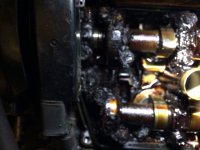
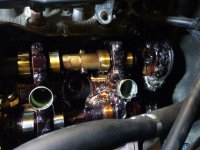
I really need to change my oil more frequently, seemed like there was a lot of 'gunk' in there and my work is only 5 kms away so short trips for my DD, cold-ish -15 C (5 F) winters, hot-ish summers 35-40 C (95-104 F) degrees and I occasionally pull a small camping trailer. I think I'll do the oil 5 times a year instead of 4 now that I've seen the camshafts!

I'm eyeing up that Tundra brake upgrade now....
Thanks a lot for your help everyone, really gave me the confidence to pull this off and sorry for the long book, but I'm just sooo happy I was able to do this