4Runner alternator upgrade (gen 5)

Thought I'd offer this as well:

Here's an excerpt from SMD (Steve Meade Designs, world class audio system expert) who also advises that you Not replace, but add new cables to your vehicle when performing a BIG THREE upgrade:

How to do the Big III (Steve says')...

The Big III is a simple electrical upgrade for any vehicle to improve a better electrical charge from the alternator to the battery. Your stock electrical system consists of 3, or more, wires hence the term “Big III”. These are the main wires for your electrical charging system. The actual “upgrade” is we are adding a thicker gauge wire to the system.

*Notice I said add and not replace, reason behind this is the current will automatically take the path of least resistance, easier to do. You are more than welcome to replace all wires but be sure you do it properly otherwise you could harm the ECU...

And here's the full link: https://www.google.com/url?sa=t&rct...KrmJULsz-dafBjBeQ&sig2=m1YM7f9uGfsuT_Qx6yqYVw

Hope this helps!
 
Last edited:
G'day team mates'

After I posted this thread I saw something that I did that I knew just wasn't right... and certainly beneath all electrical code safety provision docs (I should have caught that!). Remember this (ANL) 140A in-line wafer fuse below?
rigtec-albums-%26quot%3Bgentilmen+prefer+redheads%26quot%3B-picture26813-img066.jpg
rigtec-albums-%26quot%3Bgentilmen+prefer+redheads%26quot%3B-picture26782-all-cell-pix-june-2014-006.jpg


It connects the new aux alternator output line to the Positive battery terminal's new aux cable. To reiterate on it's purpose... it's there so that in the event of a serious front end collision and the main alternator harness were to be severed, this fuse would offer an opportunity for the power to be "disconnected" to prevent a fire or an explosion. Well theoretically it will do just that... "theoretically". But, If you look at this line very carefully, w/detail to it's position, you would hone in on the problem that I saw.

Problem is the aux line from the battery is too long and the fuse is much too far away from the battery so if the supply line is severed from the fuse holder then the "safety line itself" becomes the biggest safety hazard of all. This line is so long that if severed, it will be allowed to flail wildly beneath the hood, arcing on everything in it's path, and no way to disconnect the battery; fuse and holder still sitting on the leftside wheelwell. When I noticed this, I immediately went to amazon.com and ordered a 140A circuit breaker from "Rockford Fosgate".
rigtec-albums-%26quot%3Bgentilmen+prefer+redheads%26quot%3B-picture26888-img411.jpg
rigtec-albums-%26quot%3Bgentilmen+prefer+redheads%26quot%3B-picture26889-img413.jpg


I removed the old wafer fuse and holder...
rigtec-albums-%26quot%3Bgentilmen+prefer+redheads%26quot%3B-picture26890-img416.jpg


Then cut the loops ^^^^^ off of both 4ga power lines (see old fuse holder above) and terminated them at the new circuit breaker electrical block.
rigtec-albums-%26quot%3Bgentilmen+prefer+redheads%26quot%3B-picture26891-img417.jpg
rigtec-albums-%26quot%3Bgentilmen+prefer+redheads%26quot%3B-picture26896-img418-1.jpg


Now this set-up is much better... and does recognize safety code guidelines! The RED button on top allows the user to shutdown the amplifier or other 140 amp load without unbolting the terminals; for a "quick disconnect"! But the purpose of this circuit is just to supply power to the battery as it becomes depleted from the 'added' high current aftermarket accessories.

PS: I did say that I would keep you all abreast of any problems or changes that may come about so... there's one! Best to you all!

Greg (rigtec)
 
Last edited:
G'day team mates'

After I posted this thread I saw something that I did that I knew just wasn't right... and certainly beneath all electrical code safety provision docs (I should have caught that!). Remember this (ANL) 140A in-line wafer fuse below?
rigtec-albums-%26quot%3Bgentilmen+prefer+redheads%26quot%3B-picture26813-img066.jpg
rigtec-albums-%26quot%3Bgentilmen+prefer+redheads%26quot%3B-picture26782-all-cell-pix-june-2014-006.jpg


It connects the new aux alternator output line to the Positive battery terminal's new aux cable. To reiterate on it's purpose... it's there so that in the event of a serious front end collision and the main alternator harness were to be severed, this fuse would offer an opportunity for the power to be "disconnected" to prevent a fire or an explosion. Well theoretically it will do just that... "theoretically". But, If you look at this line very carefully, w/detail to it's position, you would hone in on the problem that I saw.

Problem is the aux line from the battery is too long and the fuse is much too far away from the battery so if the supply line is severed from the fuse holder then the "safety line itself" becomes the biggest safety hazard of all. This line is so long that if severed, it will be allowed to flail wildly beneath the hood, arcing on everything in it's path, and no way to disconnect the battery; fuse and holder still sitting on the leftside wheelwell. When I noticed this, I immediately went to amazon.com and ordered a 140A circuit breaker from "Rockford Fosgate".
rigtec-albums-%26quot%3Bgentilmen+prefer+redheads%26quot%3B-picture26888-img411.jpg
rigtec-albums-%26quot%3Bgentilmen+prefer+redheads%26quot%3B-picture26889-img413.jpg


I removed the old wafer fuse and holder...
rigtec-albums-%26quot%3Bgentilmen+prefer+redheads%26quot%3B-picture26890-img416.jpg


Then cut the loops ^^^^^ off of both 4ga power lines (see old fuse holder above) and terminated them at the new circuit breaker electrical block.
rigtec-albums-%26quot%3Bgentilmen+prefer+redheads%26quot%3B-picture26891-img417.jpg
rigtec-albums-%26quot%3Bgentilmen+prefer+redheads%26quot%3B-picture26896-img418-1.jpg


Now this set-up is much better... and does recognize safety code guidelines! The RED button on top allows the user to shutdown the amplifier or other 140 amp load without unbolting the terminals; for a "quick disconnect"! But the purpose of this circuit is just to supply power to the battery as it becomes depleted from the 'added' high current aftermarket accessories.

PS: I did say that I would keep you all abreast of any problems or changes that may come about so... there's one! Best to you all!

Greg (rigtec)

Um... If I read this and understood it correctly... with the 140A in-line wafer fuse, is that factory or did you install that? If it is factory, did you just improve a safety feature on the T4R that the factory has overlooked or designed inadequately?
 
Um... If I read this and understood it correctly... with the 140A in-line wafer fuse, is that factory or did you install that? If it is factory, did you just improve a safety feature on the T4R that the factory has overlooked or designed inadequately?

Hi VT,

I originally installed the 140A 'wafer fuse' as a safety provision. After upgrading the 4Runner's 130A alternator to a high output 270A unit, there were still a number of main current carrying cables that needed to be replaced due to the potential for an overload. Instead of ripping out each one of those main load carrying wires and replacing them, I chose to leave them in place and to give each one of them 'a partner' to split the load with. This is the equivalent of using one much larger cable.

Because the (OEM) main load carrying cable (which runs from the battery to the alternator's main output terminal) is protected by an in-line 140A fuse, it was necessary for me to include a fuse of the same electrical value in the partner line as well. If I didn't, then the added lines would in effect, be 'jumping' or by-passing the factory's safety provision fuse, thus preventing that fuse from doing what the Toyota electrical engineers intended for it to do; open up in the event of a catastrophic electrical failure.

What I did yesterday was replace the 140A wafer, with a 140A CB (circuit breaker) because where I located the wafer fuse was too far away from the battery to provide even nominal circuit protection... t'was an oversight on my part so I corrected it right away! Thanks much for your question... and the opportunity to clarify!

rig
 
Last edited:
Good job! I have "chased" alternator, heavier wiring and battery capacity in previous VEHICLES (lol) and its better to just upgrade everything at once and be done with it. An electrical engineer once gave me some words of wisdom that are worth repeating here and may help some of you new guys: "Your supply can be greater than your demand but if your demand is greater than your supply there's going to be trouble in circuitville."

Nice
 
Nice write up bit if it were me instead on the 4ga underhood, which in the audio world is called the Big3 upgrade...I would have used some nice OFC 1ga wire.
 
Nice write up bit if it were me instead on the 4ga underhood, which in the audio world is called the Big3 upgrade...I would have used some nice OFC 1ga wire.

"You understand that those 'stock' 4ga cables will carry 135 amps alone, and those 'added' ('BIG THREE') 4ga cables are only 'supportive' correct..."
 
I've considered alternator upgrades in my 5th gen, but even with the monster 4KW audio system (always listened to clean with headroom, never clipped!!!), I never have charging issues with the massive DieHard 31M "current reservoir" under the hood. System uses a 300Amp primary ANL fuse on the 1/0 OFC run to the amp rack. Serious power here!

The 150Amp stock alternator that is included with the "Convenience Package" (and the stock 400watt inverters) seems to handle the dynamic load of the 4KW audio system along with the rest of the stock electronics just fine. Sure, I'd like to see 14.4v at the battery, but I haven't had a single charging issue in 23 months, and my voltage generally hovers around 13.4v. Lord knows I loved my old Lestek (sold by Rockford Fosgate/Perfect Interface) 190-Amp chrome alternator with built in isolator and external voltage regulator back in the 90's! Trying to keep the belt from slipping on that thing was next to impossible!!!

I guess Toyota is leaning towards the Honda method of charging batteries for fuel economy concerns? Honda's low voltage (just enough to push a charge the battery) alternators are notorious in car audio circles, but luckily all of my amps are Class D and are internally regulated at their switchmode PSU's - they will put out full power with as little as 10-11 Volts input (just with much more current demand!).

If I revert to my old high-school listening habits, an alternator upgrade might make sense to me. For my present listening habits and 4KW system, headroom and the stock alternator are all I need :) . As 1E always says - why second guess Toyota engineers? They aren't dummies, and a nominal 13.4v charging system must make sense to them :)

:cool:
 
Randy what's your set up. . Would love to hear more about it. You can pm me if you want so we don't jack the thread lol
 
"I've considered alternator upgrades in my 5th gen, but even with the monster 4KW audio system (always listened to clean with headroom, never clipped!!!), I never have charging issues with the massive DieHard 31M "current reservoir" under the hood. System uses a 300Amp primary ANL fuse on the 1/0 OFC run to the amp rack. Serious power here!..."

Hi Randyman,

I'm with you 100%, that's a TREMENDOUS amount of power to generate! My issue though was the (potential) amperage draw from the add-on's. Having only 130A (gross) from the stock 'Denso' to start out with, and then compromising that pool by running two mono-blocks 'that you know' can draw 56A each is like spending the rent money in "Atlantic City", and then hoping to find enough change in your recliner to cover it; I mean that's beggin for trouble. And yeah, those engineers know exactly what they're doing... provided we cooperate w/ their protocol and observe the rules. I think I rough estimated the 4Runner limited's 'potential' electrical consumption to be something like 110A; based on it's accessory line-up, available to be used 'simultaneously'; even though I seriously doubt that anyone would actually impose such an excessive demand!

The other thing that you brought up was the alternator's nominal voltage output. My stock Denso would average about 13.2 to 13.3 once the engine had reached it's normal operating temperature. I thought that, that was really low so I did some design research on the subject and found out that most of these newer vehicles are designed that way for two reasons.

(1) To increase the battery's service life. Higher charging voltages are said to deteriorate the lead plates in the battery that store energy/power. By reducing the alternator's output, the car manufacturer can safely (theoretically) extend the vehicle's warranty to the customer w/o worrying about having to replace the original battery prematurely!

(2) The other benefit of lowering the voltage output is said to be an increase in fuel economy. By having less drag (caused by the alternator) on the belt pulleys, the engine will "Theoretically", consume less fuel, which is a very competitive concern among automakers!

Now I can't say if these two reasons for the lower output voltage settings are realistic or just a wish list, but these are the explanations that publications like: 'Consumer Reports' and 'Car and Driver' are providing. With my new large case "Denso Hairpin", I'm seeing 14.01 volts at all times; no matter the RPM, the Load, or the temperature; it runs very close tolerances. But I still think that I'll end up getting a big battery like the 31M or a large "AGM" battery just because it seems like the stock Panasonic battery doesn't belong in there! Best to you!

Cheers
 
Voltage regulator in front of the battery?

(1) To increase the battery's service life. Higher charging voltages are said to deteriorate the lead plates in the battery that store energy/power. By reducing the alternator's output, the car manufacturer can safely (theoretically) extend the vehicle's warranty to the customer w/o worrying about having to replace the original battery prematurely!

(2) The other benefit of lowering the voltage output is said to be an increase in fuel economy. By having less drag (caused by the alternator) on the belt pulleys, the engine will "Theoretically", consume less fuel, which is a very competitive concern among automakers!

Educate me more! This is a great thread!

Would there be value in a voltage regulator in front of the battery to preserve the batteries service life?

Also isn't the drag from the alternator always equivalent to the actual load? how would a less powerful alternator decrease drag on the engine? the more powerful alternator has increased inertia and friction losses?
 
The BBS won't let me post my reply!!! Says my reply is too short, but it's like 4 paragraphs long!!! Tried to re-post from 2 different PC's and by copying and pasting my text into Notepad to remove any odd formatting. Still no go...

Whatevs...


"The following errors occurred with your submission:
The message you have entered is too short. Please lengthen your message to at least 4 characters."

I guess my original post was not meant to be... Here is an excerpt:


Accessory current draw will also be lower at lower voltages (unless talking about regulated switch-mode power-amps or other regulated devices that will pull more current as voltage drops) - and this likely has greater overall effect than simply considering the battery and its charging behavior. Lights won't be as bright at 13.5v, but they also pull less current in the process - and that means less power draw from the alternator and thus better MPG.

To be honest, I never considered plate longevity vs. charging voltage - and that does make a lot of sense, too. But I kind of doubt Toyota and Honda engineers are wasting R&D dollars to make other people's batteries last longer :) Lord knows I burned through way too many 4D batteries "back in the day" due to irresponsible overcharging! Oh, how I hate the smell of overcharged batteries :p


Agreed - I would feel better if I had a solid 14-14.4v, but even with my voltage sagging to 11v or so if I'm "goosing it", I don't feel I'm missing any headroom (don't really need much more!), and my T4R always cranks right up.

Granted, I'm generally jamming my system on the freeway (long drive to work and back!), and not so much when idling or with the engine off. If that was the case, I'd opt for a higher output alt just to lessen re-charge times and likely add a second 31M. And I honestly don't "Jam" the system all that often now that I'm getting older. But boy howdy - I would never go without it when I really need it :) (yes, I NEED good loud clean audio to survive!)

Vwright14 - Will send system details later. I had a build thread at DIYMA, and linked to it on a thread here. Upgraded front stage amps since then.

Nice thread :)
 
Last edited:
Educate me more! This is a great thread!

Would there be value in a voltage regulator in front of the battery to preserve the batteries service life?

Hi Swarty,

Well, if I'm understanding you correctly... the 'front-end' voltage regulator that you speak of is already there. Some automobile manufacturers monitor the vehicle's electrical demand from the 'on-board' ECM/PCM (electronic control module/power-train control module). This module has sensors located 'strategically' throughout the vehicle to monitor the predetermined parameters e.g., battery temp, voltage, current draw, engine temp, outdoor air temp... etc. The control module will then make the adjustments necessary to maintain proper electrical protocol through the alternator.

And then (as you know) there's the 'Stand-alone' (conventional) alternator with an internal voltage regulator; as on the 5'th gen 4Runner. I do believe our trucks have a "voltage monitoring" ecm or ecu, but it does not control the alternator in the manner described above, but does process that information (for the purpose of trouble code storage/logs). Our alternators are 100% self sufficient, and controlled from within; this was one of my main concerns when I was preparing to replace the stock 130 amp denso...I worried that the ecm would over-ride the new (270-XP') alternator's voltage increase, rendering the anticipated swap, pointless!

Also isn't the drag from the alternator always equivalent to the actual load? how would a less powerful alternator decrease drag on the engine? the more powerful alternator has increased inertia and friction losses?

I think you're correct in your theory wrt the alternator's operation but it's the way you've expressed the question that's a little different.

You said:
"isn't the drag from the alternator always equivalent to the actual load?"

The drag from the alternator may be 'Proportional' to the load that's placed on it's output. I think that's what you're asking? And yes, that's true! One more statement that you made... I'm not trying to change your questions but rather be on the same page with you so as not to get into trouble :redface: lol!

You said:
"how would a less powerful alternator decrease drag on the engine?"

Again, just the way you phrased your question... It's not that it's a "LESS POWERFUL" alternator, but rather, when there's less of a magnetic field imposed on the rotor, the "Stator" will generate a lower output voltage creating less drag; and thereby requiring less torque to turn or twist it.

"Please believe me, I'm not trying to talk down to you or anything like that". Your questions are highly intelligent and thoughtful; so much so that you're sending me back to electrical school just to answer you! lol!!

"If I haven't answered your questions successfully, please feel free to tell me to try again... perhaps I need to brush up on my electrical theory some; been a while since I actually worked as an auto technician!"

Cheers!
 
Last edited:
"...the more powerful alternator has increased inertia and friction losses?"

Opps!

I neglected to address this part of your question... (FWIW: I've been having problems posting replies here on this forum all last night and today. There's an error message informing me that... The message is too short... I have been unable to post or reply to anyone properly... ) "my apologies"!

"Regarding friction and inertia": There may be some nominal differences between a smaller alternator e.g., (80A) and a larger one (250A), but those differences are completely negligible! All of the 'appreciable' differences regarding 'Drag', directly correspond to the amount of 'load': "The electrical energy consumed by a device (or circuit), imposed upon the alternator while generating power through the process of 'Inductance'". "This is what creates the drag that will affect your gas mileage/fuel economy"!

I know that this definition of what an electrical load is, has been way over simplified here, but for the sake of "this subject", I need not go into this highly complex, theoretical (off topic) discussion at this time; just trying to focus on the alternator right now! Hope this helps!

rigtec, cheers
 
Last edited:
Thread jack: The requested system components in my T4R. An interesting fact: It is possible to fit 9" woofers (Morel Elates in my case!) in the stock 6x9 door locations w/o any visible door panel mods!!! :) My doors look 100% factory - Gotta love that.

System Components:
Alpine INA-W910 Navigation/DVD Head Unit
Alpine PXA-H800 DSP (X-Over/EQ/Time Alignment/DTS 5.1 decoding)
Alpine RUX-C800 Remote (In-Dash Remote for PXA-H800)
Alpine DHA-S690 6-Disc DVD/CD Changer w/ 5.1 Optical out
Alpine HCE-C117D Back-up Camera with direct connect to INA-W910
PAC SWI-RC Steering Wheel Interface and PAC TR7 “Video Bypass” Interface
ARC Audio KS2500.1 sub Amp (2848Watts at 1 Ohm)
JL HD600/4 Amplifier (Bridged: 300 Watts x2 on 9” Elate Woofers in front doors)
JL HD600/4 Amplifier (150w x2 on Dash Speakers; 150w x2 on Rear Doors)
JBL W12GTi Subs (Three); Sealed Enclosure – 1.3cu.ft. each chamber
Morel Elate 9" Midbass (Front Doors)
Morel Hybrid Integra 402 - 4" Point Source 2-Way (Dash/off the windshield)
Morel Tempo 6c - 6.5” Coax (Rear Doors)
DieHard Platinum 31M Battery – Stock Location
• Knuconceptz & Stinger 1/0 OFC Power Wire + 300-Amp ANL Fuse

My crappy DIYMA build log from 2012-2013 (never updated the pics with the finshed Dash Pods):
2013 4Runner - SQL Install (Randyman) - Car Audio | DiyMobileAudio.com | Car Stereo Forum


As you were :)

And a last PS - I had the "@" symbol on the Sub power spec and I got the "Message is too short" BBS error like clockwork!:
ARC Audio KS2500.1 sub Amp (2848Watts at 1 Ohm)
(was "@" instead of "at" - that cause the BBS error)
 
Last edited:
Thread jack: •Alpine INA-W910 Navigation/DVD Head Unit

PAC SWI-RC Steering Wheel Interface and PAC TR7 “Video Bypass” Interface

Hi Randy,

I wanted to ask you about your Alpine INA-W910 and Steering Wheel Interface and PAC TR7

I plan to change out the HU with an Alpine ***-**** and 'steering wheel adapter'. Are you satisfied with this HU or would you get something different if you had it to do all over again? Also, does the phone (Blue tooth) "pair" properly w/ this system e.g., voice command, steering wheel call button, touch screen... anything that doesn't work right?? I'm just about to buy something; so glad I saw your system list!

BTW: I selling one of my subs (have the JL Audio 4 ten sub listed in the classifieds, here's a link:http://www.toyota-4runner.org/sale-...ofer-jl-audio-bergenfield-nj.html#post1807846 "Just in case you're interested"!

Regards!
 
Last edited:
Continued Threadjack (OK since the OP is the one requesting more jacking :) ):

I based my system around the lovely Alpine PXA-H800 8-Output DSP unit. This directly affected my choice of HU (but doesn't have to).

Current model Alpine HU's don't contain an Ai-Net port, and won't control the H800 directly. The INA-W910 was the last Alpine DVD/NAV HU that contained an Ai-Net port and would work seamlessly with the H800 (W910's volume control and steering wheel volume controls actually control volume at the H800's DAC's!). So the W910 is what I went with (got my W910 at the very end of the manufacturing run!). The W910 also has the SPDIF output that can feed DTS and DD encoded bit-streams to the H800 for true multichannel decoding - or just send PCM to avoid another DA/AD conversion into the H800 DSP.

FWIW - The W910's USB connection ALWAYS re-converts to Analog inside the W910, is sent to the H800 as an analog input, and then the H800 re-converts back to digital for the DSP - so this is a little disappointing as iPod is my primary source.

That said, I can't hear much difference from a CD over SPDIF (stays digital until it hits the H800's DAC's) or a iPod over USB (converted to Analog, then back to Digital, then back to analog at the H800 DAC's). ADC's and DAC's are getting very good these days (even inexpensive ones!). I hardly ever use CD's, and am totally happy with the SQ of the iPod interface.

I love the W910 & H800 combo hands down. SQ and tweakability is fabulous. The W910's navigation can be a little slow at times, and Alpine does not appear to be releasing any map updates for it (maps are from 2011 or so :( ).

I'm a Luddite in that I don't own or use smart-phones (not into the whole social media selfie jerk-off fest either), so I can't address the bluetooth pairing questions.

The PAC SWI-RC works like a champ. Since I don't use BT or hands-free crap, I re-programmed the "Hang Up" button as "Power Toggle", the "Call" button is "Play/Pause", and the "Speak" button (or whatever it is) is a "Mute". These are easily programmed during initial SWI-RC configuration. I'd have to assume BT pairing would work fine, and the steering wheel buttons should be easily programmed for their designed BT functions.

I'd love to swap out the W910 to one of the newer Alpine DVD/NAV units, but I'd lose the tight integration with the H800. Granted, the RUX-C800 I have mounted low in the dash (above the 4WD selector) will allow full control over the H800 DSP, but I like the Ai-Net integration I have now, and the Optical connection from W910 to H800 is nice for surround sound or just for getting a pure digital signal from CD to the H800 DSP.

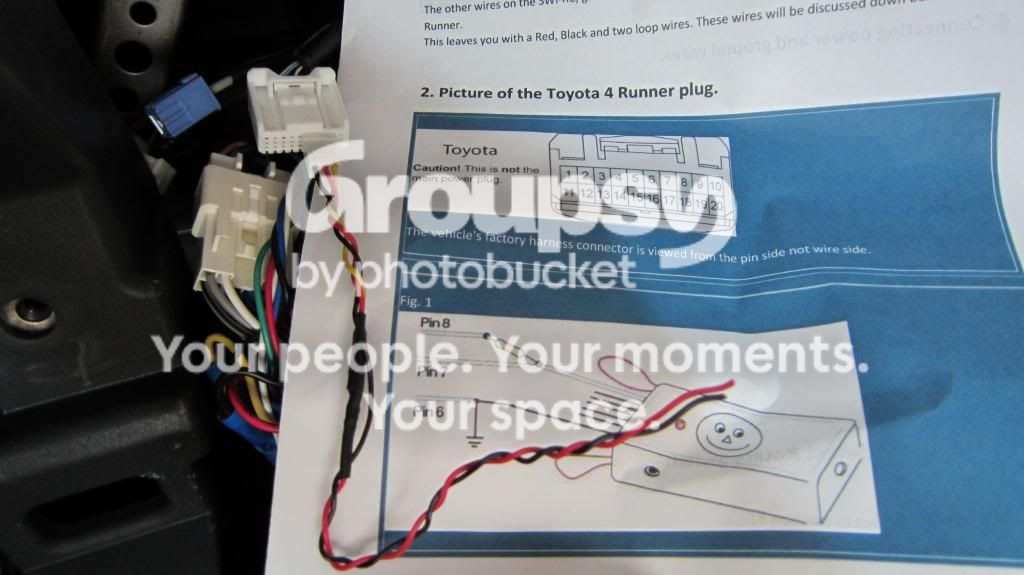
Lastly - You can use an ATX Personal Computer's 3-pin fan header to interface into the factory T4R harness for the steering wheel controls (don't need to cut that harness, and other adapters are available for Power and Speaker harnesses if needed to avoid cutting ANY stock harnesses!):

PAC SWI-RC ATX Fan Wire Trick

IMG_0610.jpg~original


Any more thread-jacking needed (any more questions?)? :bluejump:
 
Last edited:
Continued Threadjack (OK since the OP is the one requesting more jacking :) ):

"Any more thread-jacking needed (any more questions?)?" :bluejump:

Hi "Threadjacker2014" lol

I'm planning to buy an Alpine Nav HU but don't know which one to choose cuz I'm really unfamiliar with their product line-up. I like Alpine; just replaced my JL Audio four ten sub w/ four Alpine "SWR-1522D" fifteens' in an 8 cuft sealed environment. Can you recommend one of their Navigation units that has everything our 'Entune' HU has (plus steering wheel interface and harness kit)? If I don't choose Alpine I'll look into "Clarion".

Thanks! cheers
 
Hi "Threadjacker2014" lol

I'm planning to buy an Alpine Nav HU but don't know which one to choose cuz I'm really unfamiliar with their product line-up. I like Alpine; just replaced my JL Audio four ten sub w/ four Alpine "SWR-1522D" fifteens' in an 8 cuft sealed environment. Can you recommend one of their Navigation units that has everything our 'Entune' HU has (plus steering wheel interface and harness kit)? If I don't choose Alpine I'll look into "Clarion".

Thanks! cheers

Wow - Big balla' steppin' it up to FOUR 15"s!!! Nice!!! I had seven Rockford Punch 18"s back in the day in my '88 Mazda B2200 Snug-Top with the rear wall cut-out (I built the box for eight 18"s, but never had all 8 drivers installed before it got stolen from the mall in back in 1993 :( ). Love that low end!!!

The '88 Mazda B2200 system is where I had that 190 Amp Lestek Dual-output externally regulated chrome alternator I mentioned earlier, and had TWO humongous 8D batteries in the back. Oh the fun! My current T4R system is about 1/10th (or less) the size of that B2200 monstrosity, but more powerful and almost as loud!!! The my current front stage is much louder and images much better, and I probably have more actual SPL above 50Hz now! (Those 18"s were no joke in the 10-50Hz range - holy crap they would shake your guts).

To be honest, I'm not that familiar with anyone's current 2014/2015 line up (my INA-W910 is a 2012 model and is no longer made). I would simply find the biggest Alpine DVD/NAV HU that would fit in a T4R dash and see if it has all of the DSP and other features I require.

I'd have no issues running any descent Alpine DVD/NAV HU in my system. Also have some love for Clarion's upper line, but haven't personally used them in any of my installs. The higher-end Kenwood DVD/NAV HU's have been looking really nice lately (and EXPENSIVE!).

My previous '99 Tacoma install featured the venerable Sony CDX-C90 HU and XDP-4000X DSP setup - my current Alpine setup matches the SQ of that now legendary Sony setup, but adds a metric shit-ton of features, flexibility and DVD/NAV/Touch the Sony setup obviously never had. I'd never want to revert back to a single DIN HU at this point. DVD/NAV touchscreen FTW!!!

:cool:
 
Last edited:

Members online

Forum statistics

Threads
278,313
Messages
3,554,090
Members
248,016
Latest member
Advally Service

Trending content

Back
Top