A suspension question for engineers

1985taylor1925

Senior Member
My biggest complaint against the 3rd gen has always been handling, primarily the feel of the front end.

When I purchased my brand new Safari LTD steering rack last year, I had a conversation with one of their techs, in which he explained to me that the main issue with the 3rd gen steering rack is not in the rack itself, but rather in the way it is linked in the front end. Our steering racks sit behind the center line of the front tires, rather than in front. So rather that leading the tires, the rack works from the trailing end. This is what causes much of the instability in the front end. And this is easy to test. Just ride in a 4th gen 4runner, which has the same basic suspension design as the 3rd gen, except that the rack is front mounted. The 4th gen front end is far more stable regarding horizontal motion of the tires. As is the 5th gen, 2nd gen taco, 1st and 2nd gen Tundra, sequoia, fj cruiser, LC, and every other model which has a front mounted steering rack.

My front end is basically all new
- Safari LTD steering rack
- rack poly bushings
- upper/lower ball joints
- inner/outer tie rods
- sway bar bushings
- brake rotors/pads
- wheel bearings both sides
- new bilstein Taco 5100 with 99 coils (now sitting on lowest setting, just over stock height)
- tires less than a year old

Control arm bushings are the only thing I haven't replaced, and they are in great condition, no play. And Ive done a number of other things . . . i.e. the tack weld on the slip joint, replaced the steering intermediate unit, and the bushing that connects to the spline directly from the rack. And my front end still jumps around horizontally over any decent sized bump. Ive always felt that this is a dangerous condition at highway speeds. None the less I still love my 3rd gen.

Now to my question . . .

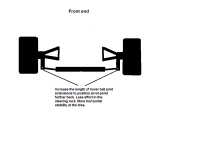
Here's my ghetto mock up of the front end.
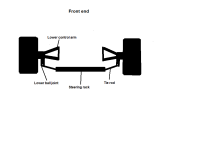
Steering.png
Steering 2.png

I don't know the technical terms (Im a scientist, not an engineer) but I understand the concept. By lengthening the lbj extension you would put less stress on the steering rack, and create a more horizontally stable front end. Its a leverage/pully effect (like putting a cheater bar on the end of a wrench to remove a bolt, allowing you use a lot less force). The biggest issue I see with this is with running 16" wheels. In that case you don't have enough space to extend that part of the ball joint because it will contact the inner wheel well. But Im running 17" wheels, and theres about a 2.5" gap between the tie rod end and inner wheel well.

I know there is a design in the geometry, such that the further you turn the steering wheel, the sharper that forward angle on the tie rod ends gets on the inside tire, which causes the inside tire to be angled further than the outside tire. And I know extending the lower ball joint would change that a little bit. But would that have any detrimental effects on the vehicle while turning?? I wouldn't think so, especially since you will be moving at very slow speed when turning that sharply anyway.

 

Attachments

  • Steering.png
    Steering.png
    8.8 KB · Views: 1,108
  • Steering 2.png
    Steering 2.png
    11.9 KB · Views: 950
Register to hide this ad
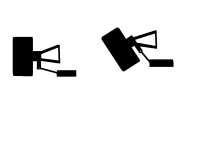
Something like this. I know my angles are probably extreme, but they illustrate what happens when you turn.


Steering 3.png


If the lower ball joint were extended toward the rear, say 1.5", to move the tie rod ends attaches point rearward 1.5", there would still be a slight forward angle on the tie rod (I looked and measured on my truck).

Anyways, that part of the lower ball joint is not the high stress area, where they commonly fail. So basically, as screw-ball as the idea might sound, I was contemplating if it would be possible to simply cut that rear section of the lower ball joint, and weld in an additional (roughly) 1.5" of steel to extend them.
 

Attachments

  • Steering 3.png
    Steering 3.png
    8.1 KB · Views: 984
You'd give up turning radius!

Very true, good point. But its a rare occasion that I find myself doing a U-turn. And I do very little true off-roading. And our 3rd gens do have a really sharp turn radius. So loosing a bit of that turn radius to gain better front end stability on the highway and on bumpy roads would be well worth it to me.
 
That would completely destroy your Ackerman angles.

In simple terms, your vehicle will become very unstable when any rack movement is introduced. And your turning radius would be ruined.

Also, very high bending loads into the steering knuckle/ball joint arm.
 
That would completely destroy your Ackerman angles.

In simple terms, your vehicle will become very unstable when any rack movement is introduced. And your turning radius would be ruined.

Also, very high bending loads into the steering knuckle/ball joint arm.

"Modern cars do not use pure Ackermann steering, partly because it ignores important dynamic and compliant effects, but the principle is sound for low-speed manoeuvres. Some race cars use reverse Ackermann geometry to compensate for the large difference in slip angle between the inner and outer front tyres while cornering at high speed."


I pulled this quote off of wiki. The source is given. Do you know if the 3rd gen has precise Ackerman? As I understand it this would mean that the lower ball joint pivot point, and tie rod pivot point (on either side) would both be in line with the center of the rear axle.

Edit: What I am proposing does not change that angle. It would change the angle of the tie rods as they would be mounted further back on the extended lower ball joints. But the tie rod pivot point would still be in line between the lower ball joint and center of the rear axle.
 
Last edited:
theoretically you could use the lower ball.joints from a tundra and move the steering rack to the front, but it would be a lot of work.
 
"Modern cars do not use pure Ackermann steering, partly because it ignores important dynamic and compliant effects, but the principle is sound for low-speed manoeuvres. Some race cars use reverse Ackermann geometry to compensate for the large difference in slip angle between the inner and outer front tyres while cornering at high speed."


I pulled this quote off of wiki. The source is given. Do you know if the 3rd gen has precise Ackerman? As I understand it this would mean that the lower ball joint pivot point, and tie rod pivot point (on either side) would both be in line with the center of the rear axle.

Edit: What I am proposing does not change that angle. It would change the angle of the tie rods as they would be mounted further back on the extended lower ball joints. But the tie rod pivot point would still be in line between the lower ball joint and center of the rear axle.
The difference between dynamic ackerman and true ackerman is if the angle is being measuring with or without accounting for tire scrub angle. I would highly doubt the 4runner uses true ackerman.

And yes, changing the steering arm length (from the wheel center to the tie rod point) WILL change your ackerman angles when turning. Look at that wiki page again and tell me in the top picture if, with longer steering arm lengths, that top picture will still intersect lines at the center of rotation? The answer is NO they wont.

theoretically you could use the lower ball.joints from a tundra and move the steering rack to the front, but it would be a lot of work.
While rearward steering arms are not as good as front steering arms on well designed systems, you definitely cannot just switch them on a suspension where all the other geometrical characteristics are built around rearward steering arms.

In addition to that, you would increase your number of steering wheel turns from lock to lock. In other words, you'd need to rotate the steering wheel more times to get the same turning effect.
The steering rack only has a certain amount of stroke, I highly doubt you can get much more stroke out of the stock one that it gives on stock geometry. He would definitely lose turning radius with no ways to get it back besides a custom steering rack setup.
 
It is very rare for "the internet" to do a better job of re-engineering something on a Toyota than the original design.
 
theoretically you could use the lower ball.joints from a tundra and move the steering rack to the front, but it would be a lot of work.

I have looked and looked at the front end trying to figure out a way to front mount the steering rack, and I don't see a way to do it, unless you did like a full front end conversion from a 4th gen, or tundra (control arms, ball joints, steering rack, everything). Which would be an absurd amount of work. Not worth the time or money to me
 
you could convert to a steering box. just coming up with possibilities, not saying they will or wont work.
 
The difference between dynamic ackerman and true ackerman is if the angle is being measuring with or without accounting for tire scrub angle. I would highly doubt the 4runner uses true ackerman.

And yes, changing the steering arm length (from the wheel center to the tie rod point) WILL change your ackerman angles when turning. Look at that wiki page again and tell me in the top picture if, with longer steering arm lengths, that top picture will still intersect lines at the center of rotation? The answer is NO they wont.

I can see that. What about extending the lower ball joint, and then moving the steering rack further back an inch?

It seems to me that to start, I would first need to know the exact angles with the oem setup. I would think if anything, with the oem setup when the rack is fully locked to one side the wheels are between parallel and ackerman, but probably very close to true ackerman.

But, to be precise, suspension lifts must also change this geometry as well. A lift would add even more angle to the inside tire a full turn, because the tie rod angle is more severe, correct?
 
I can see that. What about extending the lower ball joint, and then moving the steering rack further back an inch?

It seems to me that to start, I would first need to know the exact angles with the oem setup. I would think if anything, with the oem setup when the rack is fully locked to one side the wheels are between parallel and ackerman, but probably very close to true ackerman.

But, to be precise, suspension lifts must also change this geometry as well. A lift would add even more angle to the inside tire a full turn, because the tie rod angle is more severe, correct?

What do you mean by "extend the lower ball joint"?

Properly aligned lifts increase turning angles, creating a Toe-in situation when turning. Extending the steering arm length would reduce your turning angles, creating a toe-out situation when turning. Toe out is what causes poor vehicle stability. Most vehicles are aligned with slight toe-in and to also designed to toe-in during bump situations.
 
Last edited:
The steering rack only has a certain amount of stroke, I highly doubt you can get much more stroke out of the stock one that it gives on stock geometry. He would definitely lose turning radius with no ways to get it back besides a custom steering rack setup.

Ok, that's a fair point. Yeah, the steering stops on the LBJ arm would no longer be the limiting factor to turning radius. You would change the limits of the steering rack into the turning limits, which might be another bad thing - over-extending the steering rack.
 
For the record, NO CAR, or truck has 100% Ackerman.

Funny that you think the 3rd gen has a tight turning radius, because the rack is very limiting in that sense. All the SAS crawlers use boxes, while the sand fairies sometimes use a rack. Oh, did I say that out loud?

:humble:
 
What do you mean by "extend the lower ball joint"?

Properly aligned lifts increase turning angles, creating a Toe-in situation when turning. Extending the steering arm length would reduce your turning angles, creating a toe-out situation when turning. Toe out is what causes poor vehicle stability. Most vehicles are aligned with slight toe-in and to also designed to toe-in during bump situations.

By extending the lower ball joint I mean the same thing I was showing in the pictures - extending the length of the rear shank to move back the location at which the tie rod connects. My picture is exaggerated. There would still be a forward angle on the tie rod (from the rack to the lbj). It would still turn the inner tire at a sharper angle than the outter tire.

I know Im kind of talking in conjecture here, rather than numbers. I would have to build a working model
 
By extending the lower ball joint I mean the same thing I was showing in the pictures - extending the length of the rear shank to move back the location at which the tie rod connects. My picture is exaggerated. There would still be a forward angle on the tie rod (from the rack to the lbj). It would still turn the inner tire at a sharper angle than the outter tire.

I know Im kind of talking in conjecture here, rather than numbers. I would have to build a working model
That's steering arm length.
 
Anyway, you don't have to believe me. Im just some guy on the internet that answered the call. Give it a shot if you want, just don't say I didn't warn you.
 
"I know Im kind of talking in conjecture here, rather than numbers. I would have to build a working model"

It is too complex for a 2d drawing. If you can make an .stl file I will 3D print one.
 

Members online

Forum statistics

Threads
278,306
Messages
3,554,045
Members
248,016
Latest member
Advally Service

Trending content

Back
Top