I realize that there are a number of threads out there that discuss replacing the standard filament bulbs with led based bulbs and even a number of these threads use custom led based bulbs that the user made themself. I didn't want to hijack another user's thread with another take at the custom led bulbs, so here is my shot at it.
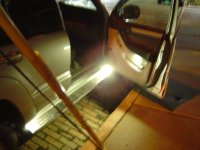
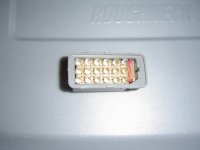
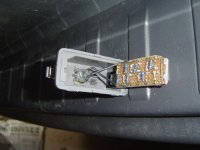
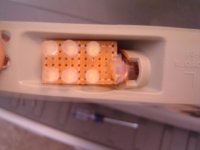
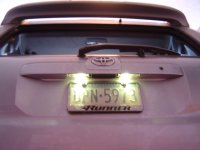
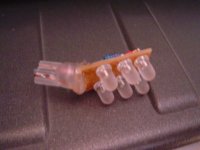
Instead of trying to cram as many leds into the small wedges purchased from autolumination, I decided to use what we had available. If you noticed when replacing the door lights and the license place lights, there is a lot of wasted space in these bulb housings. What I did was cut a perf board to fit the available area and mounted the leds to this, using the led resistance calculators found all over the web. Since I used warm white 5 mm leds, I could place 3 leds in series with a 220 Ohm resistance, which draws about 15 mA. Once the leds and resistances were mounted, I ran a positive and negative wire to one of the empty sockes and used that to replace the bulb. For the door lights, I needed to leave enough slack in the wires to be able to plug in the socket, and then *fold* the perf board in the housing. For the license plate lights, I glued the socket to the perf board at the same angle found in the housing for the license plate bulb, so this one plugs right in. Check out the pictures and I'll do my best to answer any qeustions that you have. I have also done this with my running board lights as well,but keep in mind that I added the lights to my running boards so I am not familiar with the stock running board lights.
Tom
Instead of trying to cram as many leds into the small wedges purchased from autolumination, I decided to use what we had available. If you noticed when replacing the door lights and the license place lights, there is a lot of wasted space in these bulb housings. What I did was cut a perf board to fit the available area and mounted the leds to this, using the led resistance calculators found all over the web. Since I used warm white 5 mm leds, I could place 3 leds in series with a 220 Ohm resistance, which draws about 15 mA. Once the leds and resistances were mounted, I ran a positive and negative wire to one of the empty sockes and used that to replace the bulb. For the door lights, I needed to leave enough slack in the wires to be able to plug in the socket, and then *fold* the perf board in the housing. For the license plate lights, I glued the socket to the perf board at the same angle found in the housing for the license plate bulb, so this one plugs right in. Check out the pictures and I'll do my best to answer any qeustions that you have. I have also done this with my running board lights as well,but keep in mind that I added the lights to my running boards so I am not familiar with the stock running board lights.
Tom