This was my thought as I read this. I'm surprised that 1E didn't bring this up, but admittedly, I know zip-$h!t about the subject.
Seems to me that without a control, these values are, um, valueless.
So, if "the molybdenum was 576", what use can I derive from that if I don't know the molybdenum content of the stock oil?
Can someone 'splain?
"....I have changed my oil every 10K per manual (Toyota engineers know much more about their engines than me so I listen) and I have no issues with anyone getting "piece of mind" by doing it sooner."
Being a Comm'l H.V.A.C. tech for the last 25 yrs, and an Auto Mechanic just prior to that, hasn't helped me one bit wrt the idea of neglecting my obligatory responsibility of changing my truck's oil every 2500 miles.
Now, I just bought my 2nd 4Runner on April 21'st of this yr; my 1'st was a '98 SR5. It now has 2,500 miles on the clock. I always believed that, on a New Engine, you needed to change the oil @ 1,000 miles; during break-in due to the excessive metallic particles in the oil.
And truthfully, I'm a little concerned about not changing the oil...like tomorrow!
Is it really ok to wait until the truck reaches 10,000 miles before dropping the oil?; that's unthinkable. Getting Nervous :wow:
rigtec, Cheers
Wow, you only have 2500 miles? I bought mine on April 21st too and I have 18,000 miles already.
Do you feel comfortable changing the oil at the recommended interval; 10,000 miles???
Have you considered getting a job closer to your house? lol!
I am an inspector and service technician of certain equipment used in hospitals and surgery centers. I have to go to where the days work is located, sometimes it is nearby, but usually it is not.
This whole engine oil analysis stuff is a complete waste of time and $.I'm still trying to figure out what this test actually tells you beside wear indication.
My big question is what happens is you see excessive levels of any metal??
This whole engine oil analysis stuff is a complete waste of time and $.
I'm still trying to figure out what this test actually tells you beside wear indication.
My big question is what happens is you see excessive levels of any metal??
Blackstone and the folks at Bob is the Oil Guy have a lot of documentation on this. It tells you a great deal about how your oil, your engine, and and your fuel interact.
For instance:
1. If silicon is detected in the oil, you probably have either a vacuum leak somewhere or your air filter isn't seated right. You'll see higher levels of wear in other metals too, since silicon particles are abrasive.
Result: You realize there is an issue with a loose vacuum hose or your filters before it can increase long-term wear in your engine.
2. If a lot of sulphur is detected, you might be running fuel with enough impurities in it to overwhelm the protection package in the oil you're using. Since compounds of sulphur tend to be corrosive, you'll either want to evaluate a different fuel or shorten the OCI. LPG and CNG engines get this, as do some types of diesel engines. Some gasolines also have higher sulphur content.
Result: longer engine life
3. The total base number is lower than expected. You're either running the oil in question too long, too hot, or you have blowby that's causing fuel to accumulate in the oil, thinning it.
Result: Now you can talk about perhaps switching to a thicker oil.

And scientific analysis beats bro-science any time.
Think harder.
Since the 4Runner was new I decided to change the oil at 2000 miles and will change again at 5000 miles. The first 5000 miles will be where most of the wear occurs. After the 5000 mile oil change I will change again at 10,000 and see how it looks.
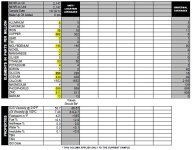
As you can see from the Blackstone Lab report it shows a lot of wear metal as to be expected. Which is the main reason I changed it at 2000 miles.