Cooper Discoverer STT LT265/70R17 recommended tire pressure?

amt006

New member
Hi all.

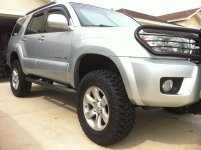
Just replaced my Nitto Terra Grapplers P265/70R17. Got almost 30k out of them. Since the Nittos didn't wear so well I when with the Cooper Discoverer STT LT265/70R17. What psi are you all running these at? I ran the Nittos at 35 psi but the Coopers are Light Truck E rated and the Nittos where Passanger C rated the old psi isn't right.

Aaron

PS

Will load pictures once I get home. Since I can't load these from my iPhone.
 
Register to hide this ad
for daily driving, E load should be run slightly higher than 35, i dont have coopers but i keep mine at 43-45.
 
Every tire is different. You should check YOUR tires sidewall. We can give you opinions and what we run, when what you need is what the manufacturer has tested and certified the tire at.
 
Yes its a DD. I called Cooper and they said 35 PSI. Which is what they were at on the way home and they seemed very floaty. I was doing the math for what the load for a P265/65R17 stock tires at 32 PSI and what the required PSI for the P265/70R17 for the same load which turned out to be 35 PSI. I then did the same thing for my new tires which is turning out to be about 53 PSI which seems really high.

Also here is the picture.
 

Attachments

  • Cooper Discoverer STT.jpg
    Cooper Discoverer STT.jpg
    132.9 KB · Views: 19,986
I was doing the math for what the load for a P265/65R17 stock tires at 32 PSI and what the required PSI for the P265/70R17 for the same load which turned out to be 35 PSI. I then did the same thing for my new tires which is turning out to be about 53 PSI which seems really high.

Nice looking tires.

The math should have put you around 44psi if I'm following what you did.

Adding 10-15lbs over door sticker pressure when switching same size from P to LT is a nice simple rule that works really well without having to consult load tables.
 
Last edited:
So I bumped the tire pressure up to 45 psi and it sure felt like I was running on the center of the tires. So I did the chalk test. This it when you color in all the treads across the tire and drived about 15 or so feet and check where the chalk wore off. Well as I had suspected. It was gone in the center of the tire. I keep lowing the tire pressure by 2 psi until I got an even wear across the chalk on the treads. It ended up being 35 psi. I am going to keep a close eye in the tires but they sure feel better now.

Aaron
 
Last edited:
Hi all update on tire pressure.

After driving a few days I started bumping up the tire pressure by 5 PSI every few days. It seems the tires had to break in a little. After a few hundred miles and consulting the Tire and Rims Load charts I am running 55Psi front and back. The tires feel good not floaty or sluggish. I have never had a tire that had to broken in then again I have never bought a Light Truck E rated 10 Ply tire before always had P rated tires.

Aaron
 
Thank you for the compliment. I really like the tires. They are not too load. My worn Nittos where loader. At highway speed I can hear them with the windows up and radio on. They don't bother me though it's a big lug truck tire and much quieter than other mud tires I have heard.

Aaron
 
Good deal. I'm most likely going with the the same tires (running a 3/2 lift and spidertrax). I've heard you can spray the underside of the fenders with undercoating and it'll reduce noise. I really want these tires but don't want to give up a smooth/quite ride. Thanks for the info!
 
Every tire is different. You should check YOUR tires sidewall. We can give you opinions and what we run, when what you need is what the manufacturer has tested and certified the tire at.

WRONG.

Sidewall is MAX pressure. Not safe to always run max pressure.

Manufacturer tested and certified pressure (in the door sill) is only valid on stock size and weight rated tires. Once you change it, you need to find the new pressure yourself.
 
Going a little over the tire pressure on the sticker on the door is fine...But going to max or 10-15lbs over and you could be compromising handling.
 
The recommended tire pressure is for the OEM tire size and type. When you keep the same size tire and just go from P-rated to LT tires you will have to increase the tire pressure to maintain the correct axle load rating which is specified on the sticker on the driver-side door sill. When you up size or down size your tires the car manufacture's recommended tire pressure will be invalid but the axle load rating will still be correct. You will either have to contact the tire manufacture and/or refer to the Tire and Rim Association year book for the correct tire inflation pressure for the recommended load for a given tire size and type. I fist called Cooper Tire and they recommended a tire pressure between 40 to 55 PSI. Later I have a friend look up the recommended tire pressure for this tire and my axle load and he came up with around 55PSI give or take a few Lbs. I am very happy with the way these tires are handling in wet and dry conditions here in Florida at 55PSI.

Aaron
 
Last edited:
55psi...Sorry...No way....Tell me how they are in 10k miles..and how much they are wearing out in the middle.

I have Cooper Discover LT tires on my truck....And the recommend tire pressure is 32psi.

The axle load rating is the MAX load a tire can handle. Each tire will have a MAX tire pressure PLUS the load that the tire can handle...So it may read 55psi @ 2500lbs. That means if you have 2500lbs on this axle then the proper psi should be 55. Last I checked the 4runner doesn't weigh 10,000lbs.

To calculate the proper psi....

First get the vehicles weight...then add a few hundred pounds for passengers and "stuff". That'll bring it up to about 5200lbs. Then divide by 4. That'll bring the axle weight to 1300lbs.

Let's say the new tires are 55psi @2000 lbs. Take the 1300 and divide by 2000. That equals .65.

Multiply the 55 x .65 and that equals 35.75....Maybe add a couple of psi for good measure.
 
55psi...Sorry...No way....

I have Cooper Discover LT tires on my truck....And the recommend tire pressure is 32psi.

The high psi numbers come from the idea of maintaining the load reserve of the stock passenger (P) tires at door sticker pressure. LT tires require much more air pressure to carry the same load as Ps of the same dimensions.

Comparing against the load capacity of the stock tires when de-rated because of their application in an SUV produces a psi of 44 for the new switched out LT. Using the load capacity, not de-rated, produces 49psi. Some instructions say to round up to the nearest 5psi increment which produces 45 and 50, respectively. Load tables can differ slightly from each other, so allowing for that and then factoring in the 5psi rounding is presumably where 55psi comes from.

SInce the stock load reserve is very generous, LT load reserve can be maintained on paper with pressures less than the above, but since speed ratings also take a hit on the tire switch, it doesn't seem like a great idea to stray too far from the above adjustments. 32 psi is pushing it, imo. That's the equivalent of about 20psi in the stock tire.
 
Last edited:
******Edited******More info supporting my stance on tire pressure for LT265/70R17 tires which also supports JB's reply while I was typing up this reply*****

Okay I did some more research and this is what I have come up with. Toyota recommends the stock tires to be ran at 32PSI. I looked up the P265/65R17 tire in the Tire and Rim Association(TRA) year book to locate the load of this tire which is 2337Lbs at 32PSI. Now since this is a passenger tire being installed on a light truck the tire load has to be reduced by 1.10 so this brings the load down to 2125Lbs @ 32PSI. The tires I had on my truck before where P265/70R17 Nittos and ran at 34PSI. Nitto recommended this PSI for my truck. Just to verifiry I look these tires up in the TRA year book which states they should be ran at 34PSI. I replaced these P265/70R17 tires with LT265/70R17 I looked them up and for the load of 2125 these tires 50PSI. The TRA year book is the standard for the tire industry. Now each brand of tire with differ a little. I have been keeping a close eye on my tires and 55PSI is about right. When I was running these tires at 35PSI I started to show wear on the about 1/4 of and inch on the side lugs of the tires. If I ran these tires at 35PSI the load would be 1770Lbs which isn't what Toyota recommends for even the OEM tires which will increase side wall temperatures which tends to lead to side wall fatigue. The side wall fatigue could lead to a blow out.

Recap
Stock tire. P265/65R17@32PSI
2337Lbs reduce by 1.10 = 2125Lbs @ 32PSI

Up sized tire. P265/70R17@35PSI
2337Lbs reduce by 1.10 = 2125Lbs @ 35PSI

Up sized LT tire. LT265/70R17@50PSI
2125Lbs @ 50PSI
2337Lbs @ 55PSI

Aaron
 
Last edited:
year book to locate the load of this tire which is 2337Lbs at 32PSI.


What you're saying is that the truck weighs 9,348lbs (2337 x 4).

The load of the vehicle is CONSTANT...It does NOT change when you change the tires...

When a tires MAX rating says 55psi @ 2500lbs...it means that this tire will have a MAX load carrying capacity of 2500lbs with the tires properly inflated at 55psi. You then have to know the load rating of your vehicle. This is a fairly static number. It can only change if you add weight to the vehicle (i.e more passengers, towing...etc).

Your first set is rated at 50psi @2125lbs....With a vehicle load rate of 1300lbs per axle that means the tire pressure should be about 30psi...Add a couple of psi for good measure and it brings it up to 32psi (which is about right).

If I ran these tires at 35PSI the load would be 1770Lbs

The load is NOT changing...it'll still be 1300lbs...What happens is because the pressure exceeds the load that is being exerted...the tires will may not handle as well as they were designed to. Auto manufacturers tend to keep their pressure on the low side for a softer ride. So you can add a few lbs to their recommended psi.
 
Correct the load of the vehicle is constant. Mike thank you for pointing out my error. What I should have said is at 35PSI the max recommended load for a LT265/70R17 tire is 1770Lbs.

To ensure you are running the proper tire pressure one needs to know what their vehicle load rating is. When changing tire sizes and/or type tires the tire should be inflated to the proper tire pressure that will support the vehicles load rating. If tires are ran below recommended pressure the tires will not be able support the max load safely. Also at this under pressure tire performance and handling are compromised. Same is true for running tires over pressure. Some manufactures like VW will give different recommended tire pressure for different situations like half load above or below 100M/hr and full load above or below 100M/hr.

Aaron
 
Last edited:
I looked up the P265/65R17 tire....

I've run 265/70/17 for so long I tend to forget the above is the stock size. Not real important, but for the record it slightly reduces the LT PSIs I quoted on the previous page.
 
Last edited:

Members online

Forum statistics

Threads
278,316
Messages
3,554,120
Members
248,016
Latest member
Advally Service

Trending content

Back
Top