EasyAndy's MPG Analysis (winter gas redux)

1engineer

Moderator
Why am I starting another gas mileage thread you ask. I know but hopefully this will help some of the members that would just rather either complain or post "my mpg thingie says 17 mpg" or such nonsense.

This is a bit different. Andy, also an engineer, posted here http://www.toyota-4runner.org/5th-gen-t4rs/160015-4runner-trd-pro-173.html#post1881836 that his data was not equating to the "'ol summer-winter fuel blend mpg blues."
Now the conversation that started this was here http://www.toyota-4runner.org/5th-gen-t4rs/160015-4runner-trd-pro-168.html and several took offense (so what else is new) to my post on winter gas. People like [MENTION=117561]drsus[/MENTION] and [MENTION=117527]SLAYER[/MENTION] and [MENTION=24218]Doc[/MENTION] Fry apparently were not pleased with their truck's efficiency yet when I tried to explain they focused more on words than the actual content. Anyway, here http://www.toyota-4runner.org/5th-gen-t4rs/160015-4runner-trd-pro-171.html#post1881007 I told [MENTION=117561]drsus[/MENTION] to give me hard data and I would take a look at it. I have not heard from him but Andy stepped up and sent me his data in .xls format. BTW Andy that is an excellent program to track your mpg!

Now back to why I am posting yet another mpg thread:
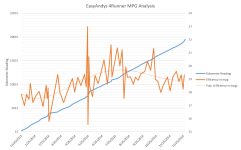
Andy's case is very typical and as you will see his data is for one year, starting at basically zero miles and driving around 20K miles in that one year with a stock 4Runner. I went back and re calculated his numbers (because I am an engineer and we do that) to make sure the data was correct. I then plotted the MPG on the secondary Y axis, odometer reading on the Y axis all over time on the X axis. I then added a polynomial trend line in the 4th order to show a smoothed trend.

The results are typical of most vehicles as you will see. He started out with a new vehicle in the winter, broke it in and rode it during the summer and the chart finishes in the winter. He went from around 17.5 mpg during the first winter break in up close to 20 mpg during the summer and is currently in a decline down around 19 this winter. I expect it to decline further (down to maybe 18 mpg) around Feb-Mar, bottom out and then steadily increase throughout the summer months. This would give it around 10% difference between winter and summer.

Now, I have no knowledge of Andy's driving habits but from the chart I would say he is a pretty typical driver. There are a few anomalies here and there but those outliers are typical of anyone's driving over a period of time.

For those of you that are new to the concept of winter gas, altitude and cold weather driving here are some links to read to help you out here Summer-Blend vs Winter-Blend Gasoline: What’s the Difference? - Popular Mechanics and here http://www.toyota-4runner.org/5th-gen-t4rs/133786-cold-air-horsepower.html. Anyway, here is the chart and I hope it helps:
 

Attachments

  • 4Runner MPG.png
    4Runner MPG.png
    109.9 KB · Views: 698
Register to hide this ad
Spot on master of mathematics! I figured I lose about 10-15% of my hyper-efficient setup in the winter crap gas months. However, with lower cost of fuel, it doesn't bother me one iota! Oh, you probably have guessed I care deeply what my mpg is!
 
Have you accounted for decreasing rolling resistance of the tires as the tread wears down? More time spent in 4HI in the winter? Additional wheel spin starting from a dead stop during winter? More time idling to warm the vehicle up during winter? Extra wind resistance from driving with the windows open during the summer?

(you know I had to do it Greg)
 
Just wanted to say cheers to creating a separate thread!

Seems like it's getting to the point where the entire forum can operate within the TRD Pro thread. Ha!
 
Now that I have that post out of the way I need to say a few things.

I don't do this crap to "feed my ego" or for "self importance" or anything else. I do it because there are some really nice guys who have questions and sometimes I can give some unique insight into their issues. [MENTION=47340]Titanpat57[/MENTION] told me to quit helping some of you because you are insolent spoiled brats that couldn't find your own ass with both hands (my words not his) and wouldn't understand anyway. I would name you (but that would get me banned, which wouldn't be a bad thing) but you know who you are so it's all good. People like [MENTION=101966]Omar RVA[/MENTION] here http://www.toyota-4runner.org/gener...ransmission-current-4runners.html#post1882395 put together great posts that help a lot of you, including me, out. So all those whiners (again, you know who you are) can either get with the program or just STFU and put me on your ignore list. 1engineer out.
 
Awesome write up 1Engineer, interesting to see the polynomial trend line and how/when the decrease happens. I will keep tracking and provide you with the data again next year. I plan to change the wheels and tires at some point after this winter so it will be interesting to see how that truly affects everything.

For anyone who wants to track their own mileage, and has an Android phone, the name of the app is Acar. I use it mainly for financial purposes, but it does basically track anything related to MPG and expenses. One interesting/sickening tidbit of information from the app is that I have basically paid $85.16 a day since I bought the car. That includes down payment, trade in value, payments, gas cost, car washes, insurance, plastidip, ect... Looking forward to this going down in the coming years.

Thanks again 1Engineer
 
Last edited:
Why am I starting another gas mileage thread you ask. I know but hopefully this will help some of the members that would just rather either complain or post "my mpg thingie says 17 mpg" or such nonsense.

This is a bit different. Andy, also an engineer, posted here http://www.toyota-4runner.org/5th-gen-t4rs/160015-4runner-trd-pro-173.html#post1881836 that his data was not equating to the "'ol summer-winter fuel blend mpg blues."
Now the conversation that started this was here http://www.toyota-4runner.org/5th-gen-t4rs/160015-4runner-trd-pro-168.html and several took offense (so what else is new) to my post on winter gas. People like [MENTION=117561]drsus[/MENTION] and [MENTION=117527]SLAYER[/MENTION] and [MENTION=24218]Doc[/MENTION] Fry apparently were not pleased with their truck's efficiency yet when I tried to explain they focused more on words than the actual content. Anyway, here http://www.toyota-4runner.org/5th-gen-t4rs/160015-4runner-trd-pro-171.html#post1881007 I told [MENTION=117561]drsus[/MENTION] to give me hard data and I would take a look at it. I have not heard from him but Andy stepped up and sent me his data in .xls format. BTW Andy that is an excellent program to track your mpg!

Now back to why I am posting yet another mpg thread:
Andy's case is very typical and as you will see his data is for one year, starting at basically zero miles and driving around 20K miles in that one year with a stock 4Runner. I went back and re calculated his numbers (because I am an engineer and we do that) to make sure the data was correct. I then plotted the MPG on the secondary Y axis, odometer reading on the Y axis all over time on the X axis. I then added a polynomial trend line in the 4th order to show a smoothed trend.

The results are typical of most vehicles as you will see. He started out with a new vehicle in the winter, broke it in and rode it during the summer and the chart finishes in the winter. He went from around 17.5 mpg during the first winter break in up close to 20 mpg during the summer and is currently in a decline down around 19 this winter. I expect it to decline further (down to maybe 18 mpg) around Feb-Mar, bottom out and then steadily increase throughout the summer months. This would give it around 10% difference between winter and summer.

Now, I have no knowledge of Andy's driving habits but from the chart I would say he is a pretty typical driver. There are a few anomalies here and there but those outliers are typical of anyone's driving over a period of time.

For those of you that are new to the concept of winter gas, altitude and cold weather driving here are some links to read to help you out here Summer-Blend vs Winter-Blend Gasoline: What’s the Difference? - Popular Mechanics and here http://www.toyota-4runner.org/5th-gen-t4rs/133786-cold-air-horsepower.html. Anyway, here is the chart and I hope it helps:

Still gotta get jabs in huh? Saying how we focus on words more than content?

I said I learned from your posts and was just stating how you introduced the topic as it was something I should have known rather than say "hey dude, check this out" ...so your people skills seems to not be the best in how you present something that is new to us.

Again, you can say you have posted about winter gas numerous times....but if somebody did not know to look for that since they never heard of it, then it does not go far. May as well yell or bash that person I suppose and that will make him know about it. Well now I know about it, so you succeeded!!!

Glad you got your 2 cent jab at us again if it makes you feel better.
 
we don't need no stinkin chart :) to tell me when I remote start my cold a$$ -15F ambient temp truck for 15-20 minutes so I don't freeze my body parts not in contact with my seat heaters gas efficiency.

its the cost of doing business when you use that magic remote start :)

and btw, plug for drone mobile. love it that I can remote start no matter the distance or interference from building now :)
 
Why am I starting another gas mileage thread you ask. I know but hopefully this will help some of the members that would just rather either complain or post "my mpg thingie says 17 mpg" or such nonsense.

This is a bit different. Andy, also an engineer, posted here http://www.toyota-4runner.org/5th-gen-t4rs/160015-4runner-trd-pro-173.html#post1881836 that his data was not equating to the "'ol summer-winter fuel blend mpg blues."
Now the conversation that started this was here http://www.toyota-4runner.org/5th-gen-t4rs/160015-4runner-trd-pro-168.html and several took offense (so what else is new) to my post on winter gas. People like [MENTION=117561]drsus[/MENTION] and [MENTION=117527]SLAYER[/MENTION] and [MENTION=24218]Doc[/MENTION] Fry apparently were not pleased with their truck's efficiency yet when I tried to explain they focused more on words than the actual content. Anyway, here http://www.toyota-4runner.org/5th-gen-t4rs/160015-4runner-trd-pro-171.html#post1881007 I told [MENTION=117561]drsus[/MENTION] to give me hard data and I would take a look at it. I have not heard from him but Andy stepped up and sent me his data in .xls format. BTW Andy that is an excellent program to track your mpg!

Now back to why I am posting yet another mpg thread:
Andy's case is very typical and as you will see his data is for one year, starting at basically zero miles and driving around 20K miles in that one year with a stock 4Runner. I went back and re calculated his numbers (because I am an engineer and we do that) to make sure the data was correct. I then plotted the MPG on the secondary Y axis, odometer reading on the Y axis all over time on the X axis. I then added a polynomial trend line in the 4th order to show a smoothed trend.

The results are typical of most vehicles as you will see. He started out with a new vehicle in the winter, broke it in and rode it during the summer and the chart finishes in the winter. He went from around 17.5 mpg during the first winter break in up close to 20 mpg during the summer and is currently in a decline down around 19 this winter. I expect it to decline further (down to maybe 18 mpg) around Feb-Mar, bottom out and then steadily increase throughout the summer months. This would give it around 10% difference between winter and summer.

Now, I have no knowledge of Andy's driving habits but from the chart I would say he is a pretty typical driver. There are a few anomalies here and there but those outliers are typical of anyone's driving over a period of time.

For those of you that are new to the concept of winter gas, altitude and cold weather driving here are some links to read to help you out here Summer-Blend vs Winter-Blend Gasoline: What’s the Difference? - Popular Mechanics and here http://www.toyota-4runner.org/5th-gen-t4rs/133786-cold-air-horsepower.html. Anyway, here is the chart and I hope it helps:

I didnt take offense to it, It simply didn't make sense to me since I was under the impression that SoCal didn't get winter blends... Now I know, thanks to you, that we do. And my argument wasn't so much about winter blend affecting gas mileage as much as mine not been affected throughout the year... For whatever reason, I'm not the engineer here. Every car I've owned has had very consistent mpg numbers through the seasons (if you can call what we get in Los angeles "seasons"). I happen to pay attention to this things on my cars so it serves the purpose on this threads.

The argument did turn to winter blends in CA with me, but my actual argument, again, is that if my previous vehicles haven't been affected, then it's only logical to assume my new one won't be affected either. so what my mpg numbers are now probably won't get much better after break in. By that I mean, I don't expect to gain 5mpg on this truck once I am on summer blend and the engine is broken in. If I'm making wrong assumptions, I am all ears of course! that would mean good news for me, better mpg down the road.
Realistically I'm expecting maybe 17mpg on my truck by the time it's all said and done. Am I way off here?

As far as "hard data" what would do? You're taling to a non engineer here so.... Other than me resetting my trip ODO at every tank and noticing what I get out of every tank and making sure I am getting the usual range (obviously taking into account unusual driving conditions in particular tank loads), what would constitute a better method? This is the time, I hbe a truck with 1000 miles in the winter so it's prime for this experiment
 
Last edited:
and for something completely off topic, don't forget to add some -35F windshield wiper fluid to dilute your summer bug removal fluid.

stupid me forgot and now my whole setup is frozen. hoping adding in some -35F fluid will help liquefy the frozen summer blend.

/off topic
 
I didnt take offense to it, It simply didn't make sense to me since I was under the impression that SoCal didn't get winter blends... Now I know, thanks to you, that we do. And my argument wasn't so much about winter blend affecting gas mileage as much as mine not been affected throughout the year... For whatever reason, I'm not the engineer here. Every car I've owned has had very consistent mpg numbers through the seasons (if you can call what we get in Los angeles "seasons"). I happen to pay attention to this things on my cars so it serves the purpose on this threads.

The argument did turn to winter blends in CA with me, but my actual argument, again, is that if my previous vehicles haven't been affected, then it's only logical to assume my new one won't be affected either. so what my mpg numbers are now probably won't get much better after break in. By that I mean, I don't expect to gain 5mpg on this truck once I am on summer blend and the engine is broken in. If I'm making wrong assumptions, I am all ears of course! that would mean good news for me, better mpg down the road.
Realistically I'm expecting maybe 17mpg on my truck by the time it's all said and done. Am I way off here?

As far as "hard data" what would do? You're taling to a non engineer here so.... Other than me resetting my trip ODO at every tank and noticing what I get out of every tank and making sure I am getting the usual range (obviously taking into account unusual driving conditions in particular tank loads), what would constitute a better method? This is the time, I hbe a truck with 1000 miles in the winter so it's prime for this experiment

You need to document three basic things:
1. Odometer reading at every fill up
2. Gallons purchased at every fill up
3. Date of fill up

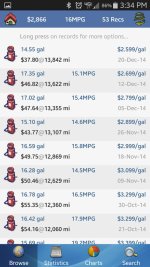
I just use my notepad app on the phone and enter it later into Excel. There are several specific app you can use that will do the same but I like manipulating my own data. You are correct now is the perfect time to do this.
 
or be lazy and use an app on your phone :)

.
 

Attachments

  • Screenshot_2014-12-30-15-34-34.jpg
    Screenshot_2014-12-30-15-34-34.jpg
    66.9 KB · Views: 611
Last edited:
Laptop

Now back on topic.


touch screen FTW :)


anyway, I expect my mpg to take a complete nosedive on my current tank. I have been using the remote start the last two days since it was -13F yesterday and -9F today ambient (-35F wind chill).

now if it was in the 10's or 20's I wouldn't use it, too dam warm :)
 
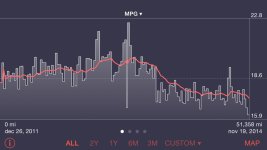
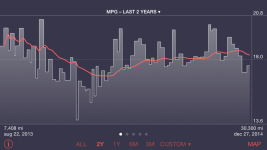
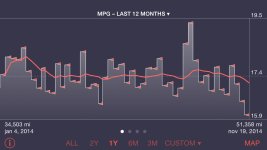
For the last 16 months. I have not had a big hit this winter so far on gas as I broke my knee cap and the truck has been mostly sitting in the garage...

Last spring I changed from 275/55/20 MS2's to 265/70/17 AT3's and reflects in a little lower MPG this summer and fall.
 

Attachments

  • IMG_6451.PNG
    IMG_6451.PNG
    86 KB · Views: 290

Members online

Forum statistics

Threads
278,314
Messages
3,554,096
Members
248,016
Latest member
Advally Service

Trending content

Back
Top