
You are using an out of date browser. It may not display this or other websites correctly.
You should upgrade or use an alternative browser.
You should upgrade or use an alternative browser.
Getting more current from your stock alternator at idle
- Thread starter rigtec
- Start date

Hi A team,
Just the other day, one of our community members had a question and it was an EXCELLENT ONE! He was trying to determine if one of his new accessories was defective or if his new 4Runner was having trouble supplying enough voltage/amperage to feed it properly. Well, as far as I know the jury is still out on that conclusion. But my position is that sometimes the problem isn't that our 130A Denso (small case) hairpin alternator isn't capable of supplying enough current to your accessories. Sometimes the trouble exists because our alternators are not able to supply enough current... 'at curbside idle!
"Well rigtec, what are we supposed to do... go out and spend $800 bucks and buy a Huge output alternator like you did; money don't grow on trees you know..." lol! No, not at all tech-team! What you can do about not having enough current to run certain accessories when idling is simply change the alternator's idle speed by manipulating the Crankshaft to alternator pulley ratio. Here's how that works: Your 5'th gen 4Runner employs a 6 inch crankshaft pulley (w/6 or 7 grooves) which turns everything from your water pump to your power steering pump...etc! Now your alt pulley IIRC is about three inches +/- .5 inches.
That gives a 2 to 1 alt ratio e.g., so if your engine/crankshaft turns at say: 800 RPM, then your alternator pulley is turning at 1600 RPM; which gives a 2 to 1 ratio. But that can be changed within a nominally margined upgrade. If you install a 2 inch +/- alt pulley and the crank spins at 800 RPM then the alt pulley will turn at 2400 RPM at idle; which yields a 3 to 1 spin ratio. It's not a matter of needing more alternator output; 130A may be plenty for your basic needs. It's just a matter of when you need to use it, which in this case, you need to be there while at idle, like for sitting still with the engine running and watching the tv or trying to chill a six-pack!
The only caution I guess would be a marginal amount of extra wear and tear when revving the engine at high rpms, like when doing 65-70 mph, the rpm may be up to 4,000 rpm; which means the alt will turn at 12,000 rpm, so the bearings and brushes life span will suffer, but like they say: "There's no free lunch"! Here are a few articles that I pulled from my library for your reference; they're very good reading info; especially in the bathroom!:
Here's another article to hold on to just FYI!
Listen folks, I realize that I put a lot of information here, but I tend to post threads here that no one else has posted about with any intensive, peripheral, theoretical detail and my threads address issues that are highly relevant to your subjects of concern on these forums! I never intended for you to read all of this stuff at one time (lol), just print the ones you are interested in and put them aside for another time. I say it's relevant because this is a truck modification advisory forum and does involve about 55-60% of electrical T/S that we provide here, so I just want you to be somewhat informed about the mods that you're interested in 'BEFORE' your desperate cry for help, hahaha!
Oh... Here's a documented video of an alternator that's dishing out 75% of it's full load capacity; it really doesn't matter how many amperes that it's capable of, but it's pulley size/ratio is determining it's curbside idle percentage output... your's will do the same thing (just not the same amount of current) wrt it's ratio! Hope you enjoy the read An alternator putting out 75% of it's full load at idle
rig


This is an interesting study. I’m having a hard time believing that increasing the alternator’s drive speed by 50% wouldn’t cause a dramatic failure. Changing from a 2:1 to a 3:1 drive ratio means your alternator is changing from ~12,000 rpm to 18,000 rpm max speed. Beyond the severe increase in bearing stress it is likely the other internal components are not designed for the resulting centripetal force.
Centripetal Force can be calculated as mass*angular velocity squared* radius. Mass and radius are constant. So, the change from 12,000 to 18,000 RPM means an increase of 2.25x the force. That’s pushing the ~2:1 - 3:1 factor of safety most non life/safety dependent systems are designed with.
Seems like, for the trouble, swapping for a higher capacity alternator makes a lot more sense.
SO now what?
Thanks for all of your insight RIG...very informative.
BUT, if I read this correctly, what is the owner of a 2017 or newer to do?
Apparently our ECU thinks it knows better than we do about voltage/Amperage requirements...
A BCDC 1225 charger is a work around for those with both a LEAD ACID and an AGM battery...but we are still stuck with a puny 130A alternator...
What options do we have have to up the amps to 270?
I thought about the pulley change but, I am running 4.88's and 70mph is already 2600 rpm ish. Any more and the bearings will be screaming for mercy..
Any and all options will be welcomed!
AMLOR
Thanks for all of your insight RIG...very informative.
BUT, if I read this correctly, what is the owner of a 2017 or newer to do?
Apparently our ECU thinks it knows better than we do about voltage/Amperage requirements...
A BCDC 1225 charger is a work around for those with both a LEAD ACID and an AGM battery...but we are still stuck with a puny 130A alternator...
What options do we have have to up the amps to 270?
I thought about the pulley change but, I am running 4.88's and 70mph is already 2600 rpm ish. Any more and the bearings will be screaming for mercy..
Any and all options will be welcomed!
AMLOR
SirWilliamGoes
New member
Wow I just switched a fuse and my alternator been charging at 13.9-14.5 for past year now!!
Sent from my iPhone using Tapatalk
Sent from my iPhone using Tapatalk
Wow I just switched a fuse and my alternator been charging at 13.9-14.5 for past year now!!
Sent from my iPhone using Tapatalk
william...would that "fuse" be the "GM DIODE" Rigtec was referring to ???
If so can you please share which fuse you replaced to trick the alternator?
Thanks!
AMLOR
SirWilliamGoes
New member
william...would that "fuse" be the "GM DIODE" Rigtec was referring to ???
If so can you please share which fuse you replaced to trick the alternator?
Thanks!
AMLOR
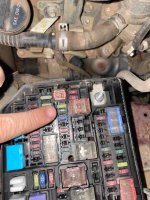
Yes that’s it. Looks like alt-s this one in pic
Sent from my iPhone using Tapatalk
Attachments

Yes that’s it. Looks like alt-s this one in picView attachment 382398
Sent from my iPhone using Tapatalk
Thank you sir!!
ALT-S fuse replaced and running a steady 14.0-14.2V
AMLOR
2021nightshade4x4
New member
This is an interesting study. I’m having a hard time believing that increasing the alternator’s drive speed by 50% wouldn’t cause a dramatic failure. Changing from a 2:1 to a 3:1 drive ratio means your alternator is changing from ~12,000 rpm to 18,000 rpm max speed. Beyond the severe increase in bearing stress it is likely the other internal components are not designed for the resulting centripetal force.
Centripetal Force can be calculated as mass*angular velocity squared* radius. Mass and radius are constant. So, the change from 12,000 to 18,000 RPM means an increase of 2.25x the force. That’s pushing the ~2:1 - 3:1 factor of safety most non life/safety dependent systems are designed with.
Seems like, for the trouble, swapping for a higher capacity alternator makes a lot more sense.
Why is it hard to believe that it would fail? What do you think happens cruising 2k RPM vs 3k RPM? A 50% increase in rotational speed!
Sent from my iPhone using Tapatalk
BUT, if I read this correctly, what is the owner of a 2017 or newer to do?
Apparently our ECU thinks it knows better than we do about voltage/Amperage requirements...
A BCDC 1225 charger is a work around for those with both a LEAD ACID and an AGM battery...but we are still stuck with a puny 130A alternator...
What options do we have have to up the amps to 270?
Any and all options will be welcomed!
AMLOR
[MENTION=420040]AMLOR[/MENTION] did you get get an uprated alternator, or otherwise solve the 130A alternator problem?
[MENTION=420040]AMLOR[/MENTION] did you get get an uprated alternator, or otherwise solve the 130A alternator problem?
Well, sort of.... the 270A alternator is on my list of cool stuff to do to the 4R, but not as of yet.
Currently running the "GM diode" trick on my 2019 with acceptable results.
Output is 14.2-14.5v on cold startup. That said I DO believe this mod shortened the life of my Optima Red start battery.
All other auxiliary power needs are routed through a RedArc BCDC 1225 that manages the AGM auxiliary battery at 13.2-13.5V.
BlueRunner428
New member
You guys may as well be discussing the workings of a nuclear reactor from my perspective, I have a lot to learn, I will say though I didn't know that the air conditioning compressor spins with the heater on.

rigtec
New member
You guys may as well be discussing the workings of a nuclear reactor from my perspective, I have a lot to learn, I will say though I didn't know that the air conditioning compressor spins with the heater on.
BlueRunner428 (Lol),
That feature is there to protect the A/C Compressor from seizure, due to lack of oil circulation during the winter months! BTW: I see you live only a few miles from my home in N.J.; "Howdy neighbor!" LOL!
BlueRunner428
New member
BlueRunner428 (Lol),
That feature is there to protect the A/C Compressor from seizure, due to lack of oil circulation during the winter months! BTW: I see you live only a few miles from my home in N.J.; "Howdy neighbor!" LOL!
Yes, I have a blue 4Runner
 I am in Upstate, NY though, not New Jersey. Why do other vehicles not turn the compressor on unless the AC specifically is turned on?
rigtec
New member
Yes, I have a blue 4Runner
...I believe that nowadays... "They ALL do that!" :car:
Yes, I have a blue 4Runner
My understanding is modern vehicles turn the compressor on when defrost is chosen (regardless of temp setting) and some do and some don’t show it to be on via the AC light. This is to dry the air , as you need dry air to remove moisture from the windshield. As a bonus, hot air can hold more water.
BlueRunner428
New member
My understanding is modern vehicles turn the compressor on when defrost is chosen (regardless of temp setting) and some do and some don’t show it to be on via the AC light. This is to dry the air , as you need dry air to remove moisture from the windshield. As a bonus, hot air can hold more water.
Did defrostersin the olden days just operate with more moisture?
Did defrostersin the olden days just operate with more moisture?
I suppose I wrote that a little differently than I meant. I assume cars in the olden days also ran compressor when defrost selected, but I’m not sure. I am sure that without it, the air is less dry and less effective at removing moisture from windshield.
My real point was I’ve seen modern vehicles that do not illuminate A/C light in defrost mode, but compressor is certainly on.
Now I’ve made an ass of myself
.
rigtec
New member
...I love this...LOL, :lmao:
In the "OLDEN-DAYS", the defrost cycle would direct the return (Cabin-air) through the A/C system's Evaporator coil to remove moisture from the air; drying it out, BEFORE... sending it through the the Heater-core to be warmed back up! That's the way I remember vehicles from when I worked as an auto-tech back in the day!
~rig~ Best regards!
In the "OLDEN-DAYS", the defrost cycle would direct the return (Cabin-air) through the A/C system's Evaporator coil to remove moisture from the air; drying it out, BEFORE... sending it through the the Heater-core to be warmed back up! That's the way I remember vehicles from when I worked as an auto-tech back in the day!
~rig~ Best regards!
BlueRunner428
New member
I suppose I wrote that a little differently than I meant. I assume cars in the olden days also ran compressor when defrost selected, but I’m not sure. I am sure that without it, the air is less dry and less effective at removing moisture from windshield.
My real point was I’ve seen modern vehicles that do not illuminate A/C light in defrost mode, but compressor is certainly on.
Now I’ve made an ass of myself
My 1998 GMC Jimmy never turned on the A/C light for the defroster.

nglayton
Senior Member
...I love this...LOL, :lmao:
In the "OLDEN-DAYS", the defrost cycle would direct the return (Cabin-air) through the A/C system's Evaporator coil to remove moisture from the air; drying it out, BEFORE... sending it through the the Heater-core to be warmed back up! That's the way I remember vehicles from when I worked as an auto-tech back in the day!
~rig~ Best regards!
I think it only did that in the de-ice mode.
Similar threads


- Replies
- 0
- Views
- 1K


- Replies
- 14
- Views
- 5K


