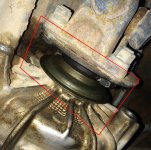
Time for an update to this thread. 5 years and 55k miles later, the actuator seal was still holding up great, no leaking at all. However, I developed a leak at both the input and output shafts about a month ago. It was a small leak, so figured I'd try the White Sheperd (Blue Devil) stop leak again. Within a couple hundred miles, my slow drip turned into a massive leak. On a 180 mile trip I lost over 1 quart of fluid. I assume at this point the seals were too far gone. I ended up having a local shop replace all seals in the transfer case for a total of $850.
My thought is the stop leak is a good temp fix, but not a true long term solution. I expected this from the beginning, and didn't loose a thing by running it the last few years. However, if you plan to keep your 4runner a while, a rebuild seems inevitable.
Hi there, I'll try to respond to this for the sake of others who are interested.
I have never been a fan of any stop leak additive.
Brake systems typically use something like EP(ethylene propylene) rubber, which swells "just the right amount" for a braking application, while retaining excellent high temperature tolerance, when exposed to your typical glycol-ether based brake fluid. However, drop a standard rotating shaft seal( which is made from a rubber with completely different elastomeric properties) and you will notice that in time, this seal will swell considerably. The same is true for most other types of rubber seals in your engine and transmission.
An an elderly gentleman (who liked to fix his cars the "quick and dirty" way) once taught me a trick to fix leaking oil seals: Add a teaspoon of *brake fluid* to the oil and run it for the duration of an oil change. Then sell the car.
This gentleman may or may not have been my grandfather who happened to be a child during the great depression. If queried, I will deny everything. He never told me anything about sawdust in differentials nor manual transmissions, either. I swear.
The point here is that the brake fluid caused the seals to swell. This means that now your nice symmetrical lip seal may expand in a non symmetrical way, and will subsequently experience new wear due to increased contact with the rotating shaft. If you've replaced a shaft seal before, remember that you saw a nice, narrow shiny spot where the lip was contacting, and outboard of this spot, you saw nastiness. Now imagine that shaft seal expanding into this little shiny spot and the nastiness next to it. That's right. Bad news. Sure, it slowed the leak down for a bit, but that seal is softer now, has worn in a way that it shouldn't have, and likely will start slowly shrinking back to its original size. If it starts shrinking, your small leak will become a large leak very quickly.
I see stop leak additives as the same thing. They must be. All the additives are "secret", but I'm betting a look at the "formula" would reveal something similar to the glycol ether in your brake fluid reservoir. It's a temporary fix, and I just couldn't ever do something like that and subsequently sell the car due to the guilt I would feel (and the fear that the buyer might be both an axe murderer and an automotive forensics specialist). All rubbers outgass over time. Anything deposited in them that is capable of evaporating, eventually will. This includes the hydrocarbon chains that they are made of (short hydrocarbons to the front of the line!). Logic dictates that sooner or later, the stop leak additive that has caused the rubber to swell and stop leaking must slowly evaporate or dissipate in some other manner.
If you're going to keep the 4runner, and you want to love it like a 4runner should be loved, I think the best thing to do is replace the seals. I'll try to be more responsive on this site, some people messaged me during my sans-4runner days, but I'm back, and I'm going to have some fun with my beautiful new stratospheric mica beauty. I would like to make a simple little box which can be plugged into the transfer case actuator to actuate it and show the positions of the rotary switches. If I had something like this, it would have been so much easier to do the seal swap on my 2003. If there are any available guinea pigs in michigan, ohio, or indiana, let me know :cheers: