Group buy : DC power Engineering 270amp alternator

Hi Zmartin,

It has been 'Unofficially' observed (on a few different occasions) that the 5'th gen 4Runner (the LE in particular...) has a nominal available capacity for it's factory installed electrical accessories ONLY. Using the vehicle's two separate electrical blocks (Engine room Main fusebox, and D/S relay/fusebox) as a rough indicator of it's potential current consumption, along with the factory's choice of the alternator's full output.

After that, a 20% safety margin was factored in which make all of our high consumption accessories e.g., HVAC Blower, A/C clutch, Exterior lighting systems, front & Rear wipers, Heated seats and mirrors...etc, equivalent to 80% of our total fuse load capacity. By combining our total fuse load cap., we can get a very realistic assessment of how much 'Potential' current our vehicle may consume with only the factory installed electrical load accessories in operation.

And what's amazing to me... [MENTION=55815]Okki[/MENTION] did some very similar calculating in one of his recent threads: http://www.toyota-4runner.org/2421227-post42.html ...and came up with much the same conclusion wrt the truck's nominal ability to to provide only enough current for the factory installed electrical accessories; I just find that funny how we both concluded the same range of unimpressive numbers!

To see how this calculation was done, here's an excerpt from a thread which demonstrates exactly what I mean; take a look: http://www.toyota-4runner.org/1734407-post15.html With all due respect to you and to your POV, how much "On-board current" would you like to have available? Is it your philosophy that you'd prefer to have no more current available than what's absolutely necessary... just curious.

And if that's true, what size alternator would you be running, smaller than a 270A to support your add-on accessories e.g., JL audio system (above 2000w), Rigid 40 inch E-series LEDs, two six inch Rigid SR's which are mentioned in your previous quotes... Once again, I'm not criticizing your calculations, just want to know how you came up with the idea of the need for a smaller power plant!

rig, 'Best'!

i didn't really calculate anything, i would guess that those lights and the sound system would only require about 50 or so amps in addition to the factory possible output. technically this would be with everything running at the same time, which will most likely never happen. i was simply trying to save money as i saw they made the same alternator with a lower output that was still more than factory and was cheaper. also i wanted to know because it could effect the gauge wire required for installation.

i see many people saying that these also are plug and play, however i would advise absolutely not installing this without upgrading the wiring. the wiring should always be designed to handle a possible max output scenario and fused accordingly to prevent fires.
 
Last edited:
i didn't really calculate anything, i would guess that those lights and the sound system would only require about 50 or so amps in addition to the factory possible output. technically this would be with everything running at the same time, which will most likely never happen. i was simply trying to save money as i saw they made the same alternator with a lower output that was still more than factory and was cheaper. also i wanted to know because it could effect the gauge wire required for installation.

i see many people saying that these also are plug and play, however i would advise absolutely not installing this without upgrading the wiring. the wiring should always be designed to handle a possible max output scenario and fused accordingly to prevent fires.

I understand what you've just said about your wiring load concerns, but what I believe you are not understanding is that 'NONE' of the factory wiring will be affected by the new alternator or the additional aftermarket loads that you've installed! All of your 'Add-on' equipment will have it's own Aftermarket harnesses and relays to carry their loads from the battery (POS) through the designated heavy gauge 'fused' lines and directly to the high power consumption aftermarket accessories, so your stock fuseboxes are never affected by this new electrical system that's been installed!

And going from a stock 130A alternator to a unit that will produce twice what the factory power plant could generate is practically the bare minimum size alternator that I would recommend anyone install that is planning to start adding exterior lighting systems, an audio system upgrade; especially when the audio system will be driven by an amp that is capable of 2,000W True RMS (160A); which is more than the factory alternator can produce if that were it's only assignment... but it's not! I don't see the point of increasing the available current in only fractional increments when starting off with that kind of potential aftermarket consumption! Hope this explains my reasoning,

Cheers, rig
 
Added [MENTION=52968]deanyuan[/MENTION] to batch 4! Anyone else looking to join this group buy as we are in the final couple days? :bounce:

Okki
 
2015/2016

Hey guys,

Sorry about the late update, having a super busy Monday here at work. I've received the alternator from the dealer which the part number reads (27060-31260 Toyota) So it seems like we're okay for the 2015/2016 models. Like previously said I can't say they will work for 2017 so I'd like to hold off on the 17's until I have more information on those.

After you're done ordering, please send me a follow up e-mail with your Year/Make/Model/Liter Motor so I can update your order as it goes into the system. [email protected]

Thanks for everyone's patience! :guitar3:
 
Hi Anthony,

And thanks for the that great 'Heads-up'! Now that this has come up, it's triggered a couple of questions:

(1) I wonder if the LIN (for linear??) controlled regulator can be removed and swapped out for a conventional Denso analog regulator, or...

(2) If an interface module can be connected to that LIN 'single pin' connector and then there would be a four pin connector on the interface module input side for a simple 'plug-n-play' installation.

"...it'd be nice if I still had my stock 'Denso' 130A alternator (sold it soon after I purchased the 270-XP), and the newer model (2016) 130A so I could take them both apart and see just what parts are interchangeable. Then I could see how to get around the recently modified 'single pin' Denso 130!" Once again Anthony, thanks for all your help and the info!

rig, Cheers

Question 1:

We've tested something similar like this in the past and were unsuccessful, LIN/COM is just a big PITA. I kinda think that answers question 2? But we won't know until we have an actual Toyota here with a LIN/COM system that we can test out.
 
Hey guys,

Sorry about the late update, having a super busy Monday here at work. I've received the alternator from the dealer which the part number reads (27060-31260 Toyota) So it seems like we're okay for the 2015/2016 models. Like previously said I can't say they will work for 2017 so I'd like to hold off on the 17's until I have more information on those.

After you're done ordering, please send me a follow up e-mail with your Year/Make/Model/Liter Motor so I can update your order as it goes into the system. [email protected]

Thanks for everyone's patience! :guitar3:

Thanks Anthony!

I'll PM the batch 4 and 2015/2016 batch after dinner with the ordering instructions. :pop2:
Okki
 
Everyone from the 2015/2016 batch has been PM'ed as well as everyone on Batch 4. At this time, everyone who is on the list should have received ordering instructions. :trophy:

Let me know if you haven't or would like to be added to the list. The group buy is open till 12 AUG.

Thanks and have a great day!
Okki
 
Cool, since a lot of us thought this was a no go, it'd be nice if the timeline was extended a bit. But whatever. Thanks for making this happen.
 
First post updated with the inclusion of 2015/2016 model years.

Batch 5 started. Everyone recorded on a previous batch should have received a PM with ordering details.

The group buy is open till 12 AUG. please let me know if you want to be added to the list.

Thanks and have a great day!
Okki
 
I understand what you've just said about your wiring load concerns, but what I believe you are not understanding is that 'NONE' of the factory wiring will be affected by the new alternator or the additional aftermarket loads that you've installed! All of your 'Add-on' equipment will have it's own Aftermarket harnesses and relays to carry their loads from the battery (POS) through the designated heavy gauge 'fused' lines and directly to the high power consumption aftermarket accessories, so your stock fuseboxes are never affected by this new electrical system that's been installed!

And going from a stock 130A alternator to a unit that will produce twice what the factory power plant could generate is practically the bare minimum size alternator that I would recommend anyone install that is planning to start adding exterior lighting systems, an audio system upgrade; especially when the audio system will be driven by an amp that is capable of 2,000W True RMS (160A); which is more than the factory alternator can produce if that were it's only assignment... but it's not! I don't see the point of increasing the available current in only fractional increments when starting off with that kind of potential aftermarket consumption! Hope this explains my reasoning,

Cheers, rig

how would none of the factory wiring be effected when the new alternator could potentially see a high load (the factory wiring is fused at 130 amps)? which tells me that the gauge wire used to hook the alternator to the battery can probably only handle around 130 amps...
 
Order placed, thanks @Okki, [MENTION=83083]rigtec[/MENTION] and [MENTION=144561]DCPower_Anthony[/MENTION] ! :hatsoff:
 
how would none of the factory wiring be effected when the new alternator could potentially see a high load (the factory wiring is fused at 130 amps)? which tells me that the gauge wire used to hook the alternator to the battery can probably only handle around 130 amps...

When adding a high output alternator you'll want to do what they call the Big 3 wiring upgrade. Shown here

How To Do The Big 3: Tutorial - Electrical-battery- Alternators- Wiring - SMD Forum

You'll add on bigger cable that goes along side the factory wire, why you ask? Because current will take the path of least resistance which is the newly added bigger wire. You factory accessories will not request more current than they already do so the alternator will not "overcharge" any accessories causing failures within your components. All alternators are demand based, meaning that with all of your accessories off your vehicle will pull anywhere from 30-40 amps by itself and that's all the alternator will generate. Once you start turning on accessories and demanding more current the alternator will generate more current to keep up with the demand. When people add winches, or stereo equipment to their vehicle they run bigger wire from the battery to those accessories to ensure they current flows freely with low resistance.

Hope this answers your question.
 
Zmartin19's Question...

how would none of the factory wiring be effected when the new alternator could potentially see a high load (the factory wiring is fused at 130 amps)? which tells me that the gauge wire used to hook the alternator to the battery can probably only handle around 130 amps...

DCPower_Anthony's Explanation...

When adding a high output alternator you'll want to do what they call the Big 3 wiring upgrade. Shown here

How To Do The Big 3: Tutorial - Electrical-battery- Alternators- Wiring - SMD Forum

You'll add on bigger cable that goes along side the factory wire, why you ask? Because current will take the path of least resistance which is the newly added bigger wire. You factory accessories will not request more current than they already do so the alternator will not "overcharge" any accessories causing failures within your components. All alternators are demand based, meaning that with all of your accessories off your vehicle will pull anywhere from 30-40 amps by itself and that's all the alternator will generate. Once you start turning on accessories and demanding more current the alternator will generate more current to keep up with the demand. When people add winches, or stereo equipment to their vehicle they run bigger wire from the battery to those accessories to ensure they current flows freely with low resistance.

Hope this answers your question.

Hi [MENTION=144561]DCPower_Anthony[/MENTION],

I liked your reply sooo much I decided to take the day off and just post this DC Power Engineering 270-XP Review/tutorial that was written when I first discovered and installed the 270-XP just over two 'trouble-free' years ago; "See link">>: http://www.toyota-4runner.org/5th-gen-t4rs/172070-4runner-alternator-upgrade-gen-5-a.html I know that (Thanks to my community brothers, Paul (Okki) and Anthony) we have quite a few forum members here that will be dropping in the DCPE 270-XP; so glad to see so many of you jumping on-board! There may still be some of you, however, that have never read this Alternator upgrade essay, so I hope that if you have questions you will take this opportunity to have a look at it because a lot of those questions will most likely have been covered here in this thread,

'Best to you all'! rig
 
Zmartin19's Question...


DCPower_Anthony's Explanation...


Hi [MENTION=144561]DCPower_Anthony[/MENTION],

I liked your reply sooo much I decided to take the day off and just post this DC Power Engineering 270-XP Review/tutorial that was written when I first discovered and installed the 270-XP just over two 'trouble-free' years ago; "See link">>: http://www.toyota-4runner.org/5th-gen-t4rs/172070-4runner-alternator-upgrade-gen-5-a.html I know that (Thanks to my community brothers, Paul (Okki) and Anthony) we have quite a few forum members here that will be dropping in the DCPE 270-XP; so glad to see so many of you jumping on-board! There may still be some of you, however, that have never read this Alternator upgrade essay, so I hope that if you have questions you will take this opportunity to have a look at it because a lot of those questions will most likely have been covered here in this thread,

'Best to you all'! rig

im sure im getting annoying but ill try to clarify why i thought this... i dont remember reading anywhere in this thread where anyone explicitly stated that depending on power demands you would need another wire to care the additional load. i already knew this... however, i did read a lot of posts written in such a way they could be interpreted as this alternator would be completely plug and play no matter what your demands. not the case. just wanted to point out what seemed to be a misconception for a few people. theoretically if you never added to the load sure you could get away without adding additional wiring but i dont see the point in getting a high output alternator and never actually upgrading the wire to utilize its potential generation anyway.
 
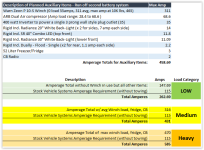
It's happening! Order placed for the 270-XP for my 2016 Trail Prem. Thanks to Anthony at DC Power Inc for his input on my planned electrical add-ons. The winch is the big hit but running it off a fully charged auxiliary battery at high RPM, with other items turned off, it shouldn't be an issue with the 270-XP.

For anyone curious, here's a photo of the planned mods and their respective amperage draws that will run off the dual battery and new alternator system. Should be in the low range 99.999% of the time.
 

Attachments

  • Screen Shot 08-09-16 at 09.55 PM.PNG
    Screen Shot 08-09-16 at 09.55 PM.PNG
    38 KB · Views: 373

Members online

Forum statistics

Threads
278,316
Messages
3,554,120
Members
248,016
Latest member
Advally Service

Trending content

Back
Top