I find it amusing that you are blaming your own ineptitude on the 4Runner. You push a wrong button? Blame it on the 4Runner.
Look, I know the 4Runner does not have the best in class interior but I am also astute enough to know that every vehicle is a compromise. You sound like the guy who wants $80,000 in options and reliability in a 40K vehicle. Good luck with your next vehicle.
I haven't followed any of the other complaints, but that's what I read from this thread.
The interior deteriorated quickly. The squeaks developed in less than a year of moderate use, on and off road.
Don't make apologies for crap quality.
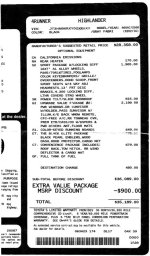
For 40 grand (altho I paid less) the TE interior quality is not that great.
Maybe I have a bad example, because my wife's LE is much nicer and better put together.
Or maybe I just beat the shit out of cars and legendary Toyota quality isn't what it used to be... There are trucks that are worse out there (Grand Cherokee, Xterra), I guess I should be happy that it starts in -20 F weather as well as it does in 110 F and I have driven it through ice and snow conditions that only plows could manage... I'm just not happy with the QC of the interior bits compared to the drivetrain stuff and feel that for the price you don't really get your money's worth in terms of interior durability.
...also, really, don't make excuses for cheap interior switchgear that can't even keep the same texture/font face between surfaces.
The point is that I bought the TE because I was thinking I was getting more value than a Taco that cost 10-15 grand less. And I'm not seeing it.
I can understand some of your gripes with the interior. I for one, agree that the leather in the LE sucks. But, I'm also comparing that to European leather models in a BMW, Mercedes, and Porsche. That's not really fair.
What I'm happy with Toyota is how much more truck you get in the year 2013 vs. what you got in 2000.
Let's face it. Toyota gives us a ton of bells and whistles with the technology that's available today. There are plenty of people here that complain they don't get those extra bells and whistles you get in a GC. Well, I've worked on plenty of GC and Jeeps in general and you'll never catch me owning one. I'll deal with crappy leather interior before I deal with any American car product.
One of the previous times [MENTION=92049]LandCruiser[/MENTION] was going down the list of things that he hated about his 4Runner he mentioned that Toyota should have put in a Locking Center Diff instead of the part time transfer case in the TE edition. I mentioned that the full time 4wd/center diff was one of the things that some of the FJ guys disliked about the manual transmission option on the FJ's.
This lead to a long discussion about which was more durable - the locking center diff (like used on the LE) or the part time transfer case on the SR5/TE. The more I've looked into it, [MENTION=92049]LandCruiser[/MENTION] was right - the locking Center Diff is more durable than the part time transfer case, though the part time transfer case Toyota uses is highly durable and not a part known for a high failure rate.
In a perfect world, Toyota would offer a Trail Edition w/ a full time 4wd, lockable center diff and lockable front/rear differentials. The realities of mass production and Toyota's decision making process means its not an option on anything Toyota offers from the factory. The closest you can come is to buy an LE and have aftermarket ARB lockers added front and rear to the factory diffs.
The lockable center differential, in addition to being slightly more durable, allows you drive around w/o the center diff locked until its needed. This allows for shorter turning radiuses and reduced stress/wear to the driveline components as they don't experience driveline bind until the center diff is locked. Again, this is a largely theoretical discussion - the differences are minor and of little consequence in the vast majority of uses.
David
David
The shortest turning radius is allowed by the part time tcase that's in 2wd. Not a full time case that doesn't have the center diff locked.
I'm not sure where you're getting your reliability resources from. But let me state some facts. These are general facts about t-cases full time and part time.
Most part time tcases are chain driven. There are some exceptions that are gear driven. In fact, there are conversions designed to go from chain to gear drive specifically for the off road market. Some would say they are the most desired and reliable. The chain or gear gives the tcase a locked position. Your front and rear driveshaft will have equal power.
One of the most sought after transfer cases in the off road community is the Atlas or Atlas 2. These are gear driven.
Most full time/awd tcases require a viscous coupler. This allows power to transfer to the front or rear driveshaft as required. The viscous coupler is similar to what a limited slip is in a differential. The locking feature is what is desired for the viscous coupler to engage the front and rear driveshaft completely, similar to a part time tcase.
I don't know where you're seeing any failure rate for ANY Toyota tcase. The only part that fails consistently (and that's usually after 100k+ miles) is the electronic actuator that engages 4wd/hi/lo. It's been a long time since I've crawled under a lever actuated tcase such as a 2010-2013 TE or SR5, but I don't believe these had them. I would love for someone to go under and snap a pic of the back of their tcase. And if I'm wrong, I apologize. But, I would much rather have a manual actuated tcase than the current one I have in my LE. It's just one more thing to break/leak....100k miles from now.



 But, let's take the center differential: why are you so upset you only have two? Or is it that you're upset you don't have a center differential lock?


 op2:
op2:





