

Robb235
Senior Member
Before I get into describing how to build your own rear O2 simulator, I just want to say that I did not come up with this mod on my own. You can search Google and find all kinds of write-ups describing this method. However, I didn't see any write-ups here on T4R, and since many of us suffer from the P0420 disease, I figured I'd share it here as well.
I also apologize for the lack of pictures. I didn't think about posting this write-up until everything was put together and installed on my rig. I encourage other people who do this mod to take pictures along the way and post them up.
You will need to have a working rear O2 sensor for this spoof to work. By "working" I mean that all you have to have is an O2 sensor that's putting out some kind of signal. You're O2 sensor can still be "bad" (putting out bogus signals), but as long as it's putting out something, we can modify it and fool the ECU into thinking that the rear O2 is okay, and that the catalytic converter is working like it should be (even if you don't have one). This method is far cheaper than replacing the rear O2, and is MUCH MUCH cheaper than replacing your catalytic converter.
DO NOT DO THIS MOD TO YOUR FRONT OXYGEN SENSOR. ONLY DO THIS TO THE REAR ONE.
Before you get started, you'll need to run to RadioShack and pick up two items:
A 1 Microfarad (1μF) Capacitor - RadioShack part number 272-1055
A 1 Mega ohm (1MΩ) Resistor - RadioShack part number 271-1134
This should cost around $5 or $6.
Step 1: This step isn't required, but it will make things easier. Unbolt the rear oxygen sensor from the exhaust pipe, which is held on by two 12mm nuts. Then disconnect the rear O2 sensor pigtail from the main wiring harness. With the rear O2 sensor completely removed, you can modify it on your work table or where ever you want, instead of cutting and splicing while underneath your rig.
Step 2: Cut the blue and white wires on the oxygen sensor. Leave the two black wires alone, they are part of the heater circuit and we don't want to mess with that. I chose to cut the blue and white wires halfway between the sensor element and the plug connector. Wire in the resistor and capacitor as shown below. I chose to use heat shrink butt connectors, however if you want to use another method such as soldering, crimping, etc. then that's completely up to you. Use whatever method you like. Just make sure it looks like this:
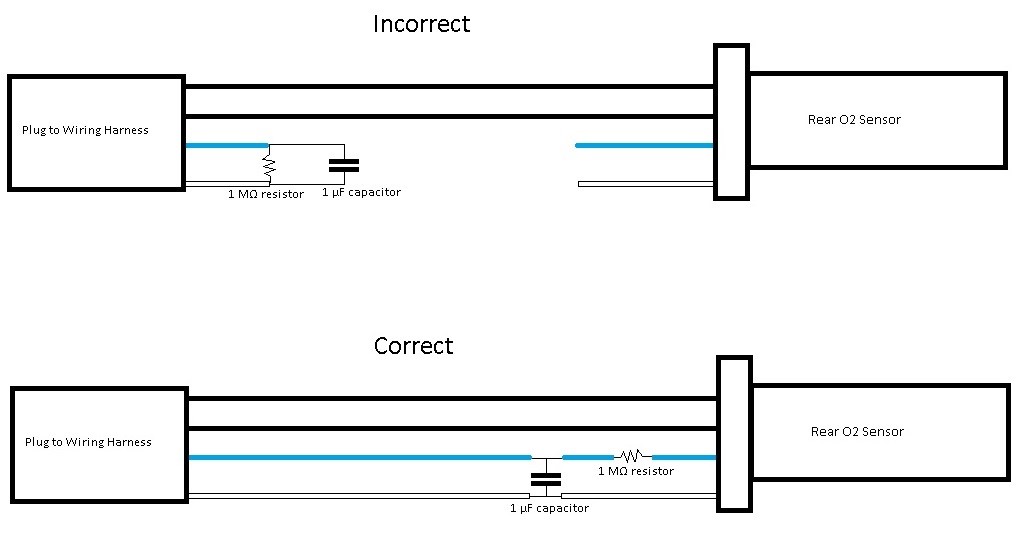
You'll notice that I have the first diagram labeled "incorrect" and the second one labeled "correct". I've seen some diagrams posted on the internet that show the first wiring diagram. Don't do that one. Your truck will read 0.0 volts at the rear O2 and will throw a code P0136 "O2 Sensor Circuit Malfunction". Go with the second diagram.
Step 3: Make sure the resistor and capacitor are protected from the elements somehow. I'd recommend wrapping everything up in electrical tape. Then re-install the O2 sensor back into the exhaust pipe, and hook the pigtail connector back into the wiring harness. Make sure that none of the wires hang too close to the exhaust pipe (you may have to zip tie things out of the way).
That's it. This should help get rid of your P0420 code for good, whether you have a catalytic converter in place or not. My '99 has had a P0420 code since the day I bought it, and it's been like that for over 2 years. It has the California style emissions and 2 catalytic converters, yet it still threw a code for "Catalyst System Efficiency Below Threshold". Every time I'd reset the Check Engine light, it would come back right away with the same code. After building and installing this O2 spoofer, I have yet to have the Check Engine light come back on.
I also apologize for the lack of pictures. I didn't think about posting this write-up until everything was put together and installed on my rig. I encourage other people who do this mod to take pictures along the way and post them up.
You will need to have a working rear O2 sensor for this spoof to work. By "working" I mean that all you have to have is an O2 sensor that's putting out some kind of signal. You're O2 sensor can still be "bad" (putting out bogus signals), but as long as it's putting out something, we can modify it and fool the ECU into thinking that the rear O2 is okay, and that the catalytic converter is working like it should be (even if you don't have one). This method is far cheaper than replacing the rear O2, and is MUCH MUCH cheaper than replacing your catalytic converter.
DO NOT DO THIS MOD TO YOUR FRONT OXYGEN SENSOR. ONLY DO THIS TO THE REAR ONE.
Before you get started, you'll need to run to RadioShack and pick up two items:
A 1 Microfarad (1μF) Capacitor - RadioShack part number 272-1055
A 1 Mega ohm (1MΩ) Resistor - RadioShack part number 271-1134
This should cost around $5 or $6.
Step 1: This step isn't required, but it will make things easier. Unbolt the rear oxygen sensor from the exhaust pipe, which is held on by two 12mm nuts. Then disconnect the rear O2 sensor pigtail from the main wiring harness. With the rear O2 sensor completely removed, you can modify it on your work table or where ever you want, instead of cutting and splicing while underneath your rig.
Step 2: Cut the blue and white wires on the oxygen sensor. Leave the two black wires alone, they are part of the heater circuit and we don't want to mess with that. I chose to cut the blue and white wires halfway between the sensor element and the plug connector. Wire in the resistor and capacitor as shown below. I chose to use heat shrink butt connectors, however if you want to use another method such as soldering, crimping, etc. then that's completely up to you. Use whatever method you like. Just make sure it looks like this:
You'll notice that I have the first diagram labeled "incorrect" and the second one labeled "correct". I've seen some diagrams posted on the internet that show the first wiring diagram. Don't do that one. Your truck will read 0.0 volts at the rear O2 and will throw a code P0136 "O2 Sensor Circuit Malfunction". Go with the second diagram.
Step 3: Make sure the resistor and capacitor are protected from the elements somehow. I'd recommend wrapping everything up in electrical tape. Then re-install the O2 sensor back into the exhaust pipe, and hook the pigtail connector back into the wiring harness. Make sure that none of the wires hang too close to the exhaust pipe (you may have to zip tie things out of the way).
That's it. This should help get rid of your P0420 code for good, whether you have a catalytic converter in place or not. My '99 has had a P0420 code since the day I bought it, and it's been like that for over 2 years. It has the California style emissions and 2 catalytic converters, yet it still threw a code for "Catalyst System Efficiency Below Threshold". Every time I'd reset the Check Engine light, it would come back right away with the same code. After building and installing this O2 spoofer, I have yet to have the Check Engine light come back on.
Attachments
Last edited:


