Link:
Edmunds Comparo: H2 is last place!
2003 Large Luxury SUV Comparison Test
Fifth Place - 2003 Hummer H2
By Erin Riches
A typical luxury SUV purchase is more likely the result of a whim than a carefully weighed response to a perceived need. Even so, the H2's last-place finish is a reminder that even pleasure crafts need to be well-rounded. And Hummer Jr. certainly isn't that.
The H2 was designed and engineered by General Motors; although it makes use of hardware from the company's existing full-size truck line, numerous modifications were made to give it one-of-a-kind off-road ability and styling in line with that of the H1. Our off-roading trip was all in a day's work for the Hummer, as its 9.9 inches of ground clearance, 42-degree approach and 38-degree departure angles, generous wheel travel and gargantuan LT315/70R17 BF Goodrich tires allowed it to master pretty much any terrain we encountered without getting stuck or taking damage. Its pair of locking differentials (center and rear) was second only to the G500's three.
The Hummer's four-wheel-drive system didn't offer quite the versatility of the LX 470's or G500's, in that putting it in 4WD Low automatically locked the center differential (instead of leaving that to the driver's discretion). And some editors noted that its four-speed automatic didn't offer a super-low first gear (in 4 Lo) — useful on very steep descents — as could be found in the G and the LX 470. But these are minor issues only of concern to hard-core off-road enthusiasts.
The real issue for the average H2 owner who goes off-roading on the weekends (or not) and drives into the city during the week is size. With a width of over 81 inches, the H2 is a wrecking ball of sorts on many off-road trails, and editors found it difficult to avoid taking out the local plantlife. On tightly packed freeways, the driver must be vigilant at all times, because the Hummer just doesn't fit into lanes as well as other SUVs. Also in play are the rough-and-tumble suspension and steering components. Tuned for a life off the pavement, they give the H2 all the manners of a heavy-duty pickup everywhere else — even with our test truck's optional self-leveling air suspension. The ride isn't uncomfortable nor is body roll excessive, but compared with the others, the H2 felt sloppy and disconnected from the road. The steering is similarly vague in feel, and the turning radius is a large 43.5 feet.
To make matters worse, the H2 has huge blind spots — the passenger compartment sits high off the road, the windows are short and a full-size spare takes up half of the cargo bay. It's easy for smaller vehicles and people to escape your glance. A set of supplemental convex mirrors (as on Ford's Excursion) might have helped, but GM left them off.
Beyond that, our test vehicle was too tall to fit in our office parking garage. And even our 6-foot-plus editors had to use the tubular running boards to manage the huge step-in height; one of them hit his head on the roof in the process.
But size was only one problem for the H2. A lack of luxury features, minimal cargo space, subpar interior materials and take-it-or-leave-it engine performance were others. Let's start with features: We identified 12 that we thought were important in a luxury SUV; the H2 had just two and a half of them — low-range gearing, an in-dash CD changer and an optional one-person third-row seat (we could only give it partial credit). Among the missing items that can't be had even as options were side-impact airbags of any kind, stability control, adjustable pedals, rear parking sensors, a rear air conditioner for the four possible rear-seaters and a rear DVD entertainment system.
The cargo space issue is obvious. When a vehicle weighs 6,400 pounds and meets the heavy-duty vehicle classification (and therefore isn't subject to pesky EPA gas mileage estimates), you'd expect it to double as a moving van when needed. However, the H2's cargo bay is occupied by the aforementioned spare tire and third-row seat, and even on large grocery trips, one of these has to come out to get everything in. On the plus side, the 60/40 second-row seats fold easily to create a flat load floor.
Inside, editors noted GM's attempt to give the H2 a bold, masculine ensemble but wrote that the final product seemed like a rush job with various elements thrown in at the last minute. Low-quality materials certainly didn't help — there was hard plastic in abundance, along with weak leather and vinyl trim and unconvincing faux metal where there should have been real stainless steel. "Nothing seemed worthy of such an expensive vehicle," one editor wrote in his evaluation. Build quality wasn't perfect, either; panel fits weren't all that tight and the shifter, one of the few stylish holdovers from the H2 concept truck's sharp interior, wiggled in its gate.
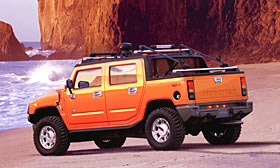
Obviously, GM did a better job with the outside of the H2. Two of our editors gave it a perfect 10 in the exterior design category for its exacting translation of the H1's rawness into a more refined, less cumbersome form for a more mainstream audience. Others marked it down for being "too toylike to take seriously" and for having "obscenely wide hindquarters."
Under the signature reverse-opening hood is the same 6.0-liter V8 found in the Escalade, though it's rated for less power in the Hummer — 316 horsepower and 360 pound-feet of torque (versus 345 and 380 in the Cadillac). While this V8 gives the 5,641-pound Escalade a terrific rush, it has difficulty overcoming the H2's massive weight. All of our editors wrote in their evaluations that the H2 felt slow off the line, providing merely adequate acceleration overall. Instrumented testing supported our impressions, as the H2 took 10.8 seconds to reach 60 mph. Fortunately, GM's trusty 4L65-E four-speed automatic did a good job with gear selection to maximize the available thrust. Just in case you're wondering, the H2 averaged an abysmal 9.2 miles per gallon during our week of testing — it was the only vehicle that couldn't break into double digits.
So what did we like about the H2 aside from its off-road ability and astute transmission? Well, the first- and second-row seats offer pretty good cushioning and headroom as well as multi-setting seat heaters. Then again, limited legroom and just a center lap belt make the backseat less hospitable for older kids and adults. And if you travel with a big thirst or a lot of personal effects, you may find the cupholders and in-cabin storage lacking.
The control layout in the H2 isn't bad. The climate and stereo controls are identical to those in other GM trucks, and that means they're easy to use even if they're not pleasing to the eye. But if you're looking for an authentic luxury experience, you probably won't like the three-on-one cruise/signals/wipers stalk or the fact that none of the windows roll up automatically.
Ultimately, any attempt to compliment the H2 as a luxury vehicle comes across as backhanded. Even with the Lux Series trim package, it simply can't pull off this role. Sure, it was the least expensive vehicle in our test at $55,060, but this is still a hefty price to pay for a vehicle that doesn't fit your lifestyle. And unless you're a skilled off-roader who doesn't mind tearing up vegetation, the H2 doesn't.