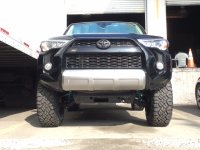
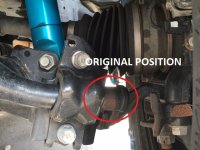
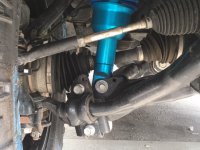
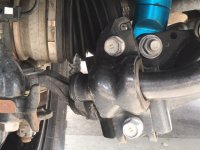
My goal is for it to perform well off road. I won't be doing much, if any crawling as I am located in So. Cal and do frequent desert runs, glamis trips and occasionally trips up to Nor. Cal. The ride height is only a concern at the moment due to excessive front rake. I am not trying to build a huge, lifted 4Runner, but one that looks great and performs great.
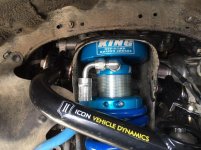
Are you saying it won't perform well off road due to my hard ware or because of the way I have it currently sitting? If going with a shorter rear spring and lowering the front end is needed in order to optimize the overall performance of the Kings, UCAs and rig itself, I am more than willing to do so.
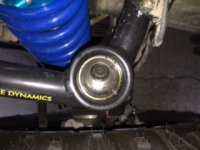
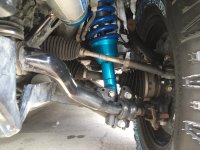
Because of the way you have it currently sitting. The IFS has a limited range of travel. Lifting it without moving the pivot points of the control arms doesn't increase you travel. Rather it just changes where in that range you are starting from. When you're near the limit of height, that means there's basically no remaining downward travel. The result is that when you encounter an obstacle like washboard roads it will max it's downward travel very quickly and often do so before it hits the bottom of the hole. The result then is a tire that's only intermittently in contact with the ground and the result is a very jarring impact each time it hits. The ride quality then feels much rougher on fast rough roads.
An easy way to think about this is if you imagine the tire has say 10 inches of possible travel. If you start with it at zero you have +5 and -5. If you move to a 3.5" lift, now you have a range of -1.5 and + 8.5. Unless you add softer springs its unlikely that you would use the full +8.5" of travel. So now you'd have less usable travel.
Also the angles transmit a lot more of the energy of the impact into the frame as a function of the geometry of steep control arms. In an ideal world they would begin level. Of course there are compromises for other things like ground clearance and such, but the further you get from level the more energy from each bump will transfer into the frame/body and not into the shocks/springs. It also causes your steering linkages to be at odd angles so more of the bumps and vibrations will feed back through the steering system. This will be more pronounced in corners where your steering links will not match the arc of the suspension (the steering geometry of the links change relative to the a-arms when you turn).
There are other things you might not recognize if you're not really into suspension - and I'm no expert either. But the OEM design has specific geometry relative to the ground and it's intended to have some rake. You'll notice the frame rails are level with some visual rake in the body. There are properties of anti squat/anti dive in the front geometry that are dependent on those same angles. I dont' know how much difference leveling it out makes, but I think it's air to say that you are to some extent changing amount of brake dive by leveling the body. I could be exactly opposite, but I think lifting the front may actually slightly reduce brake dive. There's also a whole set of issues with roll axis and how cornering forces will change.
It all depends on what you want to do through. If you wanted to just go jump it - the softest landing would be the soft springs and maxed ride height. If you want to go fast smoothly, somewhere near stock height, maybe plus 1 inch might be ideal. If you want to rock crawl, probably stock height plus big tires and cutting away all the rub points is ideal.
In a perfect world with an unlimited budget you'd cut out the front suspension, remove the add and side tube off the diff. Center the front diff. Then put in long travel IFS with much longer arms for more travel.
In the realistic world of people with budgets, I'd probably just lower the rear a bit with with some different springs. It's an art as much as a science finding the right suspension for you.