Lifted on King Coilovers - How to obtain more, safely?

while it is true that rate does not change the more preload you add does affect how the shock will react to initial bumps leading to it feeling firmer in most situations that are just initiating travel

Why would that be? In a monotube shock without a bypass the forces exerted by the fluid on the piston should remain the same at any point in the range of motion of the piston for the same input until it reaches the end of the stroke in either direction. The valve rate is set by the stack of shims. It doesn't change anywhere in the stroke unless you have an internal bypass or some other mechanism. (I recognize this isn't perfectly accurate as the shock internal pressure changes slightly due to the volume of the shaft, but it's negligible. Much less than the change in viscosity of a warm or cool shock would be.)

I believe the jarring ride has a lot more (actually 100% more) to do with the geometry of the a-arm transferring more vertical force to the frame than any difference in shock initial location.

In either event the preload only changes the static height. More preload on a 550 spring or less on a 650 spring with the same static ride height will both cause the same poor geometry problems and same initial shock position, but the 650 will always be more jarring than the 550 on small bumps.
 
Last edited:
King is trippen using a 550lb Spring. Wonder what their reasoning is. Sure it's 550. Never heard of below a 600lb spring for a replacement Coilover with these years Tacoma / 4Runner which is basically identical


Did you talk to King? Just talked to my buddy and he says it should be 600 off the shelf
 
Last edited:
Why would that be? In a monotube shock without a bypass the forces exerted by the fluid on the piston should remain the same at any point in the range of motion of the piston for the same input until it reaches the end of the stroke in either direction. The valve rate is set by the stack of shims. It doesn't change anywhere in the stroke unless you have an internal bypass or some other mechanism. (I recognize this isn't perfectly accurate as the shock internal pressure changes slightly due to the volume of the shaft, but it's negligible. Much less than the change in viscosity of a warm or cool shock would be.)

I believe the jarring ride has a lot more (actually 100% more) to do with the geometry of the a-arm transferring more vertical force to the frame than any difference in shock initial location.

In either event the preload only changes the static height. More preload on a 550 spring or less on a 650 spring with the same static ride height will both cause the same poor geometry problems and same initial shock position, but the 650 will always be more jarring than the 550 on small bumps.
nothing to do with the shock i am strictly refering to overcoming the Initial force downward exerted by the spring that is affected by preload to achieve proper sag. To achieve the same ride height with the softer spring you are compressing the snot out of it which is not a good place to be . Suffice to say the king shocks are under sprung with the oem kit.
 
Last edited:
nothing to do with the shock i am strictly refering to overcoming the Initial force downward exerted by the spring that is affected by preload to achieve proper sag.

I must be missing something. Are you saying that the vehicle weight is not compressing the spring beyond whatever preload setting you use? Meaning I guess there would be zero down travel if lifted by the frame or when you lower the jacks it does not compress at all?

Or that the spring compressed length with the weight of the vehicle on it is different depending on the preload? I don't understand how that would be possible.

My understanding of linear springs is that they act linearly within the range of elastic motion. So they would rest at the same static compressed length with the same weight on them regardless of preload. In the case of a 14 inch 550lb spring, so long as the preload distance is set anything greater than 9.45", the vehicle weight will compress beyond the preload setting to a length of approximately 9.45". The ride height changes not because you're doing anything to the spring, but because you're changing the distance between the shock eye and the fixed interface point with the spring creating a longer total eye-eye coilover length with a 9.45" compressed coil.
 
I am not shooting for 3.5", I am shooting for 0 front rake. Have a 2" Icon spring in the read and am happy with the height back there. what I am really curious about is any possible issues that may come from lowering the collar too much.


Besides a shittier ride and possible CV joint binding, I say no.
 
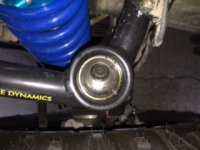
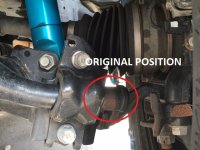
You'd have to get a custom rear Spring for zero rake. There's nothing on the market besides a stock rear spring spacer that can make the truck level. The more you preload the spring the crappier the ride gets and also limits down travel. Look at your uniball and see how it's sitting. Is it all inward toward the arm?

I went with the saw rear coils because of the rake and still had to put my icon coilovers at 2.75-3" to look decent with a little rake because I got a little over 2" with the saw springs that are advertised at 1.5" . I hope my rear springs settle and I can lower the front ride height some. I like the uniball bolt right in the middle.
 
Last edited:
You'd have to get a custom rear Spring for zero rake. There's nothing on the market besides a stock rear spring spacer that can make the truck level. The more you preload the spring the crappier the ride gets and also limits down travel. Look at your uniball and see how it's sitting. Is it all inward toward the arm?

I went with the saw rear coils because of the rake and still had to put my icon coilovers at 2.75-3" to look decent with a little rake because I got a little over 2" with the saw springs that are advertised at 1.5" . I hope my rear springs settle and I can lower the front ride height some. I like the uniball bolt right in the middle.

My uniball is very inward, toward the arm. Is this a bad place to be seated, as in cause any problems or damages? Or is center placement at rest just a preference of yours?
 
Last edited:

Attachments

  • uniball.JPG
    uniball.JPG
    32.7 KB · Views: 2,672
When you're setup like that, your suspension has no range of downward motion anyway, so I guess it may not hurt anything. It's going to ride like crap and won't work well off road, but it probably isn't going to hurt anything as far as breaking the joint. There are ways to get more lift and proper geometry, but they're not cheap.

IMO you'd be best off spending your $ on a drop bracket lift. Most will move the lower control arm mount down about 3 inches. Then set the coilover at "0" and have a true 3" lift with better ride quality. You don't have to go to 6 inches of lift with them. If you do you're right back into the crap geometry.

Long travel is another option - but it doesn't appear like you're really into offroad and it'll cost a lot more for the same visual benefit you're looking for.

good luck
 
Is this acceptable?

Don't even bother to look at that.

The thing you need to worry about is your CV angles. The boots won't last at anything much over 3" of lift. The diff drops people speak of make no difference on these trucks (they only tilt the diff).

If you want major ride height... drop bracket lift is the way to go for sure. They work fairly well and only become a problem in technical offroad situations with lots of tippy situations.

To know how much lift you currently have... Measure center of hub to top of fender and compare to stock measurement on a truck at the dealer.... (or get it from here). A little over 3 is usually OK, 4 is too much for the CVs for sure.
 
When you're setup like that, your suspension has no range of downward motion anyway, so I guess it may not hurt anything. It's going to ride like crap and won't work well off road

My goal is for it to perform well off road. I won't be doing much, if any crawling as I am located in So. Cal and do frequent desert runs, glamis trips and occasionally trips up to Nor. Cal. The ride height is only a concern at the moment due to excessive front rake. I am not trying to build a huge, lifted 4Runner, but one that looks great and performs great.

Are you saying it won't perform well off road due to my hard ware or because of the way I have it currently sitting? If going with a shorter rear spring and lowering the front end is needed in order to optimize the overall performance of the Kings, UCAs and rig itself, I am more than willing to do so.
 
My goal is for it to perform well off road. I won't be doing much, if any crawling as I am located in So. Cal and do frequent desert runs, glamis trips and occasionally trips up to Nor. Cal. The ride height is only a concern at the moment due to excessive front rake. I am not trying to build a huge, lifted 4Runner, but one that looks great and performs great.

Are you saying it won't perform well off road due to my hard ware or because of the way I have it currently sitting? If going with a shorter rear spring and lowering the front end is needed in order to optimize the overall performance of the Kings, UCAs and rig itself, I am more than willing to do so.


Because of the way you have it currently sitting. The IFS has a limited range of travel. Lifting it without moving the pivot points of the control arms doesn't increase you travel. Rather it just changes where in that range you are starting from. When you're near the limit of height, that means there's basically no remaining downward travel. The result is that when you encounter an obstacle like washboard roads it will max it's downward travel very quickly and often do so before it hits the bottom of the hole. The result then is a tire that's only intermittently in contact with the ground and the result is a very jarring impact each time it hits. The ride quality then feels much rougher on fast rough roads.

An easy way to think about this is if you imagine the tire has say 10 inches of possible travel. If you start with it at zero you have +5 and -5. If you move to a 3.5" lift, now you have a range of -1.5 and + 8.5. Unless you add softer springs its unlikely that you would use the full +8.5" of travel. So now you'd have less usable travel.

Also the angles transmit a lot more of the energy of the impact into the frame as a function of the geometry of steep control arms. In an ideal world they would begin level. Of course there are compromises for other things like ground clearance and such, but the further you get from level the more energy from each bump will transfer into the frame/body and not into the shocks/springs. It also causes your steering linkages to be at odd angles so more of the bumps and vibrations will feed back through the steering system. This will be more pronounced in corners where your steering links will not match the arc of the suspension (the steering geometry of the links change relative to the a-arms when you turn).

There are other things you might not recognize if you're not really into suspension - and I'm no expert either. But the OEM design has specific geometry relative to the ground and it's intended to have some rake. You'll notice the frame rails are level with some visual rake in the body. There are properties of anti squat/anti dive in the front geometry that are dependent on those same angles. I dont' know how much difference leveling it out makes, but I think it's air to say that you are to some extent changing amount of brake dive by leveling the body. I could be exactly opposite, but I think lifting the front may actually slightly reduce brake dive. There's also a whole set of issues with roll axis and how cornering forces will change.

It all depends on what you want to do through. If you wanted to just go jump it - the softest landing would be the soft springs and maxed ride height. If you want to go fast smoothly, somewhere near stock height, maybe plus 1 inch might be ideal. If you want to rock crawl, probably stock height plus big tires and cutting away all the rub points is ideal.

In a perfect world with an unlimited budget you'd cut out the front suspension, remove the add and side tube off the diff. Center the front diff. Then put in long travel IFS with much longer arms for more travel.

In the realistic world of people with budgets, I'd probably just lower the rear a bit with with some different springs. It's an art as much as a science finding the right suspension for you.

 
Last edited:
Because of the way you have it currently sitting. The IFS has a limited range of travel. Lifting it without moving the pivot points of the control arms doesn't increase you travel. Rather it just changes where in that range you are starting from. When you're near the limit of height, that means there's basically no remaining downward travel. The result is that when you encounter an obstacle like washboard roads it will max it's downward travel very quickly and often do so before it hits the bottom of the hole. The result then is a tire that's only intermittently in contact with the ground and the result is a very jarring impact each time it hits. The ride quality then feels much rougher on fast rough roads.

Also the angles transmit a lot more of the energy of the impact into the frame as a function of the geometry of steep control arms. In an ideal world they would begin level. Of course there are compromises for other things like ground clearance and such, but the further you get from level the more energy from each bump will transfer into the frame/body and not into the shocks/springs. It also causes your steering linkages to be at odd angles so more of the bumps and vibrations will feed back through the steering system. This will be more pronounced in corners where your steering links will not match the arc of the suspension (the steering geometry of the links change relative to the a-arms when you turn).

There are other things you might not recognize if you're not really into suspension - and I'm no expert either. But the OEM design has specific geometry relative to the ground and it's intended to have some rake. You'll notice the frame rails are level with some visual rake in the body. There are properties of anti squat/anti dive in the front geometry that are dependent on those same angles. I dont' know how much difference leveling it out makes, but I think it's air to say that you are to some extent changing amount of brake dive by leveling the body. I could be exactly opposite, but I think lifting the front may actually slightly reduce brake dive.

It all depends on what you want to do through. If you wanted to just go jump it - the softest landing would be the soft springs and maxed ride height. If you want to go fast smoothly, somewhere near stock height, maybe plus 1 inch might be ideal. If you want to rock crawl, probably stock height plus big tires and cutting away all the rub points is ideal.

In a perfect world with an unlimited budget you'd cut out the front suspension, remove the add and side tube off the diff. Center the front diff. Then put in long travel IFS with much longer arms for more travel.

In the realistic world of people with budgets, I'd probably just lower the rear a bit with with some different springs. It's an art as much as a science finding the right suspension for you.

Yours and everyone elses (don't know how to tag them w/o quoting) is so very appreciated. It can be such a pain in the ass being a perfectionist at times, not saying my rig is perfect...but that is what I am shooting for (perfect for my needs/activities). I do have a better understanding now per all the info supplied by everyone who took the time. Thank you all!

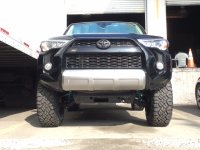
I believe my signature photo is a bit deceiving as it was taken only 20 minutes after the initial install of the entire suspension/wheels & tires. I just took some photos of the suspension components so everyone here can see real time angles of how it is sitting now. Has been 9 days and nearly 1K miles since install (commute 80 miles a day for work. Please see below.

FRONT CAMBER
FRONT CAMBER.JPG
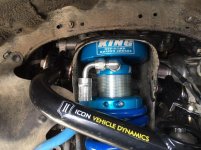
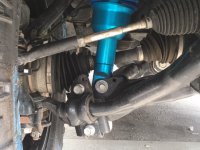
DRIVER'S SIDE COILOVER
L-S COILOVER.jpg
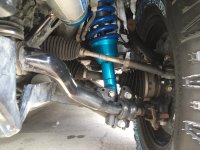
DRIVER'S SIDE CV ANGLE
L-S CV.JPG
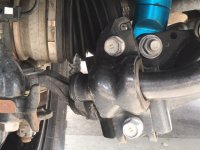
DRIVER'S SIDE SWAYBAR BRACKET POSITION
L-S SWAY BRACKET.JPG
PASSENGER'S SIDE CV ANGLE
R-S CV.JPG
PASSENGER'S SIDESWAY BAR BRACKET POSITION
R-S SWAY BRACKET.JPG
 

Attachments

  • FRONT CAMBER.JPG
    FRONT CAMBER.JPG
    111.1 KB · Views: 1,794
  • L-S COILOVER.jpg
    L-S COILOVER.jpg
    55.7 KB · Views: 1,980
  • L-S CV.JPG
    L-S CV.JPG
    131.4 KB · Views: 1,886
  • L-S SWAY BRACKET.JPG
    L-S SWAY BRACKET.JPG
    112 KB · Views: 1,851
  • R-S CV.JPG
    R-S CV.JPG
    129.9 KB · Views: 1,917
  • R-S SWAY BRACKET.JPG
    R-S SWAY BRACKET.JPG
    118.8 KB · Views: 1,742
Last edited:
Looks like your front is about as high as you'd want to go. Can't you take some measurements? Front and rear from ground to start of gender. Be exact down to the 1/16. W have the same tires/wheels so ground would be best, just make sure it's level.

I'll take measurements of mine again. I finally took mine out on its maiden voyage to ocotillo wells and made the rounds. Truck drove exceptional. It has probably settled some now since install/alignment.
 
Last edited:
Looks like your front is about as high as you'd want to go. Can't you take some measurements? Front and rear from ground to start of gender. Be exact down to the 1/16. W have the same tires/wheels so ground would be best, just make sure it's level.

I'll take measurements of mine again. I finally took mine out on its maiden voyage to ocotillo wells and made the rounds. Truck drove exceptional. It has probably settled some now since install/alignment.

I will take some measurements soon and post them up. Is your rear spring 2" as well? And is your coil over collar as low as mine? Lasty, with the way you are running your setup, do you have any front rake or is it level?
 
I will take some measurements soon and post them up. Is your rear spring 2" as well? And is your coil over collar as low as mine? Lasty, with the way you are running your setup, do you have any front rake or is it level?

I just remembered I have added sliders. So 50lbs extra per side. I took measurements throughout though. From stock to adding the 285's to my lift. I have rake. I'll still send the measurements to see where we're at. We can figure it out. You're going through exactly what I didn't want to go through.
 
I just remembered I have added sliders. So 50lbs extra per side. I took measurements throughout though. From stock to adding the 285's to my lift. I have rake. I'll still send the measurements to see where we're at. We can figure it out. You're going through exactly what I didn't want to go through.

Another thing making this difficult is the fact that this is my first "off-road vehicle". All my other cars have be lowered street performance cars. I have 0 experience to go off of. For all I know it could be driving amazingly shitty for having Kings all around, or maybe it's handling exactly how it should. Yet to take it in the dirt. I will say it drives/handles MUCH better than it did stock regarding freeway driving and soaking up dips/speed bumps and steep driveways. I've hit all at excessive speed just to feel it out/comparing to OEM suspension.
 
Here's all my measurements. Maybe it can help someone else in the future as well

My Completely stock 2016 trail with a full tank of gas
Driver Front - 34 3/4 Passenger Front - 34 3/4
Rear - 36 1/4 Rear - 37

285/70/17 bfg ko's @ 35psi on trail wheels. Stock height and full tank of gas I picked up 1/2" all around

Icon coilovers / with SAW rear coils after alignment and preloading driver side 1 1/8" to level out.
Driver Front- 38 3/4 Passenger Front- 38 3/4
Rear - 39 3/4 Rear- 40


After my first trip and addition of sliders @ 50 lbs each and NEAR EMPTY TANK (gas light about to turn on any minute)
Driver Front- 38 5/16" Passenger Front- 38 2/16"
Rear - 39 10-16" Rear- 39 13/16"

Quick Math.

285's added 1/2" height at 35psi

After lift and alignment adjusting driver side Coilover to match height of passenger straight from Icon I was at :
+3 1/2" lift coilovers
+2 1/2" - 3" rear springs. They're advertised at 1.5" lift.

With the sliders installed and some settling with a wheeling trip on the truck now and gas tank almost EMPTY.

+2 3/4" lift coilovers
+2 1/2"- 2 3/4" rear springs

1 1/4"- 1 1/2" rake

The driver Coilover which I adjusted shows 1 3/4" of thread. Passenger is 1 1/4"
 
Last edited:
My saw rear coils gave me 2.5" ish of lift and is advertised for 1.5". I do not have 3rd row. And that's where lies the problem of trying to level the 4Runner. Manufacturers claims aren't always what they post.

I chose saw because I kept seeing people getting over 3" of lift from the Regular +2" icons and knew that would be a issue for me trying to level it. So the saws didn't really work out for me as I thought but I was able to cover it not looking all goofy with rake because the icon coilovers can be preloaded to 3 1/2 ".

My next post will probably be about the available rear springs not adding up as well as manufacturers not putting in their R&D for the 4 runner and just selling cookie cutter parts. This is why I went Icon. Icon was third on my list but the more reasearch I did icon stood out as seeming to do the most R&D and most people who purchased seemed happy with their product.
 
Last edited:

Members online

Forum statistics

Threads
278,317
Messages
3,554,129
Members
248,016
Latest member
Advally Service

Trending content

Back
Top