LT tires need more air pressure.

JB.

New member
...to match the load capacity of a P-metric tire.*

*A Standard Load tire (SL), usually P-metric (or metric, euro-metric -- a nearly identical twin). This is the tire found on nearly every new car, SUV, and Light Truck. On the sidewall it looks like P265/70/17 (or 265/70/17) as opposed to LT265/70/17.

How much more pressure?
  • 10-15lbs, if an LT is switched for a P-metric tire with the same dimensions.
  • LT load range (C,D,E) doesn't affect this.
  • Tire size does.


This continues to come up and is often a source of confusion.

Not surprising though, considering that both of the following statements are true:

LTs carry less load than P-metric.
LTs carry more load than P-metric.

Throw Load Range into the discussion and things get nice and tangled. Describing the relationships in words doesn't paint a clear picture so I thought I'd try to make some -- pictures, that is.

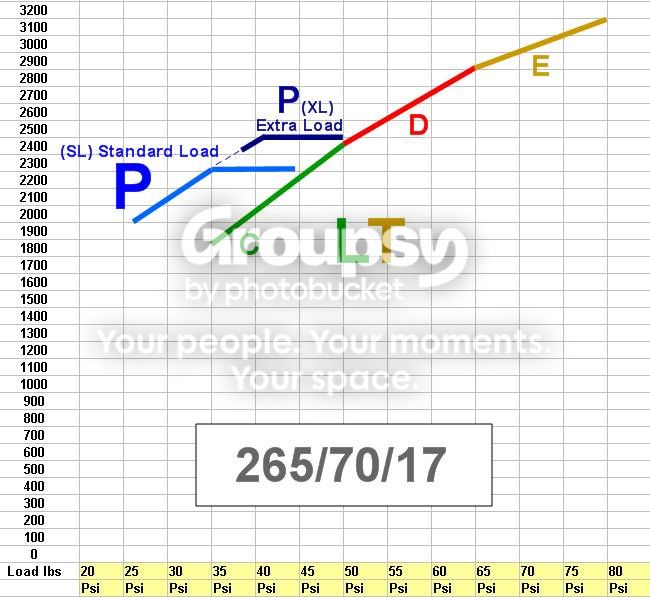
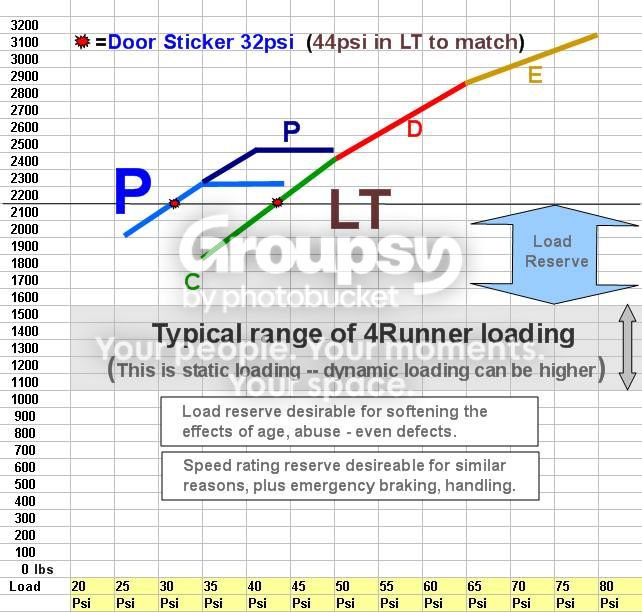
The charts are based on tire size 265/70/17 and, in the 2nd chart, how it relates to the 5th gen 4Runner because that proved easiest, but the application to other generations is obvious and not too dissimilar. The curves should be reasonably accurate and more than good enough to illustrate the point. P-metric tires get load capacity de-rated 9% when used on an SUV and the curves reflect that. The tables used for reference come from this.


Hopefully it's easy to see how an LT can carry both less and more load than P-metric. It's all about air pressure and, for this tire size, it takes about 12psi added to the LT to match the load capacity of the P-metric tire. Hopefully it's also clear how pretty much the only distinction that matters is between P and LT. Load Range doesn't meaningfully affect the choice of air pressure for LT -- unless very high pressures are desired -- since the the longer load E curve is overlapped by the shorter D and C curves.There may, however, be implications for speed capability in the selection of load range. See Baldwin here.
Truncatedcharts1.jpg~original


Extending the line for LT down past where it ends (because load tables stop there) in this chart might seem to imply that making a pressure adjustment when switching to LT isn't important since it appears there would still be load reserve at 32psi even if no additional pressure was added, but that doesn't mean there's no benefit to adding more pressure (leaving it at 32 would be the equivalent of around 20psi in the stock tire). For one thing, the curve bends more as it goes down the chart towards zero psi, so calculating it as a straight line overestimates load capacity. Secondly, having plenty of load reserve is desirable since tires change over time -- and they don't get stronger. Lower pressures result in more heat which speeds the process. The cumulative effects of dynamic loading, speed, heat, age, hard use -- not to mention the inevitably lower speed rating in an LT -- are all good reasons the load reserve established by the factory tire at recommended pressure should be given due consideration. If nothing else, the level where the tpms triggers should be a good clue to that. Most of this is covered in the doc already linked. There is also the option to Ask a tire engineer - Toyota 4Runner Forum - Largest 4Runner Forum. The horizontal lines on the P-metric tires represent the ability to add pressure for special conditions (like high speed) but the extra psi assigns no additional load capacity. The language in load tables indicates that extra pressure for LTs at high speed is recommended, as well, and at lower speed thresholds than P-metric. The capability of a tire in both load and speed necessarily overlap each other.
Truncatedcharts2.jpg~original


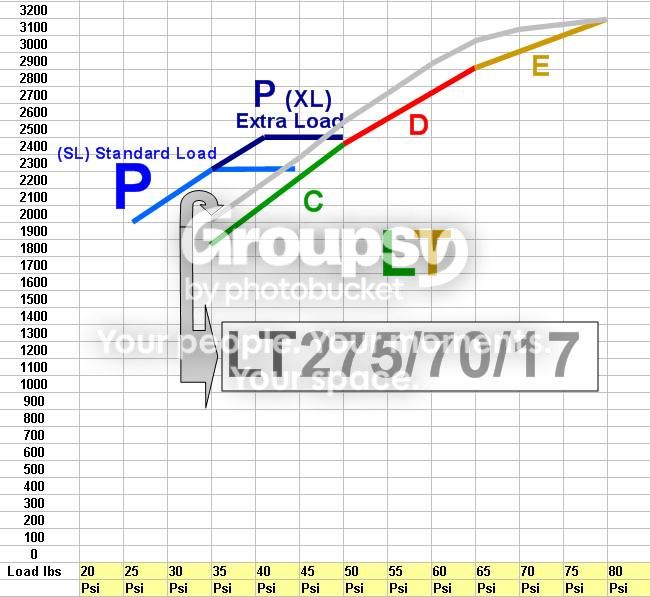
Tire size makes a difference. More air equals more load capacity, whether it's a bigger tire or more pressure in a given tire. The grey curve extends the full distance, so it would be Load E
Truncatedcharts3.jpg~original
 
Last edited:
Register to hide this ad
Where did the charts originate? Copy this over to the 5G side please. I'm sure it will help some of those guys. Good stuff.
 
good charts. The only thing is not clear to me is a maximum pressure when tires still keep enough traction to make a stable ride and especially stable turns let say on rain. Becasue as I see it if I pump tires up at let say 50 psi I might like bumpy ride and it's going to be safe from load capacity point of view but I'm sure that I'll reduce traction at least by half. And I'm going to regret it if I have to make sharp turn on wet pavement. Or hit an icy path on the road.
But I guess that nobody knows it for sure.
 
Someone's on a tire research mission! This is good info, a gap in my auto knowledge apparently! Nice to fill it in some, I can make sure I'm at 22 PSI or greater when towing my boat now after some quick mental math... :P

Should be 5000lb 4 Runner / 4 tires = 1250 / tire, adding 200 per rear tire for a 400 lb tongue weight (obviously conservative by ignoring fronts) = about 1450 lbs / tire --> ~22 PSI?

Anyway, cool to see some numbers, take away seems to be there's plenty of room for error before things get bad... unless you have a Firestone Exploder and love to run 12 PSI ahahaha...
 
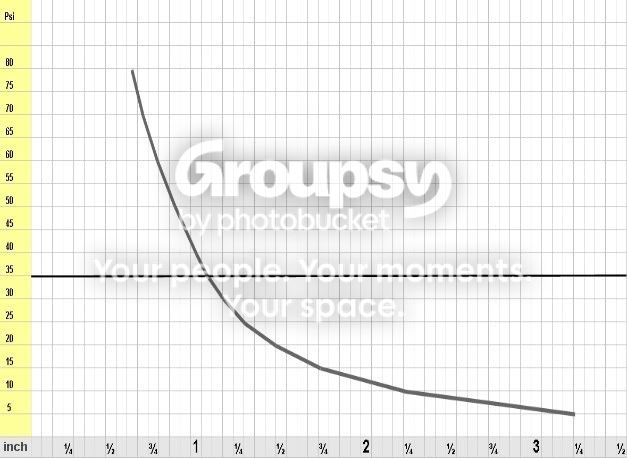
Was playing around with a small compressor in the garage a few weeks ago. One thing led to another and I ended up measuring tire deflection on the passenger front in 5lb increments from 80psi down to 5psi. The result is the graph below. One thing I wanted to know is what the curve looked like below 35psi where the load tables end for LT tires. I originally drew the lines in the charts, above, straight down to 20psi to make the relationships more obvious at a glance. They are a little too straight as it is, but continuing them straight past the end of the load tables needed to be fixed, and now it is.

It's interesting to me how 35psi is just about the spot where the curve below really starts to bend. I'm assuming it's no coincidence that's where the LT load tables end.

Deflectioncurve.jpg~original
 
Last edited:
idk where you got those graphs but they are way off... E rate tires typically hold 3600+lbs, at 80-85psi your graphs are showing tires maxing out at around 3000-3100lbs @80psi... thus throwing off your entire graph. having worked a both independent tuner shops and dealers, and been apart of several race teams and having also worked for a tire shop, i have been around tires of all makes types and styles, E rated tires can support the equivilant load of a P tire with lesser amount of psi. its in the construction of the LT type tire, now the same is true for D and C rated tires, although the gap is much less the lower the rating you go. also not all tires are created equal, one tire manufacture might say their D rated tire is able to hold 3450lbs while another manufacture will say 3500lbs... same is also true with the P tires as well, -and its not can also change within the same tire manufacture one style or design of tire might hold more or less than another(all in the same aspect ratio size)

just some food for thought. i dont know where you got the info, but its more than a little misleading...
 
Color me confused too. I check my street air pressure by looking to see if the tire bulges where it touches the ground, and if it does, I add air. My E rated KM2s require about 10 PSI less than the P-rated BigO Bigfoot ATs they replaced, so I don't get it.
 
idk where you got those graphs but they are way off... E rate tires typically hold 3600+lbs, at 80-85psi your graphs are showing tires maxing out at around 3000-3100lbs @80psi... thus throwing off your entire graph. having worked a both independent tuner shops and dealers, and been apart of several race teams and having also worked for a tire shop, i have been around tires of all makes types and styles, E rated tires can support the equivilant load of a P tire with lesser amount of psi. its in the construction of the LT type tire, now the same is true for D and C rated tires, although the gap is much less the lower the rating you go. also not all tires are created equal, one tire manufacture might say their D rated tire is able to hold 3450lbs while another manufacture will say 3500lbs... same is also true with the P tires as well, -and its not can also change within the same tire manufacture one style or design of tire might hold more or less than another(all in the same aspect ratio size)

just some food for thought. i dont know where you got the info, but its more than a little misleading...

I am not positive, but I think the max load for E rated tires really depends on the size and not the load rating...the chart [MENTION=2798]JB.[/MENTION] seems pretty spot on for the 265/70R17 tire size...
 
idk where you got those graphs but they are way off... E rate tires typically hold 3600+lbs, at 80-85psi your graphs are showing tires maxing out at around 3000-3100lbs @80psi... thus throwing off your entire graph. having worked a both independent tuner shops and dealers, and been apart of several race teams and having also worked for a tire shop, i have been around tires of all makes types and styles, E rated tires can support the equivilant load of a P tire with lesser amount of psi. its in the construction of the LT type tire, now the same is true for D and C rated tires, although the gap is much less the lower the rating you go. also not all tires are created equal, one tire manufacture might say their D rated tire is able to hold 3450lbs while another manufacture will say 3500lbs... same is also true with the P tires as well, -and its not can also change within the same tire manufacture one style or design of tire might hold more or less than another(all in the same aspect ratio size)

just some food for thought. i dont know where you got the info, but its more than a little misleading...

I believe the numbers are correct for the 265/70/17 size. Other sizes in load range E will be rated higher, some less. I know for a fact my 285/70/17 BFG ATs (load range E) that were on my silverado were rated at 3195lbs @80 psi. The same size BFG ATs that were on previously (load range D) were rated at 3195lbs @ 65psi. I have seen some load range E tires with over 4000lbs rated capacity while others less than 3000. His chart seems ok to me.
 
idk where you got those graphs but they are way off... E rate tires typically hold 3600+lbs, at 80-85psi your graphs are showing tires maxing out at around 3000-3100lbs @80psi... thus throwing off your entire graph. having worked a both independent tuner shops and dealers, and been apart of several race teams and having also worked for a tire shop, i have been around tires of all makes types and styles, E rated tires can support the equivilant load of a P tire with lesser amount of psi. its in the construction of the LT type tire, now the same is true for D and C rated tires, although the gap is much less the lower the rating you go. also not all tires are created equal, one tire manufacture might say their D rated tire is able to hold 3450lbs while another manufacture will say 3500lbs... same is also true with the P tires as well, -and its not can also change within the same tire manufacture one style or design of tire might hold more or less than another(all in the same aspect ratio size)

just some food for thought. i dont know where you got the info, but its more than a little misleading...

Your post highlights why I made the thread. This continues to be an area of great confusion.

A careful reading of the first post and the linked load/inflation table should clarify things. The problem is, it kind of flips the things you posted upside down so it may be difficult to believe.

LTs carry less load (size and psi being equal) than Ps because they create more heat and the rubber, due to thickness and composition, is more prone to long term cracking when flexed.

There is also a link above to a Q&A page for a tire engineer.
 
Last edited:
ok i see what you are saying, and your theory is correct, lb for lb yes a p rated tire will carry a greater load, but in reality you can run a E rated tire at 25psi and it will hold the weight of a 4runner just fine, you CAN NOT do the same thing with a P rated tire, it simply wont work... if you do not believe me try it.

you are trying to do a lb for lb comparison but your only control is tire size and, you have too many variables to make your statements concrete.

so i can carry a load of 15,000lbs @80psi with my tires, my 4runner lets say weighs 1/3 that @5000lbs(thats with a average daily load roughly). now for my tires to support that load i should only need 1/3 of their max psi correct? yes so i really should only need 26.4psi per tire to hold the weight properly, and i can assure you that at even 25psi in my tires there is no abnormal squatting or increase in rolling resistance, or increased consumption of fuel. now lets try the same thing with your passenger rated tire your max load is 11332lbs @ 35psi. so 5000lbs of the 11332 is roughly 44% so we will run our P rated tires at 44% of 35psi which is 15.4psi... does anyone see a problem yet? you need to run your P rated tires are a high percentage wise psi than you do an E rated tire, no way no how will a p rated tire cary more load then an e rated tire per psi, even in a ratio comparison such as this...

and if you are gonna try and tell me that the side walls will break down faster with an E rated tire run at a lower psi than recommended im not gonna buy it, besides even if it did, i still only have a 5000lb truck, not a 10,000lb truck so im not worried in the least that i might have lost 20% of my tires load carrying capacity

i get your theory, and it works in theory but in reality its never gonna work out, physics and natural "laws" and science and math say otherwise, so does the real world and everyday usage.

now what i will agree on is that a P rated tire will have a much softer ride at 35psi then a E rated tire will at 80psi, but just as i have shown above there is no need to run the E rated tire at 80psi in our rigs unless you are looking to the up-most possible mpg say like on a road trip where 98% of your driving will be hwy driving. other than that you can run your E rated tire at a much lower psi, say like 35psi and have at least as nice if not nicer ride than the P tire, all the while having a tire that has deeper treat, and a thicker carcass to help hold up to road hazards like potholes or glass or curbs ect. and with a P rated tire there is as not much leeway in your psi adjustments as there is in a E rated tire, you cant just drop 10lbs and call it good cause you want a softer ride or you cant increase psi cause you want better mileage or you want to carry a heavy load like you can with the E rated tire. nor will the tire hold up off road to rock and sticks or other dangers like an E rated tire will, not to mention the shallower tread.
 
I believe the numbers are correct for the 265/70/17 size. Other sizes in load range E will be rated higher, some less. I know for a fact my 285/70/17 BFG ATs (load range E) that were on my silverado were rated at 3195lbs @80 psi. The same size BFG ATs that were on previously (load range D) were rated at 3195lbs @ 65psi. I have seen some load range E tires with over 4000lbs rated capacity while others less than 3000. His chart seems ok to me.

yeah i see that now, i was reffing my tires, i over looked that his graph was off of a 265, my bad, but then again he is also quoting two different tire sizes himself which imo adds to the confusion as well. this goes to a point i was making as well though, that different tire manufactures will rate their respective E rated tires all differently... your 285 70 17 BFG ATs are rated at 3195lb @80psi, while my 285 70 17 Nitto Terra Grapplers are rated at 3750lbs @80psi.... its all extremely variable and one little change in any think can throw things way off... heck there are even different ratings among the E rated tires of the same size and make and design...
 
Somebody help me out please - why are we comparing optimum inflation pressures of P-Metric tires vs LT tires for an indicated Gross Vehicle Weight of 8800 pounds for a vehicle that has a GVWR of 6300 pounds (2013 SR5 4x4)?

Load carrying capacity isn't the only factor that affects vehicle manufacturer's recommended inflation pressures. Vehicle manufacturer's can and do adjust their inflation recommendations for their tires based on GVWR, mileage, vehicle handling & safety factors and passenger comfort.

From the chart information provided 44psi in an LT tire is equivalent to 32psi as far as load carrying capability. When you realize that the load carrying capacity exceeds GVWR recommendations by about 2500 pounds you must assume that Toyota had other reasons for recommending 32psi in their P rated tire applications.

The greatly stiffened sidewalls of LT tires (esp so those with higher load ratings) help offset some of the reasons for the inflation requirements on the P metric tire in excess of the vehicles load carrying capacity. As long as you don't drop below your min GVWR rating of 6300 pounds you should be fine. As the vehicle manufacturer doesn't provide inflation pressure recommendations for LT tires, you are on your own to figure it out (other than min load carrying capacity).

At 35 psi, (reading the chart, I didn't dig through the data tables for a precise number) the load carrying capacity of an LT tire is ~1875 pounds for a GVWR of 7,500 pounds. As long as you do not exceed the speed rating for the tire (99mph for my MT tires) and maintain the min 35psi inflation you have not exceeded the tires performance parameters. You may (probably will) find that your optimum inflation pressure for the best combination of mileage/comfort/handling will require a higher pressure. Without manufacturer's rec's you are on your own to experiment and figure it out for yourself.

After much experimentation, I have found 38psi to be the sweet spot (according to me!) for my Tacoma w/ E load MT's. I will have to experiment with the T4R when I upgrade the tires, I'm betting I'm going to like 40psi but we will see. Just like my Tacoma, I suspect that when towing I may like additional pressure in the tires, esp the rears. There is no need to inflate LT tires to 44psi unless you plan on loading your T4R up to 8800 pounds GVW....

David
 
Wow, I knew the 5th gens were porky, but really? 6,300lbs?

You also have to remember that you will increase the weight ontop of GVWR with extra passengers, cargo, and towing; the weight of a trailer on the vehicle imparts load as well. So this may be why the pressure rating is higher than the vehicle's GVWR in an attempt to include all reasonable weight additions to the vehicle.

In any case, Toyota even agrees that LT tires need more pressure. There's a service campaign to replace TPMS modules on TRD FJ Cruisers (They came equipped with optiona LT Tires) because of a higher tire pressure being needed and the baseline P rated tire minimum programmed value being too low (don't ask me why they just don't reflash the module... its Toyota, they haven't been very flash happy in their history...)

Perhaps we need to scrap what we're arguing about right now and start from the ground up. What are the differences in the construction of P, LT, and Commercial tires and how does this affect the tire's flexibility, load, then go into the air pressure. I think that might help allievate confusion.
 

Members online

No members online now.

Forum statistics

Threads
278,315
Messages
3,554,102
Members
248,016
Latest member
Advally Service

Trending content

Back
Top