LT tires need more air pressure.

Wow, I knew the 5th gens were porky, but really? 6,300lbs?

In any case, Toyota even agrees that LT tires need more pressure. There's a service campaign to replace TPMS modules on TRD FJ Cruisers (They came equipped with optiona LT Tires) because of a higher tire pressure being needed and the baseline P rated tire minimum programmed value being too low (don't ask me why they just don't reflash the module... its Toyota, they haven't been very flash happy in their history...)

Perhaps we need to scrap what we're arguing about right now and start from the ground up. What are the differences in the construction of P, LT, and Commercial tires and how does this affect the tire's flexibility, load, then go into the air pressure. I think that might help allievate confusion.

6300 pounds is the GVWR - the vehicle, fuel, passengers, cargo, everything. I don't remember the curb weight off the top of my head, around 4700 pounds if I remember correctly.

I agree w/ extra pressure, at the very least you've got to go up to 35psi, but beyond that you're going to have to experiment a little.

David
 
You're right, was thinking something else for GVWR; GVWR does not include trailers/towing weights though.

Curb weight 4th gen is about 4,300lbs, 5th is about 4800lbs on the higher end, 4,400lbs lower end (I doubt that number though) and for fun, 1st gens are around 3,700lbs. Pretty damn porky for an SUV that only has a V6...
 
Last edited:
ok i see what you are saying, and your theory is correct, lb for lb yes a p rated tire will carry a greater load, but in reality you can run a E rated tire at 25psi and it will hold the weight of a 4runner just fine, you CAN NOT do the same thing with a P rated tire, it simply wont work... if you do not believe me try it.

I love easy experiments that bring real evidence to endless discussion. I perform them whenever possible. Unfortunately, I don't own P tires but otherwise I'd be happy to run them at 25psi for a while (with due caution). I'm sure cornering would be less stable and mpg would suffer, but what else is it you imagine would happen?

I'm not saying LT tires are bad -- look at my sig. If someone is going to beat up their tires offroad, by all means get some. But I do dispute the common idea that they're the only way to go and are superior to P type tires. P-metric tires generally outperform them on pavement, especially in wet conditions where the water is not deep.

LTs simply have certain performance characteristics that may or may not be desirable depending on application. One important way they're different is the load/inflation curve and it's something worth knowing. The tire load reserve on 4th and 5th gens is generous enough it mostly doesn't create a problem but it could create one on, say, a 3rd gen with the smallest stock tire size offered and then switched over to an LT of the same size with no adjustment in pressure.

As far as the sidewall, here's a small point to consider. Yes, the LT sidewall is stiffer but the deeper tread and thicker carcass mean there is less air volume inside a tire that has the same outside dimensions. The P tire holds more air volume at the same psi. I'd love to do the same deflection experiment on a P tire that I did on the previous page. I'll bet the curve would look nearly identical (please feel free to contribute some experiments along these lines yourself.) Also, I specifically asked the tire engineer about sidewall life, specifying that size, load and (low) psi were the same between the tires and that rough treatment of the tire was not part of the equation. He said he would expect the aired down P tire sidewall to last longer. This is mostly academic and irrelevant for offroading, but it illustrates a non-intuitive point that helps demonstrate why the load/inflation curves can be different between the two.

But the Tire and Rim Association publishes the load tables, not me. If you think they are misleading, write to them.
 
Last edited:
....this goes to a point i was making as well though, that different tire manufactures will rate their respective E rated tires all differently... your 285 70 17 BFG ATs are rated at 3195lb @80psi, while my 285 70 17 Nitto Terra Grapplers are rated at 3750lbs @80psi.... its all extremely variable and one little change in any think can throw things way off... heck there are even different ratings among the E rated tires of the same size and make and design...

Dude, you're killin' me.

I'm trying to be polite (I didn't even bring up your advice in the other thread to run an LT at lower than P road pressure to break it in) but you've had ample opportunity to check out the sources which you apparently refuse to do. Tire size and type, alone, determine load capacity, regardless of brand. Again, write to the TRA.
 
Last edited:
I'm going to offer a good solution for the LT tire pressure. Instead of arguing abut this just look in the manual. It clearly says how to determine maximum load for a tire. Basically you'll need to check door sticker for Gross Axle Weight Ratings (there is two for front and rear axle) and pick one whichever is greater. Then you divide this number by two and now you know your maximum load of tire. Then you find your tire in the LT tire load table and see the correct maximum pressure. No guesses, confusion or arguments.
 
I'm going to offer a good solution for the LT tire pressure. Instead of arguing abut this just look in the manual. It clearly says how to determine maximum load for a tire. Basically you'll need to check door sticker for Gross Axle Weight Ratings (there is two for front and rear axle) and pick one whichever is greater. Then you divide this number by two and now you know your maximum load of tire. Then you find your tire in the LT tire load table and see the correct maximum pressure. No guesses, confusion or arguments.

Scanny,

That will give you your correct minimum pressure, not maximum right?

For stock sized LT tires on the 5th gen 265/70R17 the min pressure is 35psi. That is the min acceptable for an LT tire, will give 7500 GVWR, 3,750 per axle. But there are other reasons to increase tire pressure beyond min load specifications. Increased tire pressure may give increased gas mileage, improved on road handling characteristics which are to be balanced w/ passenger comfort and tire wear characteristics.

The min pressure for the P metric tires is 26 psi which yields GVWR capacity of 8,000 pounds, 4,000 per axle. Again, this meets the minimum necessary to be within the design parameters for this vehicle and tire combination. Toyota recommends tire pressure of 32, not the min of 26 to increase performance in other areas beyond load carrying capacity. Presumably the additional pressure increases gas mileage, provides enhanced on road handling and tire wear characteristics while providing an acceptable compromise in ride comfort.

A good starting point to provide optimum mileage/road handling would be a similar percentage increase from min in the LT tires as the percentage increase in min over P metric tires. 32/26 = 123% over min. 35x 123% = 43psi. That is the equivalent psi in the LT tires.

The problem with that is that LT tires have much stiffer carcasses and side walls than P metric tires and as such don't require as much air pressure increase over min to achieve optimum mileage, on road handling and wear benefits. The optimum is likely be somewhere in between 35 and 43 psi and you will have to determine what feels best for your particular tire/load combination. I suspect that in instances where the same LT tire is offered in both a D and an E rated tire, the E rated tire will require a slightly lower optimal pressure (maybe 1-2psi?).

Thoughts?

David
 
I love easy experiments that bring real evidence to endless discussion. I perform them whenever possible. Unfortunately, I don't own P tires but otherwise I'd be happy to run them at 25psi for a while (with due caution). I'm sure cornering would be less stable and mpg would suffer, but what else is it you imagine would happen?

Due to my own negligence I've done this before for ~750 mile long road trip. I did not find anything wrong besides the outer edges of the tires wearing off a bit more than the center. I actually didn't even notice any significant difference in handling throughout the drive and only found out after I got back from my trip and checked my tire pressure (which was in the low 20s). And yes if you are wondering, now I check my pressure before I leave for a road trip instead, lol.
 
Scanny,

That will give you your correct minimum pressure, not maximum right?

David


Well it depends on point of view, from Toyota (truck) point of view, minimum tire pressure are for not loaded truck, and maximum is for fully loaded truck. You don't have to go any higher than that.

From tire and people point of view tire maximum pressure is written on tires.

a little bit mix up in terms , so let's say that our truck requires 35 psi to support fully loaded axles. Then you can set any pressure higher than 35 psi up to tire max pressure limit.

In my experience when I run tires at 44psi they were running quieter and provided better fuel economy but they started wearing more in center and outer side weren't fully touching the pavement which might be not a good thing in slippery conditions.

I did "chalk test" at 44 psi, sort of - I was driving on gravel road and was shocked that at 44 psi about an inch of each side of outer side lugs was black when tire in centre was grey from dust. Same thing in the winter when you drive over salt you can see how much of your tire is actually touching the pavement. So as long as you have full contact you're good to run over required pressure, otherwise you're promote uneven wear and reduce tire grip. But if fuel efficiency and less noise is more important maybe it's not such a bad thing.
 
Last edited:
Well it depends on point of view, from Toyota (truck) point of view, minimum tire pressure are for not loaded truck, and maximum is for fully loaded truck. You don't have to go any higher than that.

From tire and people point of view tire maximum pressure is written on tires.

a little bit mix up in terms , so let's say that our truck requires 35 psi to support fully loaded axles. Then you can set any pressure higher than 35 psi up to tire max pressure limit.

In my experience when I run tires at 44psi they were running quieter and provided better fuel economy but they started wearing more in center and outer side weren't fully touching the pavement which might be not a good thing in slippery conditions.

I did "chalk test" at 44 psi, sort of - I was driving on gravel road and was shocked that at 44 psi about an inch of each side of outer side lugs was black when tire in centre was grey from dust. Same thing in the winter when you drive over salt you can see how much of your tire is actually touching the pavement. So as long as you have full contact you're good to run over required pressure, otherwise you're promote uneven wear and reduce tire grip. But if fuel efficiency and less noise is more important maybe it's not such a bad thing.

That's pretty much what I've seen on my Tacoma - 38psi w E rated seems to be optimum. Don't have tires for the T4R yet, but will soon...

David
 
I'm going to offer a good solution for the LT tire pressure. Instead of arguing abut this just look in the manual. It clearly says how to determine maximum load for a tire. Basically you'll need to check door sticker for Gross Axle Weight Ratings (there is two for front and rear axle) and pick one whichever is greater. Then you divide this number by two and now you know your maximum load of tire. Then you find your tire in the LT tire load table and see the correct maximum pressure. No guesses, confusion or arguments.

That could be a problem because it, too, requires reading.

But this thread isn't really about any "solution" to LT tire pressure because there is no single answer. However, for set and forget simplicity, it's hard to go wrong with simply matching factory load reserve.

This thread was simply intended to make known a non-intuitive fact about the load carrying differences between P and LT tires. Since it's a non-intuitive fact that has been shown over time to not stick easily, I attempted to make it easier by making it visual.

What people do with the information is a separate subject, but it's information worth knowing.
 
That could be a problem because it, too, requires reading.

But this thread isn't really about any "solution" to LT tire pressure because there is no single answer. However, for set and forget simplicity, it's hard to go wrong with simply matching factory load reserve.

This thread was simply intended to make known a non-intuitive fact about the load carrying differences between P and LT tires. Since it's a non-intuitive fact that has been shown over time to not stick easily, I attempted to make it easier by making it visual.

What people do with the information is a separate subject, but it's information worth knowing.

I for one appreciate your thread on LT tires. I have learned quite a bit from your link to the tire engineer and your posts and as I am getting old it's tough to teach me new things lol. Thanks!
 
That could be a problem because it, too, requires reading.

But this thread isn't really about any "solution" to LT tire pressure because there is no single answer. However, for set and forget simplicity, it's hard to go wrong with simply matching factory load reserve.

This thread was simply intended to make known a non-intuitive fact about the load carrying differences between P and LT tires. Since it's a non-intuitive fact that has been shown over time to not stick easily, I attempted to make it easier by making it visual.

What people do with the information is a separate subject, but it's information worth knowing.

Excellent information presented. Glad you posted the graphs so the data is preserved if the links eventually go dead.

Thanks,

David
 
That could be a problem because it, too, requires reading.

But this thread isn't really about any "solution" to LT tire pressure because there is no single answer. However, for set and forget simplicity, it's hard to go wrong with simply matching factory load reserve.

This thread was simply intended to make known a non-intuitive fact about the load carrying differences between P and LT tires. Since it's a non-intuitive fact that has been shown over time to not stick easily, I attempted to make it easier by making it visual.

What people do with the information is a separate subject, but it's information worth knowing.

That's what I completely agree with.
Good info and it's up to people what to do with it : )
 
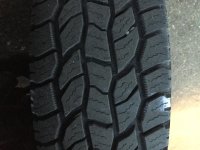
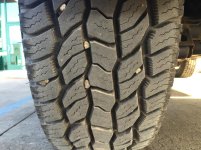
Crossposting for visibility from my other thread. 265/70/17 C load.

I'm not understanding this footprint for LT load range tire here. I know to get the same load rating as stock I need to be at 44psi, but this doesn't look right to me. Shouldn't I have even wear all the way across to the end of the lugs?

The first pic is my chalk test at 40psi.

The second is my tire footprint on a dirty paved road at 44 psi. You can see an inch or so on each side that has no contact.

Now, I think I get a fairy flat footprint at 38 psi (no pic), but I feel like that's a little low + it ends up driving a little wiggly and loose.
 

Attachments

  • Photo Dec 08, 5 11 07 PM.jpg
    Photo Dec 08, 5 11 07 PM.jpg
    132.7 KB · Views: 2,926
  • Photo Dec 09, 1 26 30 PM.jpg
    Photo Dec 09, 1 26 30 PM.jpg
    137.3 KB · Views: 2,907
On mine LT C load I keep around 36psi for the past 3 years (80,000km /50,000 miles) with no issues. No trying get stock load rating though, simply using Gross Axle Weight Ratings as per manual.
 
Thanks, I was driving at 35 psi for awhile which prompted me to make a thread on why my 4R was so touchy on the highway. I found that pressure to affect my ride negatively on the highway. Bumping the pressure up really helped stability. My main concern now is traction and safety through the winter.
 
I'm not understanding this footprint for LT load range tire here. I know to get the same load rating as stock I need to be at 44psi, but this doesn't look right to me. Shouldn't I have even wear all the way across to the end of the lugs?

For your sanity, forget the chalk test.

Just monitor wear, it works much better. It's a direct indicator that utilizes time and takes driving habits into account. Any possible sub-optimum wear will happen so slowly that you'll have plenty of time to make any psi adjustments if you rotate normally, but adjustments probably won't be necessary.
 
Thanks for the reply.

So is it possible that driving at 35 psi for the first 5K miles has worn the outer edges to the point that at proper psi would leave the edges of the treadblocks with minimal contact? It doesn't seem like it would wear that fast - i'll have to get out the tread depth guage and check. I'm having a hard time looking at the dirt pattern on the tire and thinking I'm getting the best traction/footprint possible.

At 44 psi, it rides great, handles fine and has good road manners. BUT now that winter is here, I don't want to be rolling down the snow and ice on a doughnut shape that doesn't utlize all the tread. I'm sure after driving enough the center will wear and the outer edges will start to make contact.

I'm also not quite sure how to monitor for sub optimum wear.
 
Thanks for the reply.

So is it possible that driving at 35 psi for the first 5K miles has worn the outer edges to the point that at proper psi would leave the edges of the treadblocks with minimal contact? It doesn't seem like it would wear that fast - i'll have to get out the tread depth guage and check. I'm having a hard time looking at the dirt pattern on the tire and thinking I'm getting the best traction/footprint possible.

At 44 psi, it rides great, handles fine and has good road manners. BUT now that winter is here, I don't want to be rolling down the snow and ice on a doughnut shape that doesn't utlize all the tread. I'm sure after driving enough the center will wear and the outer edges will start to make contact.

I'm also not quite sure how to monitor for sub optimum wear.

If you want to play around with all this, that's fine.

If you'd like to be done with it, just pick the psi that gives you the handling you want (since you're in a reasonable psi range) and then pay attention to the wear at whatever interval makes you comfortable (not going longer than rotation schedule). To track the wear over time, pick two or three spots on the tire and take a few guage measurements to establish a consistent reading and note the readings and measurement location. Pictures make it easy to keep track.

Within a reasonable psi range, the tread wear effect due solely to pressure is very subtle and the evenness of the wear over time will be dominated by driving conditions, so trying to take care of it up front with a chalk test is not very useful.

As for the winter footprint, the difference in footprint coverage between 38 and 44 psi would be very small, and the slightly more concentrated ground pressure at 44psi might well give you better winter road performance.
 
So, what pressure should I be running LT265/70R17 BFG TA KO2 on stock 2015 SR5P here in San Diego? :help: :biggrin2:

35?

44?
 

Members online

No members online now.

Forum statistics

Threads
278,316
Messages
3,554,112
Members
248,016
Latest member
Advally Service

Trending content

Back
Top