Non OEM Aftermarket Parts and Components

Everything I have owned since about 2000 has had a K&N style air filter put in it. Less for the added airflow than for the ability to clean and reuse it. It pays for itself in about 3 oil change intervals. You just have to be careful NOT to over oil it after cleaning. I will probably start doing the same thing with the cabin filter now that I know they are out there.
 
I have had varying experiences with various wiper blades. I typically use Bosch Icon, they have good consistent pressure along the blade, their performance is better near the end of their life than cheaper blades, and don't make noise as they wear out. The consistent pressure along the blade is the key element I look for and something I did not feel the OEM blades did as well.
 
This is THE FIRST vehicle that I have ever even considered replacing worn out parts with OEM.

Wiper blades (inserts)- OEM best I've ever owned/replaced. Period.

Brakes- over 81,000 miles now and still have pad left and absolutely zero shudder, shimmy, vibration. Nothing. Truck stops straight and true with no drama. All the more remarkable since I tow a boat with no trailer brakes every week, on average.

Air filter- Look at the aftermarket air filters and there is really no comparison to the quality of the OEM. (Based solely on what I have observed FWIW)

Oil Filter- Super cheap and excellent quality- why even consider anything else?

Hell, I may even take the damn thing to the (gasp!) dealer to have the tranny fluid changed one of these days.


I am turning into [MENTION=66316]1engineer[/MENTION]. :help:
 
Because I've always done my own work - maint or repair, I use OEM while the vehicle is under warranty and for as long as OEM for that vehicle is readily available. I rarely put less than 300K on a vehicle.

Once I get past say 200K, I generally go with after-market except for the alternator/starter. Those 2 items I have rebuilt when they get tired. I don't trust any after-market alternator/starters.

I'm not an engineer or scientist, nor do I care to get lost in the maze at the Bob-the-oil-guy-forum, but will say I have had a few "beaters" that went over 300K on Walmart oil and Fram oil filters.
 
My thoughts are best money can buy. For me I'm always after all the performance I can cram into the vehicle.

I love driving my vehicles hard. Although this is my first ever truck/suv I have ever owned, I have owned many sports cars and performance sedans.

I enjoy track days, SCCA solo1 and solo2. HPDE... California mountain passes etc.

I use up the vehicle's consumables quickly because I'm aggressive for corners/turns and braking. I do not baby my vehicles and drive them like they were intended to. I do however pay attention to making sure it's properly maintained and properly used (i.e. warmed up, and cooled down).

Because of this many OEM items do not live up.

Example: Cracked OEM brake rotors for my s2000 at track days with aggressive track pads. I carry a spare pair of front brake rotors, jack, sears 250 pcs socket/wrench set + various other hand tools with me when I hit the track.

I expect more from the vehicle than what OEM intended it to be. My last car a 2003 Subaru legacy was lowered with the B4 legacy JDM springs, and shocks... BBS wheels.... The car looked beautiful on the outside (no dings, perfect paint, perfect underbody, perfect interior), but the centre differential was burned up, the rear differential was also burned up too.

For me, I'm looking at the highest quality parts I can find. This means the best motor oil money can buy, best brake pads, highest boiling point brake fluid. Stickest tires, lightest rims, lightest suspension components. Best valved shocks. I will read and analyze damping curves of shocks for s2000s and rx7s to understand how many clicks I should set the coilovers at for the given race track.

I have and still do my own alignment with camber gauges, string, calculator/spreadsheet, toe plates etc. I used to be team captain of my school's FSAE race team more than 10 years ago.

For oil filters, I want one that has the highest flow rate with the ability to filter the smallest particles. I also want one that has the proper oil pressure bypass so the engine will never get starved. Example: the Honda s2000 oil filter is specially designed for all these considerations. No other oil filter on the market meets the requirements of the F220/22C motor.

For brake pads, I want a high coefficient of friction, with low noise and dust. I also want them to be have super high temperature range and is soft so that the pads are sacrificial compared to the rotors. But that is difficult because most manufacturers add metallic components to get the coefficient of friction high.

For oil... well that discussion spans an entire website (bobistheoilguy). I'm a big fan of Redline Oils. I use it on everything unless testing has shown a better product exist. Case in point, Honda MTF is the best oil because of the high rpms for the shaft speeds and syncros when you are at 9000 rpms.

Wiper blades, I have always loved PIAAs. From the 15+ years of driving in the salt belt in the middle of winter, PIAAs wipe the cleanest, and last the longest. However for the 4runner, they have a different blade design and I no longer live in the land of ice and snow so I'm happy with how the OEM ones work right now.

Brake rotors: I always went with Brembo blanks or ATE rotors. The casting quality is high, meaning they don't rust or crack as quickly. They also don't wear as fast as made in Canada/USA teir 1 stuff. As a side note: my friend works for a tier 1 OEM aftermarket company. They are claimed to be made in USA. However they cheat, they import scrap steel from China that is already cast in the shape of a brake rotor, the casting quality is garbage. They do the final machining in USA and claim them to be made in USA. They crack under hard use, and also wear super fast.

Tires... I always loved Japanese tires for sports cars. Bridgestone RE-11, Dunlop Starspec Z1... again I have never owned a truck or SUV before my 4runner, so the tires thing may not apply

Wheels: Lighter the better. A 17" wheel needs to weigh no more than 18lbs. I think some of the FN wheels are pretty light.


________________________________________
Jason Cheng
Google [x] | NPI Program Manager - Mfg Eng
☎ m: +1.650.215.3123 | ✉︎ e: [email protected]

 
Example: my '11 Tundra Crewmax w 125k miles. Replaced shocks two weeks ago. Research found Bilsteins that Toyota included were the entry product for that company. Not bad, but went to 5100'a for $16 additional and got a firmer shock, which I like. Upgrade IMHO.

Stock tires are a slim variety of entry level offerings from a couple of manufacturers, compromising in order to check the box on ride comfort, roll resistance, expected longevity, etc. Excelling at nothing except pt maybe best MPG delivery (along w a mushy ride). After market - even non AT selections - give me some flexibility in meeting my preferences. Not the ones Toyota selects for "Everyman." (Bridgestone Alenza Plus for Tundra and '15 SR5P 4R). Upgrade IMHO.

There's the perception that I can indeed gain desired advantages by selecting the non-mass-purchased-generally-intended-to-be-least-offensive consumables.

Windshield wiper blades? Check! Cabin air filter? No check! (Cheaper works here).
 
For me at least, I only go outside OEM offerings if I am:
1- trying to accomplish something that cannot be achieved using an OEM product/part... such as a lift, or in the case of my VW GTI, a stiffer rear sway bar.
2- if I can get OEM performance/quality from a part at a cheeper price (a rare occurance)

Otherwise, it is OEM for me. It just makes life so much easier and you have the assurance of compatibility, so why look anywhere else?

I agree with this completely. Pretty much anything on my 4Runner that isn't Toyota is basically because I found something that performs just a bit better than the factory stuff (often at an increase in cost.) For example my current oil is Amsoil's Signature Synthetic 5w-30 and their oil filter; why their oil filter and not a tried, tested, and proven quality YZZD3 or a religiously vaunted "Supra" Filter? Mainly because the Amsoil is just a smidge better at filtering smaller particles and because if I use that combo they'll warranty any damage that occurs as a result of their 25k (15k serve driving) oil change interval (and they do honor it.) At a couple dollars premium over the Toyota, it was a no brainer. I also plan on running some beefier rotors and brake pads, why? The factory ones are adequate, but with the extra gear I need more bite and less over-heating/glazing that I am seeing with the factory pads (which are a compromise between cost, dust, performance, longevity, and harshness.) As for the air filter, I run the Toyota stuff because honestly at the cost I get them at, they're great and perform so well I have little use for anything else at the moment.

Any name brand synthetic in the proper viscosity is fine. There is no better or worse as long as you stick to the major suppliers. Why? Because these vehicles see a very light duty cycle as a rule. Even pulling a trailer a few times a year or going off road every now and then is light duty. Now, if you were pulling a heavier trailer every day or if you were racing off road then I would get specific and probably change a few things but for everyday use, any name brand is just fine.

Toyotas tend to be really easy on oil (with the exception of some "sludge" motors in the past,) as long as you meet the viscosity and API index of the specified oil; these cars run happy all day. Synthetics will keep the internals cleaner in the long run, but a healthy conservative oil change interval with conventional oil will be similar.

~

Even with some OEM stuff it causes issues. I don't know exactly why, but Toyotas like Denso and NGK parts/sensors typically; people get weird issues when running Bosch plugs (and we're talking the nice quality ones.) I never really did figure out why, but often something as simple as just swapping back to Denso fixes their intermittent misfires and such they had with Bosch.
 
Everything I have owned since about 2000 has had a K&N style air filter put in it. Less for the added airflow than for the ability to clean and reuse it. It pays for itself in about 3 oil change intervals. You just have to be careful NOT to over oil it after cleaning. I will probably start doing the same thing with the cabin filter now that I know they are out there.

See you should get the Afe dry filter, slightly better filtering and you wash it out every 40-50k, no extra oiling, time, or money spent. But that's for another thread, haha.

On topic, still waiting for my brakes to wear out, still amazed given the three sets I went through with my last pos by this same mileage.
 
Last edited:
regarding wiper blades. my wife has a new ish volkswagen golf. the oem wiper blades are complete and utter ****ing garbage. they are a clip in style that is hard to find, but i finally found some at a parts store and the brand they sell, whose name escapes me are significantly better, at less than half the cost. volkswagen is a joke in general, and nothing OEM of theirs stands up at all. I will go out of my way to get non OEM stuff for it. Its always cheaper but even if it wasn't I'd still go non OEM.

the idea that these big manufacturers have performance and satisfaction in mind (resulting in the best quality OEM products) is quite frankly, ridiculous. They are all after profit at almost any cost, all the time, no matter what. No one is thinking long term customer satisfaction anymore, and haven't for probably 40 years. The only reason shit doesn't fall apart sooner is because they want to maintain profitability. They aren't going to make junk that falls apart perceivable "soon", because that will be unprofitable. planned obsolesence is very profitable however.

Id like to see the data on OEM brake pads performance vs aftermarket, especially in regard to the touted "stopping power/lifetime" ratio.
 
What you say is true but there are so many levels...

For example Brembo could just meet Toyota specs and private label for Toyota. This would allow both Toyota and Brembo to sell the exact same component under different names only. We do that all the time.

In some cases Toyota might want a "proprietary" design from Brembo and this would mean extra cost up front but only Toyota could then sell that exact same component. Brembo would then have to make a change to sell their product. We do that also.

Bottom line is how do you know unless you are in the know? You don't. I don't. Only a few do.

I understand some thinking you are paying for the Toyota "box" it comes in but to me you are also paying for a component built to Toyota specs. Is the price really that much different on consumables?

I agree, I'm just to lazy to try and explain all of the possibilities. I just don't want someone to purchase parts from "Toyota" and think they are necessarily getting the same product that came off the assembly line.

I probably give people too much credit when it comes to researching any products for their vehicles. If it costs more than $100, I tend to spend a lot of time researching whatever it is that I want. If its under that, I'm more likely to try a product and see if there are any noticeable benefits.
 
The problem with "OEM" parts, in this case I'll use brake rotors, is that they aren't the same rotors that came off the assembly line........

So, bottom line, if Toyota is going to use "OEM" aftermarket, why shouldn't we just bypass the markup to provide the Toyota part number and box? Granted, you have to do a lot more research as to what kind of product went into your truck in the first place.

What you say is true but there are so many levels...

For example Brembo could just meet Toyota specs and private label for Toyota. This would allow both Toyota and Brembo to sell the exact same component under different names only. We do that all the time.

Sorry I Didn't want to post your whole quotes.

I totally agree you have to know whom is manufacturing those parts. Granted it is easier with the Internet, and some are easier than others to determine. Still can be a daunting amount of work, might not be the exact same part, and said work sometimes costing the difference in price in the time spent researching.

For example, most recently, the Superwinch I bought had this crappy proprietary plug, I had to dig it out from the actual manufacterer of the plug components and order samples, great lesson, but for sure a PITA.
 
According to Bobistheoilguy

The Toyota 0w20 synthetic is one of the if not top 0w20 oil available.

Toyota SN 0W20 VOA | Virgin Oil Analysis - PCMO/HDEO | Bob Is The Oil Guy

I agree with Ducmonsta. I have zero interest in using any Toyota branded part that is not the same as the one coming off the assembly line. I remember Subaru with their "six star" service parts. They were utter garbage. The alternators they sourced were horrendous, the brake rotors were so soft they wore so fast.
 
Um Cheers, I had a neighbor that was a Chem E but I'm not. I did go to the link and read the posts though. I get my VI every morning in my Centrum Silver. I think.

My otherwise-very-good dealership service dept used to use Kendall, now I think Castrol as their "house brand" oil. The stuff comes in a 55gal drum (or metric similar). I'm generally dubious so request Mobil1.

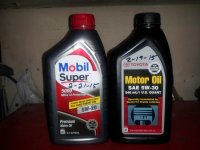
What do you refer to when saying "Toyota" motor oil?
 
It is this one:

CAM000111_zpsbd807ebe.jpg~original


CAM000141_zps6c0b0a44.jpg~original


It is supposed to be the top group IV motor oil. With an amazing additive package good for extended drain intervals (hence 10k change intervals per owners manual).

I'm torn between using the Toyota Synthetic 0w20 and Redline 0w20. Toyota has a VI of 214, whereas Redline is in the 170 VI at best. Most of the bobtheoilguy forums guys believe VI (viscosity index) is the be all and end all. But I still believe that the Redline oil being a Group V oil is still better than the Group IV Toyota 0w20.
 
It is this one:

CAM000111_zpsbd807ebe.jpg~original


CAM000141_zps6c0b0a44.jpg~original


It is supposed to be the top group IV motor oil. With an amazing additive package good for extended drain intervals (hence 10k change intervals per owners manual).

I'm torn between using the Toyota Synthetic 0w20 and Redline 0w20. Toyota has a VI of 214, whereas Redline is in the 170 VI at best. Most of the bobtheoilguy forums guys believe VI (viscosity index) is the be all and end all. But I still believe that the Redline oil being a Group V oil is still better than the Group IV Toyota 0w20.
VI is extremely important as long as the comparison fluids are good quality.
 
I would really like to hear your thoughts and reasoning behind using aftermarket (non OEM) consumable components.

Brake pads


For me, it depends a lot on the ease of purchase. I'll go out of my way a little to get the important OEM items. (Oil and Oil Filter, for example.) Other wear items not so much. The only place locally to get OEM is at the dealer and I try not to encourage those guys. Plus, they're not open on weekends when I do most of my shopping.
 
Not synthetic, but you get the idea.

Aftermarket (Non OEM) vehicle parts have been available to the end user probably since the first Model T rolled off the assembly line. I wanted to post my opinion on them and get everyone's thoughts as well.

Consumable and wear products such as oil, oil filters, brake pads, wiper blades, shocks and others are widely available. [MENTION=69860]chee[/MENTION]rs posted a nice thread yesterday on the different oil filters available. My question is "Why use aftermarket instead of OEM?"

It's been established that our OEM brake pads, under normal usage, will go at least 70K or so and perform great with no noise. Yet I still read threads on people wanting to use other brands.

I am just like the next guy and always looking for a good deal. That deal could be better performance for an increased cost or like performance for a lesser cost. In the case of shocks I understand why people change from OEM. They get a measurable or perceived performance enhancement, albeit at a higher cost. But oil filters? Oil? Brake pads? Wiper blades? I have probably done as much or more research than most of you on component performance.
Let's take oil filters for example:
What improvement can you hope to make by buying another non OEM brand? There are only two performance parameters for an oil filter and those are dirt holding capacity and particle size. Nowhere can I find specs on either of these from an aftermarket company. Oh, larger does not mean it holds more dirt. I know the OEM filter is spec'd out by the designers and it is pretty cheap to boot. Why use something else?

Brake pads:
Brake pads have three performance parameters: Stopping ability, how long will they last and perceived things like noise, dust etc. I know I can put on a set of pads that will stop a few feet shorter than the OEM pads. I know I can buy a set that are a bit cheaper than OEM. For the life of me though I can't find a set that stop quicker, make little noise or dust and cost around the same as the OEM pads.

I know oil is like a religion to some yet I doubt many of you know much about synthetics or additive packages. Wiper blades is another consumable. Can you really find a wiper that will wipe better or last longer than OEM?

I would really like to hear your thoughts and reasoning behind using aftermarket (non OEM) consumable components.
Brake pads

FYI [MENTION=66316]1engineer[/MENTION] is an OEM shill. Do no listen to the lies. Napa brand is sufficient. :cheers:
 

Members online

Forum statistics

Threads
278,317
Messages
3,554,127
Members
248,016
Latest member
Advally Service

Trending content

Back
Top