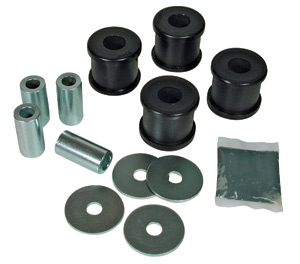
Official SPC(light racing) Product update!!!

Scott@Hightech

New member
Here is the Email i received from SPC while dealing with a warranty claim.
Chris@SPC said:
Scott, the arms that need to be updated are for '05+ Tacoma and '03+ 4-runner/GX and '07+ FJ Cruiser. They would have been sold between April 2012 and November 2012. The easy way to identify them is to note that they have large washers on both sides of each bushing.

Arm kits shipped after November will either have small washers on the
inboard sides of the bushing, or no washers there at all with a little bit
of the pivot sleeve showing. Those kits are current and do not require an
update.

Anyone with large washers on both sides of each bushing should call our
Customer Service line and ask for an update kit, P/N 25478. Installation of
the update will involve replacing the pivot sleeves with slightly longer
sleeves and re-installing the arm without the inboard washers.
The kit includes a grease packet and the four longer pivot sleeves, as well
as instructions.

Performing the update will not change alignment settings.

Chris Hinds
Senior Mechanical Engineer
Specialty Products Company
1-800-525-6505

4045 Specialty Place
Longmont, CO 80504
Specialty Products Company | SPC Alignment | The Automotive Alignment Leaders
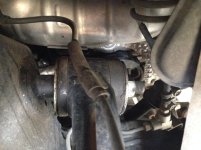
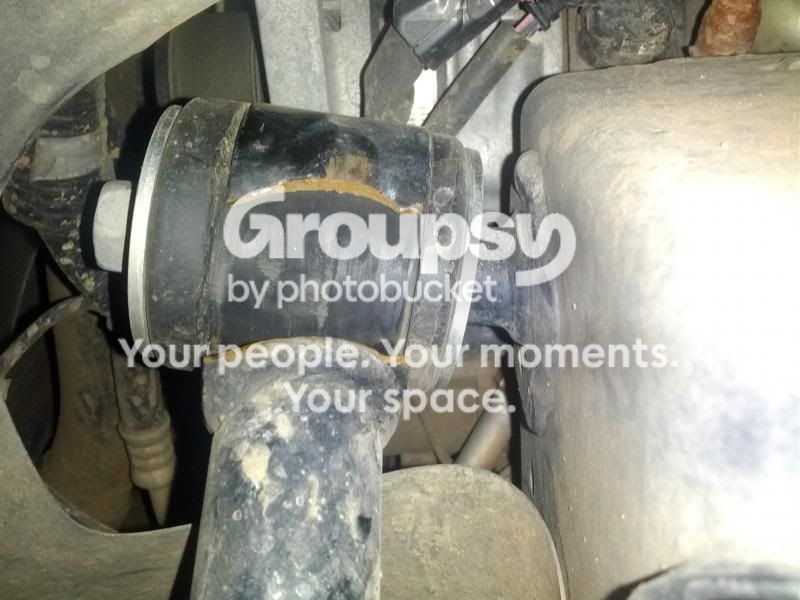
This is the bushing/washer configuration that is problematic.
IMG_20120828_152521_zps42d26a59.jpg~original

If you are unsure if this affects you, look at your upper control arms. There have been case where people replaced the original style busings with the spec ride kits and have the large washers. These also need to be updated. SPC has done a great job handling this situation, in my opinion.

Here is Ducmonsta's post that also helps outline the issue.
94927d1375817904-uca-comparison-toyota-control-arm-update.jpg


SPC's history
Version 1 - Rubber bushings, large washers on all sides (8 washers).
Version 2 - Poly bushings, large washers on all sides (8 washers). These are the ones that fail in high temp climates. The large washers "squeeze" the bushing to the point of collapse. This does not allow the control arm to pivot on the bushing. Effectively, making the control arm bend up and down at the welds.
Version 3 - Poly bushings, 4 large washers, 4 small (2 large washers on the outer most part of control arm, 2 small washers on the inside). This was SPC's solution to an extended sleeve. This does not allow the bushings to be completely compressed by large washers.
Version 4 - Poly bushings, 4 large washers (2 large washers on the outer most part of control arm). In this version the sleeve is longer and is completely butt up against the "tower tube".


Unfortunately, some of us learned at the expensive of our wallets. But I believe these are the best control arms for the money and adjustability. You just have to make sure you've got the latest version (3 or 4). Or if you're like me, I kept the rubber bushing v.1 and installed small washers.

If you are still unsure as to whether or not this applies to your vehicle, Bring your truck by the shop and we will inspect it free of charge. We have update kits in stock.

Edit: in response to this post Chris emailed me the following information
There was no bushing change between 2-3. We’ve been using the same bushing design from the beginning of SpecRide. Also, our bushings are not “poly”. Do not confuse them with Energy, Prothane, etc. When you install them with the grease we provide, they DO NOT SQUEAK. EVER. When people call the tech line for help with “squeaking bushings”, or occasionally stop by our shop, it always ends up being a rear spring, or a coilover, or a skidplate that was loose, or something like that. SpecRide is NOT “poly” and will not have the squeaking issues that are prone to poly bushings.


We really are trying to make the best product out there, and that means we constantly improve. Not only the bushings, but the boots on the ball joint, and even the arm design has been improved since I started at SPC.


Thanks for posting this info!!

Chris
 
Last edited:
Register to hide this ad
If I am understanding this correctly...

The most current "version" will contain the longer sleeves and (4) large washers only? Just checked my truck and it looks like I have "version 3" with (4) large washers and (4) small washers. Should I still call to inquire about getting the latest hardware? or is my current "version" what I have to live with?
 
If I am understanding this correctly...

The most current "version" will contain the longer sleeves and (4) large washers only? Just checked my truck and it looks like I have "version 3" with (4) large washers and (4) small washers. Should I still call to inquire about getting the latest hardware? or is my current "version" what I have to live with?

Although you don't have the latest version, You should not have any issues with that configuration. The problem lies in that the large washers do not allow the bushing to expand when it heats up. The small washers allow this expansion to occur and i havent seen any cases of failure with that setup.
 
I just did this update last night. I called SPC a few weeks ago and received my updated install kit very promptly with no questions asked. I had the version with the 4 large washers. My arms showed no signs of failure at the welds and my ball joints/boots looked perfect. I have about 12k miles on these arms.

I think in Dekoi's pic above the nut on the long bolt was not torqued to the 85ft-lb spec. To do this, pull back the mud flap protecting the engine bay and unbolt the brake line from the frame. This will allow you to get a torque wrench in there.
 
Holy crap! NOT cool. I'm sorry, but this is confusing as hell to me. I can't tell if mine are in need of an update or not.

So, the above failure may or may not have been caused by the wrong bushing/washer combo. It was a result of the nut backing off of the sheer bolt, therefore causing the bolt to back out. When this happened, the arm fell down causing the hub/spindle to shift.

This thread was started a while back when SPC released a new bushing sleeve design. The initial Spec Ride bushing kits (like mine was) contained the bushings, sleeves, and 4 large washers (2 per side). The next Spec Ride bushing kit went to two large bushings (for the outside of each bushing) and two small washers (for the inside of each bushing). This newest design consists of two large washers (still for the outside of each bushing) and new, longer sleeves. With the longer sleeves, you do not need to run inner washers.

The purpose of getting away from the large inner washers was to allow the arm to move more freely when the bushings heat up. When they were not allowed to move freely when heat was introduced, the stress was transferred to the welds. In turn, the welds had the potential to fail.

To answer your question [MENTION=66624]KCcarguy[/MENTION] , if you look at your arms and have large washers on the inside of each bushing, you need to contact SPC to get the newest bushing sleeve update. They will mail them ASAP free of charge and it only takes 1-2 hours to change depending on your skill level.

Hope this helps.
 
Last edited:
So, the above failure may or may not have been caused by the wrong bushing/washer combo. It was a result of the nut backing off of the sheer bolt, therefore causing the bolt to back out. When this happened, the arm fell down causing the hub/spindle to shift.

This thread was started a while back when SPC released a new bushing sleeve design. The initial Spec Ride bushing kits (like mine was) contained the bushings, sleeves, and 4 large washers (2 per side). The next Spec Ride bushing kit went to two large bushings (for the outside of each bushing) and two small washers (for the inside of each bushing). This newest design consists of two large washers (still for the outside of each bushing) and new, longer sleeves. With the longer sleeves, you do not need to run inner washers.

The purpose of getting away from the large inner washers was to allow the arm to move more freely when the bushings heat up. When they were not allowed to move freely when heat was introduced, the stress was transferred to the welds. In turn, the welds had the potential to fail.

To answer your question [MENTION=66624]KCcarguy[/MENTION] , if you look at your arms and have large washers on the inside of each bushing, you need to contact SPC to get the newest bushing sleeve update. They will mail them ASAP free of charge and it only takes 1-2 hours to change depending on your skill level.

Hope this helps.

This looks like I need the update. Am I right? Could someone post a pic of the updated style for comparison?

image.jpg
 

Attachments

  • image.jpg
    image.jpg
    133.8 KB · Views: 9,778
Wow. Between this and the balljoint thread, I'm thinking maybe switching back to OEM UCAs might be the route I take.
 
Wow. Between this and the balljoint thread, I'm thinking maybe switching back to OEM UCAs might be the route I take.

I wouldn't say that, Honestly, i think the ball joints are like 30-40 a piece, and the update kit is free. A little maintenance and Checking your suspension on a regular basis would prevent pretty much any failure, sans the welds cracking if you don't have the update kit.
 
I wouldn't say that, Honestly, i think the ball joints are like 30-40 a piece, and the update kit is free. A little maintenance and Checking your suspension on a regular basis would prevent pretty much any failure, sans the welds cracking if you don't have the update kit.

What worries me most is the BJ failures I've read about with "no warning". My boots look OK, but how do I know when they need to be replaced? Do I just put it on jack stands and wobble it to check for play, or what? Or, do you just routinely replace BJs every so many miles?

What kind of upkeep and durability could I expect on a uniball setup a in comparison? I don't have a problem with inspecting things periodically, I just don't want a surprise.
 
Last edited:
What worries me most is the BJ failures I've read about with "no warning". My boots look OK, but how do I know when they need to be replaced? Do I just put it on jack stands and wobble it to check for play, or what? Or, do you just routinely replace BJs every so many miles?

What kind of upkeep and durability could I expect on a uniball setup a in comparison? I don't have a problem with inspecting things periodically, I just don't want a surprise.

2 ways to check it. Jack up each side by the lower control arm so that the suspension is "loaded". then shake the wheel from with your hands on the top and bottom. to see if there is any latteral play in the joint. Then take a pry bar or something similar and pry up and down on the UCA near the balljoint to check for play in the vertical axis. Typically the play is found via the second method. Milage for wron parts has been all over the place.

Uniballs will need similar inspections and according to most websites that I've seen uniball are typically serviced annually. However the replacement should be done as necessary. Ive seen sets last 2-3 years and some 6 months. it all depends on the conditions they are put though. Keep in mind these are unsealed, so they have no protection from mud, salt, sand and dirt.
 

Members online

Forum statistics

Threads
278,312
Messages
3,554,089
Members
248,016
Latest member
Advally Service

Trending content

Back
Top