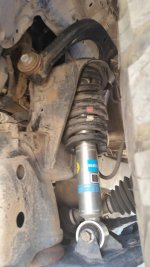
so if you compress your spring say 1" before you assemble your coilover, at full droop with a 650lb spring you will have 650lb of force that needs to be overcome before the suspension will move. imagine you are driving at high speed going over bumps and dips. you go over a dip, the suspension droops all the way, then is compressed when you come out of the dip. because there is a lot of preload at full droop on our rigs the preload must be overcome before the suspension will start moving again. if you wanted to have less preload on the springs at full droop, running a higher spring rate would solve this issue. this is probably one of the reasons a higher rate spring will feel better. im no expert but I would think that having as close to zero preload at full droop would be ideal because the suspension would smoothly start compressing from full droop. the other way to solve this problem is by simply preloading the spring less, in turn running less lift. Or by increasing the shock length and down travel length, aka long travel. one problem with increasing the spring rate though is that your suspension will not articulate and compress well during low speed manuevering. This is why I went back to running a lower lift with the stock springs on my tundra 5100s, Id rather not get stuck on obstacles and have more flex.