Prop shaft greasing

Two weeks ago I took my 2010TE to the dealer for an oil change .
When I told them I also wanted the prop shaft greased they said ok but the only time they will grease them is when a customer requests it .��

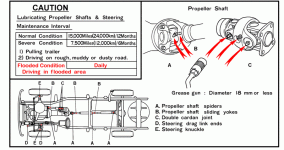
If you are handy with maintenance , do it yourself. I did my 2015 TRD and it took maybe 10 minutes for the four u-joints grease point. I ordered a separate grease gun to do the two slip yoke fitting that call for moly fortified grease.

It was really a very simple operation , at least on my truck as I was able to access all fitting simply by crawling under the vehicle.
 
Thanks for this write up. I am pretty mechanically inclined, but before this I had never heard the term propeller shaft.

Does anyone know what the dealerships charge for this service?
 
Just a friendly heads up for those who haven't ever used a grease gun before or gone under their vehicle:

Watch some youtube videos before and make sure you have room to work under the vehicle. You really have to yank that flexible hose on the grease gun for it to come out so be careful. If you get frustrated, remember to use your fists, not your words. :gun5:


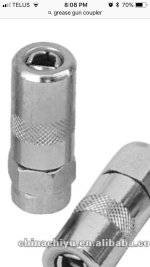
you shouldn't have to yank on it , your coupler on the end is not adjusted correctly , a slight tilt and it should almost fall off
 
you shouldn't have to yank on it , your coupler on the end is not adjusted correctly , a slight tilt and it should almost fall off

Thanks for the tip on tilting the fitting to disconnect from the zerk! I was tugging pretty hard to get mine off , now I know the trick. I would hate to break off one of those little buggers.
 
you shouldn't have to yank on it , your coupler on the end is not adjusted correctly , a slight tilt and it should almost fall off

I didn't know the coupler on the end could be adjusted. I tried tilting it, wiggling it, frying it, barbecuing it, baking it, sauteing it. I had to yank it to get it to disconnect.
 
I didn't know the coupler on the end could be adjusted. I tried tilting it, wiggling it, frying it, barbecuing it, baking it, sauteing it. I had to yank it to get it to disconnect.


LOL, how bout whacking it with a sledge hammer? just joking , do not do it !!
 
as in pic ya can see the line where the adjustment is , sometimes when they are new ya have to put them in a vice and use channel locks to get it to twist due to being too tight from factory , once moving find the happy spot once it is found ya rarely have to turn it again ever an adjustable coupler and pistol style gun with flex line the only way to go . ya need that one hand free to hold coupler especially in tight spaces
 

Attachments

  • BC2B3FCC-6DCA-4D62-B4C4-207DC24BA551.jpg
    BC2B3FCC-6DCA-4D62-B4C4-207DC24BA551.jpg
    44.4 KB · Views: 3,446
Last edited:
Hello guys, I recently visited the Toyota dealership a 30K service on my 4Runner 2WD, they were asking almost 400 dollars to perform the service such as:

  1. Synthetic oil change
  2. Lubricate and re-torque propeller shaft
  3. plus other inspections
seems to me a total ripoff :nono:

Does anybody has pictures that show where to grease these fittings, Do I still worry about greasing the propeller shaft even I have a 2WD 4Runner

Any input would be appreciated
thanks
 
Hello guys, I recently visited the Toyota dealership a 30K service on my 4Runner 2WD, they were asking almost 400 dollars to perform the service such as:

  1. Synthetic oil change
  2. Lubricate and re-torque propeller shaft
  3. plus other inspections
seems to me a total ripoff :nono:

Does anybody has pictures that show where to grease these fittings, Do I still worry about greasing the propeller shaft even I have a 2WD 4Runner

Any input would be appreciated
thanks


It's on the first page of this thread, scroll down you'll see all of the pics.
 
Our 4R SR5 is a 2011 with almost 97K miles and I have never lubed the drive shaft. I bought a new grease gun and a tube of Mobil1 XHP 222 (Lithium Grease Multipurpose) and will do this PM this weekend or next.

I will use the grease I purchased for both the yoke and spider. I noticed in my manual (2011) it used to say multipurpose and they changed it to chassis for the slide yoke which is the same thing.
 
[MENTION=135484]renau001[/MENTION],
how do you recommend to grease the yoke zerks? i hear that if overfilled, it can cause "hydraulic locking". I even read to fill it until it leaks out the old grease, then firmly push down on the front and rear of the car with the zerks unscrewed to allow the extra grease to drain out.
Suggestions?
 
[MENTION=135484]renau001[/MENTION],
how do you recommend to grease the yoke zerks? i hear that if overfilled, it can cause "hydraulic locking". I even read to fill it until it leaks out the old grease, then firmly push down on the front and rear of the car with the zerks unscrewed to allow the extra grease to drain out.
Suggestions?

I unscrewed each one after filling to make sure it wasn't overfilled.
 
old school.....

Guys....on my '87 there used to be a card in the visor that showed the lube points along the drive line. I used to pull this card and give it to the shop to use as reference. I remember telling them to put it in neutral and roll it until the zerks were visible to lube. Good stuff. The thread shows.....maybe old school's not so bad!
 

Attachments

  • VisorCard.gif
    VisorCard.gif
    68.2 KB · Views: 7,436
[MENTION=135484]renau001[/MENTION],
how do you recommend to grease the yoke zerks? i hear that if overfilled, it can cause "hydraulic locking". I even read to fill it until it leaks out the old grease, then firmly push down on the front and rear of the car with the zerks unscrewed to allow the extra grease to drain out.
Suggestions?

On my FJ Cruiser I always pumped grease into the slip yoke until it started to move. I did this at every 5K mile oil change and did not remove the zerks or anything like that. No problems with that method in the 145K miles that I had it. I've already done the same with my 4Runner on its first oil change and again, no problems.

Spicer says to apply grease until fresh grease appears at the slip yoke seal.

Spicer(R) Driveshaft Lube & Torque Specification | Spicer Parts
 
On my FJ Cruiser I always pumped grease into the slip yoke until it started to move. I did this at every 5K mile oil change and did not remove the zerks or anything like that. No problems with that method in the 145K miles that I had it. I've already done the same with my 4Runner on its first oil change and again, no problems.

Spicer says to apply grease until fresh grease appears at the slip yoke seal.

Spicer(R) Driveshaft Lube & Torque Specification | Spicer Parts

The Spicer 10 Series slip assembly has a pressure relief hole. Their instructions clearly state: (1) Apply grease gun pressure until fresh grease appears at the pressure relief hole in the slip yoke plug. (2) Cover the hole in the plug with your finger and continue applying grease gun pressure until fresh grease appears at the slip yoke seal. (3) Activate the slip spline by driving the vehicle enough to displace a little grease out of the pressure relief hole. (4) Failure to complete this recommendation can lead to premature failure of the slip assembly if the slip yoke plug is lost (… popped out because one did not perform step 3).
 
The Spicer 10 Series slip assembly has a pressure relief hole. Their instructions clearly state: (1) Apply grease gun pressure until fresh grease appears at the pressure relief hole in the slip yoke plug. (2) Cover the hole in the plug with your finger and continue applying grease gun pressure until fresh grease appears at the slip yoke seal. (3) Activate the slip spline by driving the vehicle enough to displace a little grease out of the pressure relief hole. (4) Failure to complete this recommendation can lead to premature failure of the slip assembly if the slip yoke plug is lost (… popped out because one did not perform step 3).

Fair enough but what causes the failure? Loss of grease from the lost plug? I admit that I'm not an expert on the subject, just relaying my experience with the method I use. In any case I would think that there needs to be enough grease so that the slip yoke is lubed up to the seal.
 
Fair enough but what causes the failure? Loss of grease from the lost plug? I admit that I'm not an expert on the subject, just relaying my experience with the method I use. In any case I would think that there needs to be enough grease so that the slip yoke is lubed up to the seal.

I think a lost plug leads to grease contamination and the grease also dries out because the joint "breathes" with each bump, draws in air, dust and water, and therefore slip joint failure occurs. The plug appears to be located on the driveshaft centerline, therefore grease should not be expelled by shaft rotation. Your method expels contamination if the seal ever becomes worn or cracked. Obviously, you have a lot of experience with it; it works for you, so I have no experience or reason to find fault with it. I haven't had grease ooze past the seal, so I often wonder how well the sliding surfaces are lubricated.

I smear a thin layer of grease on the exposed shiny portion of the slip joint to lubricate the seal. Obviously, you don't have to do that.

The next time I grease mine, I'll consider injecting 3 full shots of grease which may or may not ooze grease past the seal. Either way, I'll remove the zerk, wrap the joint in aluminum foil, drive over a few speed bumps and dips to see if grease is expelled and reinstall the zerk. If no grease is expelled, I'll repeat this process at the next service until I reach 150,000 miles. If still no grease is ever expelled, I'll consider opening the slip joint to see what's inside.
 
Last edited:

Members online

Forum statistics

Threads
278,309
Messages
3,554,066
Members
248,016
Latest member
Advally Service

Trending content

Back
Top