I noticed last week that my driver’s side rear axle seal had given up the ghost and I started doing my research on how to go about fixing it. Everything that I learn in the process, I will add to this post. I haven’t found a good write-up on this on T4R.org. Most of what I learned came from various write-ups I found on YT, via Google, talking to several mechanics, and now personal experience.
Here’s how you know you’ve got a bad rear axle seal:
First, I called my mechanic, who I trust and have been dealing with for 10 years, for a quote. I was quoted almost $1200.00 to replace the bearings, retainers, inner and outer seals, brakes, and associated parts on both sides of the rear axle. I decided it was worth my time and effort to try and save some money on the job and add to my tool collection in the process.
A note about rear axle seal failure: First and foremost, it’s extremely common on 3rd generation 4-Runners. Chances are that if you own your 4-Runner long enough, it’s going to happen to you. There are a couple theories as to why the failure of the seals is so common:
1. Toyota rear axle seals were a poor design in their original iteration. Toyota has improved the design of the seal in recent years, so hopefully replacing your old seals with the new design will eliminate this concern. The part number for the new seal ends in “6” and the part number for the old design ends in “1”.
2. The rear axle has a part called a breather plug. It is located on top of the rear axle, near the center, on the driver’s side of the pumpkin. The purpose of the breather plug is to allow for the expansion and contraction of the air and fluid inside the rear axle and differential. When the axle and differential get hot, the air and fluid inside them expands. The resulting pressure must be relieved in some way. The breather plug allows for the relief of this pressure. If the breather plug becomes clogged, the pressure cannot escape through the plug and the next thing to give is the rear axle seals. The breather plug can easily become clogged by mud, dust, dirt, grease, etc. If your rear axle seals have gone out, you need to check your breather plug as well. Simply remove it from the axle using a deep walled socket or open end wrench (12mm or 14mm, I can’t remember), clean it off, and see if you can blow through it. If not, it is plugged and must be replaced or you will continue to experience failure of your rear axle seals. I recently extended my rear differential breather and installed a new breather plug, so I’m sure this was not the cause of my rear axle seal failure. (Note: while you’re at it, search T4R.org for “extend rear differential breather”, as now would be a good time to do that as well.)
3. Wear and tear on the rear wheel bearings leads to rear axle seal failure. As your rear wheel bearings wear over the years, they develop a slight amount of play. This play can be just enough to allow the axle to move up/down and front/back within the axle tube. When the axle moves like this, it crushes the inner axle seal in the direction that it moves. Think of it as if you put your finger (representing the axle) in a ring (representing the inner axle seal), then bounced your finger around within the ring. If you subject your 4-Runner to lots of off-road use, washboard roads, etc. your bearings will probably have some wear on them, especially north of 100K miles. My 4-Runner is just about to roll over 160K and the bearings had quite a bit more play in them than the new ones I got from Toyota.
4. Some have suggested that switching to synthetic gear oil can contribute to seal failure, especially if your 4-Runner has only seen regular petroleum based gear oil during its lifespan. Some refer to the petroleum based gear oil as “Dino Oil”. It is thought that the smaller molecules in the synthetic gear oil can more easily get past the seal, contributing to a leak. Also, petroleum based gear oil often has conditioners in it that may help older seals hold on.
5. Finally, I believe that over time these seals can fail just like any other. The sealing surface is made some sort of plastic/rubber and is subject to heat cycling within the axle. Over time, heat cycling will cause rubber and plastics to shrink and harden, resulting in a failure of the seal.
A note about parts: There are a lot of ways to get discounts on Toyota OEM parts. You can order online from places like Jay Marks (Champion) Toyota, or TRDParts4U. You might know a guy. Everyone has their way. My tip is this: If you need the parts NOW and you have to go to your local Toyota dealer to purchase them, they have two prices on their screen. There is the retail price, which is the first one they will quote you, and the one everyone normally gets. Then there is the “shop price” which they charge independent auto repair shops. The shop price is usually a 20% discount off retail. Your mechanic buys the parts at that price, then sells them to you at retail, making a little cut for himself. If you have a decent sized order, it doesn’t hurt to ask for the shop price. Usually the guy at the parts counter will just give it to you. Easy money in your pocket. On to the part numbers you’ll need.
Part numbers for parts YOU can replace….
1. 90301-88077, O-Ring. This is the o-ring that goes between the backing plate and the axle flange. One per side. $4.43 Retail, I forgot to ask for the shop price when I picked these up.
2. 90310-50006, Seal, Type S Oil. This is the inner rear axle seal that resides inside the axle tube. One per side. $6.68 Retail, I forgot to ask for the shop price when I picked these up.
I got 3 oil seals in case I damaged one during installation, and two o-rings.
Here’s what they look like…..
Part numbers for parts a MACHINE SHOP has to replace…
1. 90363-40020-77, Bearing. This is the rear wheel bearing. I got this number from the Toyota Parts Dept. for the passenger side. I’m pretty sure it’s the same for both, but you may want to inquire about that. One per side. $85.26 Retail, $68.21 Shop Price (20% discount).
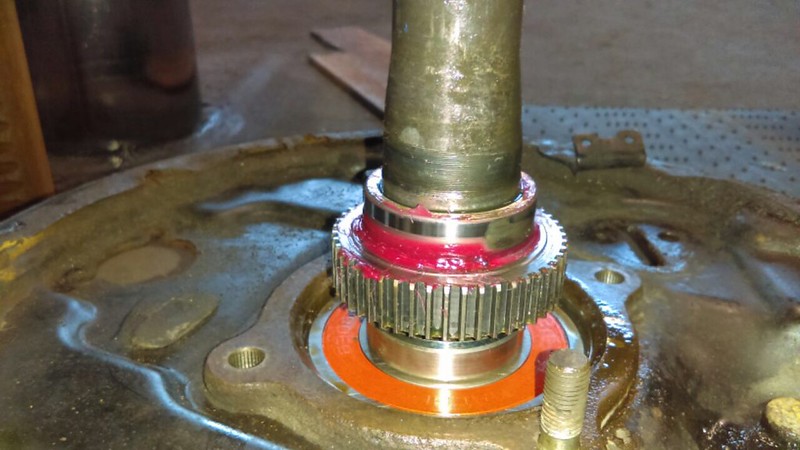
2. 42423-20010, Retainers. These are metal collars that are pressed onto the axle to retain the Skid Control Rotor. One goes on the inboard side of the Skid Control Rotor, and one on the outboard side. They not only retain the Skid Control Rotor, but they align it on the axle shaft to the proper position so that it does not sit too far inboard/outboard. You need two of these per side. $19.01 Retail, $15.21 Shop Price (20% discount).
3. 43517-35010, Skid Control Rotor. Some people refer to this as the ABS Ring, ABS Exciter Ring, etc. Toyota calls it a Skid Control Rotor. It looks like a gear, and as the axle rotates, it’s teeth pass by a magnetic sensor (ABS Sensor) to tell your truck’s ABS computer exactly how fast the rear axle is rotating, and therefore how fast the truck is moving. One per side. $52.47 Retail, $41.98 Shop Price (20% discount).
One would think that the Retainers and the Skid Control Rotor could be re-used, but they can’t. The reason why is that they are apparently very difficult to press OFF the axle, so most shops use a grinding wheel to cut most of the way through them, then cut them off with a chisel.
4. 90520-36045, Snap Ring. This is used to keep things in place on the axle shaft. One per side. $1.89 Retail, $1.51 Shop Price (20% discount).
The Snap Ring usually gets hacked up in the process of cutting off the other parts, and it’s very cheap, so it gets replaced too.
5. 90313-48001, Outer Shaft Oil Seal. This seal covers a section of the outboard side of the wheel bearing, protecting it from dust and dirt. It is not meant to keep gear oil in the axle, which is the job of the inner seal. One per side. $5.56 Retail, $4.45 Shop Price (20% discount).
Oil seals are cheap, and are always a good thing to replace while you’re in there simply as preventative maintenance.



 Man must be nice up there, I just had a buddy from BC move up to Yellowknife and he loves it!