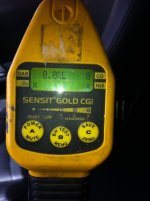
My theory is to let your senses,especially smell in this case, be your judge. I'm not sure what they were thinking,other then style points,when they changed the exhaust from coming out the side in the 3rd Gens to the back with the introduction of the 4th Gen.
It was only $65 to weld my muffler and the pipe for the exhaust out the side and have no complaints or smells with other front windows cracked open. They make oval or rectangular exhaust tips for those with SR5/Limited that have that plastic hang lower behind the wheel then TE's and are worried about it exiting too low.
There more to worry about breathing exhaust then just CO2.
Automobile Exhaust
From the EPA.....
• CARBON MONOXIDE
Carbon monoxide (CO) is a product of incomplete combustion and occurs when
carbon in the fuel is partially oxidized rather than fully oxidized to carbon
dioxide (CO ). Carbon monoxide reduces the flow of oxygen in the bloodstream
and is particularly dangerous to persons with heart disease.
• CARBON DIOXIDE
In recent years, the U.S. Environmental Protection Agency (EPA) has started to
view carbon dioxide, a product of “perfect” combustion, as a pollution concern.
Carbon dioxide does not directly impair human health, but it is a “greenhouse
gas” that traps the earth’s heat and contributes to the potential for global
warming
• HYDROCARBONS
Hydrocarbon emissions result when fuel molecules in the engine do not burn or
burn only partially. Hydrocarbons react in the presence of nitrogen oxides and
sunlight to form ground-level ozone, a major component of smog. Ozone irritates
the eyes, damages the lungs, and aggravates respiratory problems. It is
our most widespread and intractable urban air pollution problem. A number of
exhaust hydrocarbons are also toxic, with the potential to cause cancer.
• NITROGEN OXIDES (NOx)
Under the high pressure and temperature conditions in an engine, nitrogen
and oxygen atoms in the air react to form various nitrogen oxides, collectively
known as NOx. Nitrogen oxides, like hydrocarbons, are precursors to the
formation of ozone. They also contribute to the formation of acid rain.