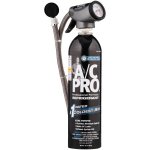
Recharging A/C?

gookies

New member
Has anyone used one of those R134a cans to recharge your A/C system? I've read you can mess up the system doing it this way. Anyone else have any experiences? Tutorials I found online on how to use them seem pretty easy and simple. My A/C still functions, but just not as cold as I'd like it.
 
Register to hide this ad
i think its best to check the cabin filter first.
then with the ac recharge, have a pro do it with the machine, the one that creates a vacuum, so it doesn't over fill.
 
Yes it's best to have a pro recharge your system and I second checking the filter, but if you get the one with a gauge on it you won't over charge the system, just make sure you stay within the green portion of the gauge, around 40lbs is where you need to be, the gauge is reusable so if you need to recharge it again in the future or do another car all you will need is a can of freon.

I just recharged my son's Jeep yesterday, his AC was blowing warm to slightly cool air and within 5 minutes or less it was ice cold in our 93 degrees temperature, I would also recommend getting one that has stopleak in it so it can maybe seal any small leaks you may have in the system.
 
Vacuum is only required if you vent your whole charge to 0 psi. The vacuum does a few things: it helps to confirm that there are no leaks in the system as you are supposed to let the unit sit in a vacuumed state for several minutes to ensure it does not change. It also removes any moisture in the air that gets trapped in the system by causing it to boil off under vacuum. It also allows the system to pull in a little charge prior to turning on the system to fill it.

Since you started your system works, just isn't as cold, you don't need to have it pulled into vacuum. The things I would start with would be cabin filter and condenser coils, make sure they are clean and clear.

As to the diy kits from the auto parts store, I believe the EPA now requires new kits to come with a gauge for serviceability and to help keep a system from venting it's charge to atmosphere from over filling. I've used quite a few of these. They work great. Just follow the instructions on the can, and you generally can't go wrong. As to the 40 psi on the gauge, some units will go into greater detail that this value is relative to outside temperature, so depending on where you are, the number may be greater or lesser than 40 psi. You can find tables showing correct low side charge for r134a given ambient temperature online.
I hope this helps, good luck!
 
Last edited:
+1 what 81runner said. Vacuum not required but it's nice to have a dual gauge setup. The amount of refrigerant in the system is normally measured on the low side (around 40psi). The high-pressure reading can also be used to diagnose other system problems. The "higher the better" is not the rule of thumb

My wife's car was starting to cool poorly so I went and picked up a new can with the built in gauge. The car was at the upper end of the "low" range so I added a bit of refrigerant to put it in the middle of the "full" reading. I went ahead and checked the other two vehicles and they were reading a bit low as well so I used up most of the rest of the can bringing them up to the same level.

Here in FL the AC runs year round but my newest vehicle is over 12yrs old. I figure I'm about due for some kind of major AC failure pretty soon.
 
4ba36271-fcfc-4d34-b03d-affe302ea99f_1.e614dde08cd98ad1b90437b373edd9a3.jpeg
Buy this. Its is easy and works great.
 

Attachments

  • 4ba36271-fcfc-4d34-b03d-affe302ea99f_1.e614dde08cd98ad1b90437b373edd9a3.jpeg
    4ba36271-fcfc-4d34-b03d-affe302ea99f_1.e614dde08cd98ad1b90437b373edd9a3.jpeg
    23.6 KB · Views: 462
+1 what 81runner said. Vacuum not required but it's nice to have a dual gauge setup. The amount of refrigerant in the system is normally measured on the low side (around 40psi). The high-pressure reading can also be used to diagnose other system problems. The "higher the better" is not the rule of thumb.
Glad that all my AC training actually sunk in, I should go get my license lol
 
Last edited:
Thanks all, I knew it was a pretty simple and easy job watching tutorials, so I couldn't understand how some individuals messed up their system by recharging it.
 
Thanks all, I knew it was a pretty simple and easy job watching tutorials, so I couldn't understand how some individuals messed up their system by recharging it.

My guess is there was already something going bad in their system or they didn't use a gauge and overcharged the system.
 
Thanks all, I knew it was a pretty simple and easy job watching tutorials, so I couldn't understand how some individuals messed up their system by recharging it.

A lot of times, people will lose the charge in the system and try one of these kits without the knowledge of how to properly use it, and they throw a charge into a system with air in it, and that WILL ruin a system, quick fast and in a hurry.
 
I killed my ac when my hard line bit into my demello bumper. Drained the whole system and pressure. Used one of those cans to recharge the system and it worked after I fixed the leak. Found out my buddy actually had a machine at his house so I took it over there, vacated the system, checked vacuum, and recharged. Couldn't really tell a difference between the two.

Sent from my Pixel 2 using Tapatalk
 
I would also recommend getting one that has stopleak in it so it can maybe seal any small leaks you may have in the system.

No. Just no. Do NOT ever put stopleak in an engine. Don't ask me how I know. Fix a leak the right way, not a band aid that could potentially plug something else up over time and have a very serious affect.
 
No. Just no. Do NOT ever put stopleak in an engine. Don't ask me how I know. Fix a leak the right way, not a band aid that could potentially plug something else up over time and have a very serious affect.

As olyeller has pointed out the stop leak I was referring to is not in the engine, i.e. cooling system, I have read of your experience of the stop leak added to your 4R's cooling system and causing havoc to your engine, and I agree wholeheartedly with your statement in that context, but the stop leak in freon is not a coagulate/collective type stop leak as in the stop leak marketed for cooling systems where they over time build up particulates or coagulates at the source of the leak until it plugs the leak.

AC stop leak in freon is a seal/rubber conditioner designed to soften/revitalize hardened rubber seals and hoses, etc. so they can possibly seal again, these seals are often the most common source of AC leaks as they age and get hard and thus no longer able to seal properly, there are no particulates or coagulants at all in these AC conditioners/stop leak formulas

not talking about the engine

Exactly
 
As olyeller has pointed out the stop leak I was referring to is not in the engine, i.e. cooling system, I have read of your experience of the stop leak added to your 4R's cooling system and causing havoc to your engine, and I agree wholeheartedly with your statement in that context, but the stop leak in freon is not a coagulate/collective type stop leak as in the stop leak marketed for cooling systems where they over time build up particulates or coagulates at the source of the leak until it plugs the leak.

AC stop leak in freon is a seal/rubber conditioner designed to soften/revitalize hardened rubber seals and hoses, etc. so they can possibly seal again, these seals are often the most common source of AC leaks as they age and get hard and thus no longer able to seal properly, there are no particulates or coagulants at all in these AC conditioners/stop leak formulas


Exactly

Interesting...I did not know that. But Im now in the realm of no false additives are going to be put in anything of my car. But to each their own!

Sent from my SM-G935V using Tapatalk
 

Members online

Forum statistics

Threads
278,307
Messages
3,554,049
Members
248,016
Latest member
Advally Service

Trending content

Back
Top