"Rumble Strip" Transmission issue

Hi guys, I just read through the entire thread and gearing up to do my first drain and fill on my 2006 4Runner v6. Here is what I plan to do:

(With car totally level)

Loosen refill plug to make sure it's not seized
Remove drain plug, drain fluid, and reinstall drain plug
Pump new fluid into refill port and reinstall refill plug
Check trans temp to make sure it's up to temp
Remove Allen key level plug to drain any excess fluid

A few questions:

1.) what needs to be jumped on obdii port to read trans temp? Where does trans temp show up?

2.) if trans is too cold, do you just start the car and run it for a bit? Or is there another way to warm up the trans?

3.) what's acceptable temp range of trans before removing overflow Allen Key plug?

4.) Does anyone have a picture of each of the three plugs (drain, refill, level checker)?

If I'm missing any steps please let me know.

Thanks
 
You read the entire thread(?) but did you click on the link in the last post (#260) before your's?

If you had it will answer all of your questions, the link is to a topic for a complete draining and refilling (flush) of all the fluid instead of a drain and fill but has all the answers you seek!
 
Last edited:
You read the entire thread(?) but did you click on the link in the last post (#260) before your's?

If you had it will answer all of your questions, the link is to a topic for a complete draining and refilling (flush) of all the fluid instead of a drain and fill but has all the answers you seek!

My apologies, missed the link.

It has everything and more. Thanks!
 
Thoughts about this??? My shudder is ONLY when towing steep uphill when the engine/driveline is straining to pull 3300lbs. 2008 V8 fulltime 4WD, 99k miles, trans had full fluid exchange at 97,490 miles (no Shudderfix), CV axles replaced same time. Didn't have a shudder before or after the service, still don't with the trailer unhooked. Drove over Gore Pass unhooked, no shudder, hooked up, shudder. Lubed all zerks and replaced diff/trsfer case fluid at 97,062 miles.

I tow in 4th gear, no shudder with moderate skinny pedal on the flats and moderate uphills, never when downshifting on steep downslopes. Happens in 2nd and 3rd gear when floored, seems to be between 2500 and 3800rpm, goes away when engine is up around 4000rpm and above.

Reminds me a lot of my 2012 Tacoma manual trans, that truck had a widespread problem with the driveshafts causing the shudder, not transmission related. Thoughts?
 
Thanks Guys

So I had the dreaded rumble strip issue appear about 4 months ago. I parked the truck in fear of ruining a very expensive transmission. Finally got around to taking it into the shop today. I had them run through 14 quarts of new fluid and 2 tubes of Shudder Fixx. I am happy to report that all of the vibration is gone. Really glad I found this thread, I was getting ready to pull the trigger on a $1200 job to replace the torque converter.
 
Hi. Been reading through this thread. I just purchased an 08 4runner with 49,500 original miles about 4 weeks ago. I just started getting the shutter. Had a 3rd gen before this and never had a problem. Guess I'm going to have to do a full fluid flush. I had done this on my 3rd gen so should not be to bad. It's to bad they keep making it harder for us DIY guys from doing general maintenance. Removing the dipstick tube just makes it more annoying to refill.

Think I'm going to use valvoline MetLife instead of the Toyota transfluid and based on this thread I wil try the anti slip additive also.(shudder fixx)
 
Last edited:
interesting thread, I get shudder on 5-th gen (2011)
If I don't find similar thread in 5-th gen forums I will update this one with the outcome.

One question - what's wrong with driving in '4' all the time, except on the highway? My 4runner doesn't shudder in 4, only in D
 
Update

So, now I have 189k, and the shudder is back. I am scheduled to have it flushed and shudderfixx added to it. I guess $300-350 every 36 months or 40k miles is good enough.


I had the same issue, started at about 149k miles and got worse in a hurry. I thought I would just drive it in 4 forever. Reading this thread, I talked to a buddy of mine that has his own shop. He said that he has used Shudderfix several times, mostly helping if not correcting the problem. I had him drain and refill the transmission and add the Shudderfixx. He drove it for 30 miles after and told me he could not feel it at all. I have since put between 500 and 600 miles on it without even a shimmy.

Don't know how long it will last, but I have no reason to think it will come back soon. I could repeat the process another 8 times for less than the replacement transmission quote.

Hope this helps.
 
So, now I have 189k, and the shudder is back. I am scheduled to have it flushed and shudderfixx added to it. I guess $300-350 every 36 months or 40k miles is good enough.

Did you do a full fluid replacement of 12-15 quarts at 149k or just the 3qt transmission drain and fill?
If you just did the drain and fill, I’m guessing it gave you just enough good fluid to fix the issue, but with a little age, the overall fluid condition is back in danger zone. If you did the full flush the first time, I’m sorry, and that’s terrifying for Mine.
 
Great post. Reading through it entirely, I gained enough to fix the shudder.
History - One year ago, flushed my trans with 12 quarts WS at 134,000 miles using the flush through the oil cooler method, works great. I averaged the temperature of the trans using a infrared gun by selecting several locations including the pan, to yield the oil temperature for the accurate level setting.
Now at 143,000 miles (one year later), shudder became progressively worse over 2 weeks until yesterday when the SR5 seemed to be shaking apart under slight acceleration at 2200 RPM, 2800 RPM, and less at 3200 RPM (all places where the lock-up is modulated). This was in "D" position, no symptoms in "4" position because lock-up is not modulated in "4" position.
Two ounces of Shudder Fixx and 10 freeway miles later (exercising the lock-up continuously), now smooth as glass.
 
Get a $20 pump, 2 buckets and necessary hoses, and 3-4 gallons of fluid and do the fluid exchange yourself. It takes all of 2-3 mins once youre set up (which takes ~5-10mins) and will save you money.

I may give that a try, hopefully no earlier than 2021!

Thanks
 
Adding My 2 Cents

Hi Guys,

I'm pretty new to this forum but not so new in the mechanic field, I've been around cars since I was born so almost 30 years now, and I'm an aircraft mechanic(much different, they like fly and stuff). I recently purchased a 2009 Limited V6 4WD 4Runner with 147,000 miles on it. It had the shudder right off the bat. I have been doing the 4th gear work around up to 150,000 miles. Luckily I found this forum right away, and I plan to do my transmission fluid full exchange soon using two methods. I will first add some transmission flush cleaner, run it as per the instructions, drop the pan, change the filter, and then for the second method go through the cooler lines. Although, I would like to add that I will be doing same entire process again after 3 weeks of driving, and I will explain why. I myself am an amsoil dealer and they have a write up about transmission services. See below:

"There has been a recent trend toward use of fluid evacuation systems in the
automatic transmission service industry in lieu of traditional transmission service
methods. These systems are used to pump the old fluid out of the transmission and
to refill with fresh fluid. This avoids dropping the pan and draining the unit which can
be time consuming and messy. The use of this method to replace the transmission
fluid is a clean, efficient, and safe way to remove hot oil from a transmission. The
problem, however, is that often times it is mistakenly thought that this represents
complete transmission service and that removal, and cleaning of the pan and
inspection and servicing of the filter are unnecessary.
Some people believe that all transmission filters are backflushed clean every time
the vehicle is turned off. This is a major misconception. Three-quarters of all
transmission filters today are not a simple screen, they are made of felt. A felt filter
CANNOT be backflushed. Felt holds dirt particles within tiny pores in the felt. It will
not wash out or flush out. If a felt filter becomes clogged it must be replaced.
Clogged filters restrict fluid flow, which lowers pressure to clutches and bands. This
can cause slippage and eventual burnout of the transmission.
Service manuals and textbooks on transmission service recommend that a
transmission filter be inspected and replaced, if necessary, as often as every 15,000
miles (24,140km), for severe service such as city driving, desert (hot dusty) driving,
extreme cold, frequent short trips, trailer towing, and delivery service. In normal
operating conditions the manuals recommend to inspect and replace the filter at
least every 30,000 miles (48,280km). Even the newer vehicles with 100,000 mile
(160,934km) drive train service warranties, the manufacturer recommends filter
replacement if the vehicle sees severe service conditions.
There have been an increasing number of instances surfacing recently regarding
transmission failures shortly after an evacuation service, without filter removal. At the
time of a fluid evacuation service, there is no way to know the condition of the filter
and how clogged it may be. The filters job is to collect and hold contaminants, (dirt,
metal filings, friction particles, etc.), and prevent these particles from causing
malfunction in such components as electronic force motors and solenoids. Today's
transmissions are far more susceptible to malfunctions caused by fine dirt
contamination. Without servicing the filter, there is no way to know if the filter is clean
of debris or nearing capacity. If the filter is nearing capacity, transmission failure may
not be far off. This is also a sign that there may be other internal problems in the
transmission. Recognizing these warning signs could eliminate major service later.
Most of the transmission failures after an evacuation service have occurred primarily
on relatively high mileage transmissions that have not been serviced in some time.
One reason for this is that the sludge and dirt buildup within the transmission will not
completely be removed during the service. When the new fluid (which has detergent
properties) is placed in the transmission, over days and weeks, the internal
components begin to wash the insides of the transmission.
This sludge does finally work loose and settles in the transmission filter, clogging it
up even further than it may have been before service. In these extreme cases, where
service has not been performed in some time, changing the filter may not completely
fix the problem. Some mechanics recommend a second service a few weeks after
the first, replacing the filter again, which may be partially clogged due to the cleaning
process in the transmission.
Even if the fluid evacuation method is desired to remove the used transmission fluid,
the pan should be removed also, and an inspection should be made of the pan
contents, fluid, and filter to determine the condition of the transmission. Aluminum
filings in the pan or iron filings on the pan magnet are signs of internal wear and may
give light to potential problems in the transmission. Transmission service is
performed for preventative maintenance. Evaluating the overall condition of the
transmission by removing the pan should be part of this preventative maintenance
also.
The Filter Manufacturers Council urges everyone to dispose of all used filters
properly."

Yes this is the messy method, yes much more money, and much more time consuming. But I feel this is the best way to do it, and with my crazy OCD background I feel I must do it this way.

I will only be using amsoil fluids, and Toyota parts. Once all of this is done I will follow up with a write on how the task went. I may have to wait another week due to my busy schedule :redbrick:

 
Hi Guys,

I'm pretty new to this forum but not so new in the mechanic field, I've been around cars since I was born so almost 30 years now, and I'm an aircraft mechanic(much different, they like fly and stuff). I recently purchased a 2009 Limited V6 4WD 4Runner with 147,000 miles on it. It had the shudder right off the bat. I have been doing the 4th gear work around up to 150,000 miles. Luckily I found this forum right away, and I plan to do my transmission fluid full exchange soon using two methods. I will first add some transmission flush cleaner, run it as per the instructions, drop the pan, change the filter, and then for the second method go through the cooler lines. Although, I would like to add that I will be doing same entire process again after 3 weeks of driving, and I will explain why. I myself am an amsoil dealer and they have a write up about transmission services. See below:

"There has been a recent trend toward use of fluid evacuation systems in the
automatic transmission service industry in lieu of traditional transmission service
methods. These systems are used to pump the old fluid out of the transmission and
to refill with fresh fluid. This avoids dropping the pan and draining the unit which can
be time consuming and messy. The use of this method to replace the transmission
fluid is a clean, efficient, and safe way to remove hot oil from a transmission. The
problem, however, is that often times it is mistakenly thought that this represents
complete transmission service and that removal, and cleaning of the pan and
inspection and servicing of the filter are unnecessary.
Some people believe that all transmission filters are backflushed clean every time
the vehicle is turned off. This is a major misconception. Three-quarters of all
transmission filters today are not a simple screen, they are made of felt. A felt filter
CANNOT be backflushed. Felt holds dirt particles within tiny pores in the felt. It will
not wash out or flush out. If a felt filter becomes clogged it must be replaced.
Clogged filters restrict fluid flow, which lowers pressure to clutches and bands. This
can cause slippage and eventual burnout of the transmission.
Service manuals and textbooks on transmission service recommend that a
transmission filter be inspected and replaced, if necessary, as often as every 15,000
miles (24,140km), for severe service such as city driving, desert (hot dusty) driving,
extreme cold, frequent short trips, trailer towing, and delivery service. In normal
operating conditions the manuals recommend to inspect and replace the filter at
least every 30,000 miles (48,280km). Even the newer vehicles with 100,000 mile
(160,934km) drive train service warranties, the manufacturer recommends filter
replacement if the vehicle sees severe service conditions.
There have been an increasing number of instances surfacing recently regarding
transmission failures shortly after an evacuation service, without filter removal. At the
time of a fluid evacuation service, there is no way to know the condition of the filter
and how clogged it may be. The filters job is to collect and hold contaminants, (dirt,
metal filings, friction particles, etc.), and prevent these particles from causing
malfunction in such components as electronic force motors and solenoids. Today's
transmissions are far more susceptible to malfunctions caused by fine dirt
contamination. Without servicing the filter, there is no way to know if the filter is clean
of debris or nearing capacity. If the filter is nearing capacity, transmission failure may
not be far off. This is also a sign that there may be other internal problems in the
transmission. Recognizing these warning signs could eliminate major service later.
Most of the transmission failures after an evacuation service have occurred primarily
on relatively high mileage transmissions that have not been serviced in some time.
One reason for this is that the sludge and dirt buildup within the transmission will not
completely be removed during the service. When the new fluid (which has detergent
properties) is placed in the transmission, over days and weeks, the internal
components begin to wash the insides of the transmission.
This sludge does finally work loose and settles in the transmission filter, clogging it
up even further than it may have been before service. In these extreme cases, where
service has not been performed in some time, changing the filter may not completely
fix the problem. Some mechanics recommend a second service a few weeks after
the first, replacing the filter again, which may be partially clogged due to the cleaning
process in the transmission.
Even if the fluid evacuation method is desired to remove the used transmission fluid,
the pan should be removed also, and an inspection should be made of the pan
contents, fluid, and filter to determine the condition of the transmission. Aluminum
filings in the pan or iron filings on the pan magnet are signs of internal wear and may
give light to potential problems in the transmission. Transmission service is
performed for preventative maintenance. Evaluating the overall condition of the
transmission by removing the pan should be part of this preventative maintenance
also.
The Filter Manufacturers Council urges everyone to dispose of all used filters
properly."

Yes this is the messy method, yes much more money, and much more time consuming. But I feel this is the best way to do it, and with my crazy OCD background I feel I must do it this way.

I will only be using amsoil fluids, and Toyota parts. Once all of this is done I will follow up with a write on how the task went. I may have to wait another week due to my busy schedule :redbrick:

Welcome to the forum!

Just an FYI, these transmissions DO NOT have a filter, they have a screen, so it doesn't need to be replaced, but if your OCD impels you then by all means pull the pan and check for sediments in the pan and clean it accordingly, but I doubt, actually almost positive you will not find anything clogging the screen, if you do then clean it as well.

That being said I personally would go much longer than 3 weeks to do another fluid exchange, I would go at least 3000 to 5000 miles since there is no filter to be concerned about, after doing the fluid exchange I do it every 30,000 miles as regular manitenance.

If you do pull the pan the good thing is you have a V6 which is relatively easy to pull the pan, on the V8 the exhaust has to be loosen and dropped to get the pan off, not so with the V6, just the pan bolts to deal with.
 
This is why I joined and love this forum. There is such an abundance of information from such a great community. It makes a lot of sense now why the "filter" that comes with a gasket is so cheap from the local auto part stores. For the first transmission fluid change, I will definitely be changing out the screen due to the possibility of oil coking on the screen material, the transmission flush cleaner also stated in their instructions to change the "filter", and it's just cheap compared to the rest of the whole transmission. It makes me feel better that it's a screen so I will be happy to go longer. Also the longer time will give the new transmission fluid more time to "wash" all of the internal parts. Are you doing a 12 quart fluid change every 30,000? I think I may take part in that with the oil cooler method. I'm the guy that does things to the extreme. If it's not needed to do something but it could help and would be better, you'll find me doing it.:crazy:
 
This is why I joined and love this forum. There is such an abundance of information from such a great community. It makes a lot of sense now why the "filter" that comes with a gasket is so cheap from the local auto part stores. For the first transmission fluid change, I will definitely be changing out the screen due to the possibility of oil coking on the screen material, the transmission flush cleaner also stated in their instructions to change the "filter", and it's just cheap compared to the rest of the whole transmission. It makes me feel better that it's a screen so I will be happy to go longer. Also the longer time will give the new transmission fluid more time to "wash" all of the internal parts. Are you doing a 12 quart fluid change every 30,000? I think I may take part in that with the oil cooler method. I'm the guy that does things to the extreme. If it's not needed to do something but it could help and would be better, you'll find me doing it.:crazy:

Yes I do a complete fluid exchange every 30,000 miles, I undoubtly could go longer but I'm a tad bit OCD as well and I would much rather have fresh fluid even if the old fluid still has some life left, so much cheaper than a new or rebuild transmission!!
 
Yes I do a complete fluid exchange every 30,000 miles, I undoubtly could go longer but I'm a tad bit OCD as well and I would much rather have fresh fluid even if the old fluid still has some life left, so much cheaper than a new or rebuild transmission!!
Looks like I will be joining you in the 30,000 mile fluid change. I'll get a oil diagnostic test after the first 3,000 - 5,000 mile change. I would like to see what's going on inside. I think having the amsoil, plus 30,000 mile fluid changes will make it drive so much better, and I would like to think it might even get better gas mileage. I'm not really complaining too much about the gas though. My other vehicle is a 1997 Ford F350 with a 7.5L V8.

Sent from my SM-G935P using Tapatalk
 
More Than Overdue

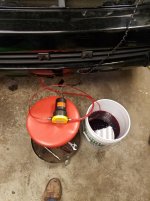
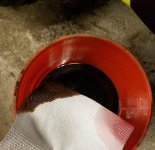
So I finally got around to changing my transmission fluid on 04/21/2018 with 150,000 miles on it. I only went through the cooler lines due to the transmission pan having a good amount of rust built up on it around half of the bolts. I didn't have a new pan at the time so I wasn't risking pulling it off and it not sealing later. Anyway, this fluid was very bad. When I pulled the line I second guessed myself if it was an engine oil cooler line. The way I did the job was I used an electrical oil excavating pump to push the fluid in the transmission. I would have the car in neutral and then start it, let it run till the steady stream of old fluid started sputtering, and then turn it off to let the electric pump catch up. I didn't check the level after doing everything because I compared the two buckets I used to do the job. I marked the new bucket at 12 quarts, and I stopped pumping fluid out of the car when the dirty bucket hit the 12 quarts mark. As far as the results go I have to start by saying my rumble strip issue was pretty bad, I had to have it in 4th gear all the time until I got up to 50mph. After doing the flush it was still shaking but its getting better as I put the miles on it. It just hit 50 miles since the change and it is way better. Once the new Valvoline Maxlife ATF has a chance to completely wash all of the parts I'm sure it will stop shaking altogether. Also this job doesn't clean out the cooler so some old fluid was still in there, and now the new fluid should help clean the cooler as well. After I know the shaking is gone, and I have put around 5,000 miles on the new fluid I will be switching over to AMSOIL. On the second flush I will replace the transmission pan, filter/screen mesh, and the cooler elbows going into the housing (rusty :-/ ).
 

Attachments

  • Oil Pump 04-21-2018.jpg
    Oil Pump 04-21-2018.jpg
    136.6 KB · Views: 503
  • Transmission Fluid.jpg
    Transmission Fluid.jpg
    123.7 KB · Views: 511

Members online

Forum statistics

Threads
278,310
Messages
3,554,080
Members
248,016
Latest member
Advally Service

Trending content

Back
Top