Seafoam'd the 4Runner

No jokes. Water works great. It's best to spray water from a spray bottle on a fully warm engine. Into the throttle body if possible. Slowly spray a pint or quart into the throttle body with it revving over 1500 rpm.

They've been injecting water into combustion chambers since the 40's. Very popular with the diesel guys these days. They inject a water/methanol mixture, 50/50 inside to cool down temps and aid combustion. Also cleans the hell out of the chamber, valves, and piston tops.

Problem with cleaning the carbon out of the head and off pistons (whether your not you use water or sea foam) is that huge chunks of carbon can break loose. Especially if the engine has never seen a treatment or has bad blow by. Chunks of carbon coming loose end up in your catalytic converter, clogging it. So the best way to seafoam an engine is to literally remove the exhaust before the cat, before the treatment, and really rev the shit out of it while spraying in water/seafoam. Clamp exhaust back together, drive to exhaust shop, have them weld it back together.
 
Last edited:
No jokes. Water works great. It's best to spray water from a spray bottle on a fully warm engine. Into the throttle body if possible. Slowly spray a pint or quart into the throttle body with it revving over 1500 rpm.

They've been injecting water into combustion chambers since the 40's. Very popular with the diesel guys these days. They inject a water/methanol mixture, 50/50 inside to cool down temps and aid combustion. Also cleans the hell out of the chamber, valves, and piston tops.

Problem with cleaning the carbon out of the head and off pistons (whether your not you use water or sea foam) is that huge chunks of carbon can break loose. Especially if the engine has never seen a treatment or has bad blow by. Chunks of carbon coming loose end up in your catalytic converter, clogging it. So the best way to seafoam an engine is to literally remove the exhaust before the cat, before the treatment, and really rev the shit out of it while spraying in water/seafoam. Clamp exhaust back together, drive to exhaust shop, have them weld it back together.
Good to know! I'm the first to admit I don't know a whole lot about cars (just enough to get myself in trouble). I like working on mine because I'm cheap, don't trust people and get a sense of accomplishment when I can fix something. I have learned alot from the haynes manual and now forums like this.

Sent from my SAMSUNG-SM-G900A using Tapatalk
 
Seafoam

Just bought some seafoam yesterday! Haven't put it in yet, still not sure how to go about doing that. Going to read this thread and the label thoroughly before I start.

New to maintenance. Trying to learn all I can - please post some tips for me if ya don't mind.
 
Check out a few you tube videos to get an idea about how to do this. You can suck too much into the intake if you're not careful. Good Luck.
 
Sea Foamed my 2008 V8 w/ 92K miles for the first time today based on this and other T4R threads about the benefits. I have the oil changed every 5K miles and all other preventative maintenance done since I bought it new, but just felt like my truck had lost some pep.

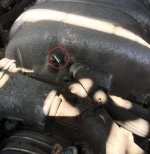
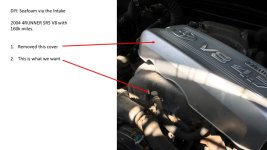
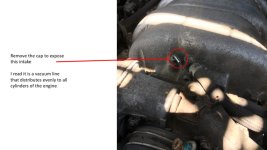
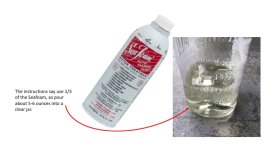
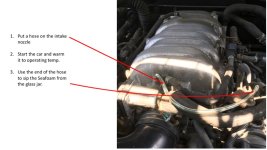
I used the thick, foam covered hose that exits the cover just forward of the manifold, inducting approx. 1/2 can there and dumping the other 1/2 can in the fuel tank with the tank being about 1/3 full.

I drove earlier in the day so only had to take her around the neighborhood to get back to operating temp. I inducted the 1/2 can and then turned off via key and let it sit for 30 mins.

Three things surprised me about the process:
1) The amount of vacuum from the hose at idle. That thing was ready to suck-start a leaf blower.
2) How the fluctuating amount of SF being "sipped" during the process made the engine idle speed fluctuate. It would go from normal to struggling/lugging right away if the hose were out of the liquid vs. being partially submerged. It probably took me three full minutes to induct 8oz. of SF.
3) THE AMOUNT OF SMOKE after the hot soak.

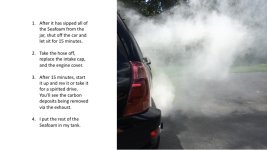
After the 30 minutes I went out and started it up and holy sh*t what a lot of smoke. I took a pic but PhotoBucket is being a PITA about hosting and I haven't found an alternative, so I'll get it up later. One thing I'm a little lost on is all of the people who call SF "snake oil" and claim it's just the SF being burned off that makes the billowing smoke (search Sea Foam in the Maintenance section for this). What doesn't jive with that though is, like I said, it took me a full three minutes to induct the SF and there wasn't a hint of smoke anywhere in that time even though it was obviously burning SF. Not until post-soak and restart did it smoke, and smoke it did from the instant I restarted.

I let it idle for 20 seconds or so and then took it for this "spirited" drive. My truck was exhausting so much white smoke that people wouldn't even get into the lane behind me. It was nuts. I had about three miles of surface roads until I hit the freeway on ramp but it was a looooong three miles with all that smoke trailing me. And of course, accelerating from a red light generated a ton of smoke so every intersection looked like a cloud upon my exit.

The check engine, VSC & traction control lights all came and stayed on so I put about 8 miles on the freeway, exited, found some shade, disconnected the negative battery terminal for five minutes and after which, buttoned everything up and lights were gone. I probably put 20 miles on it post-soak.

I rarely really get on the skinny pedal so my commute tomorrow will be the real test but this truck wanted to go. The idle also seemed lower at a stop, ~550/600 RPM. Last, my dash MPG read 18.5 consistently (95% freeway miles, was about 17.5 MPG when done on paper), so I reset and will be interested to see what that does over the next week.

Easy process for sure though.
 
Any downside if it go through this intake?
seafoam.jpg
 

Attachments

  • seafoam.jpg
    seafoam.jpg
    130.5 KB · Views: 833
Sea Foamed my 2008 V8 w/ 92K miles for the first time today based on this and other T4R threads about the benefits. I have the oil changed every 5K miles and all other preventative maintenance done since I bought it new, but just felt like my truck had lost some pep.

I used the thick, foam covered hose that exits the cover just forward of the manifold, inducting approx. 1/2 can there and dumping the other 1/2 can in the fuel tank with the tank being about 1/3 full.

I drove earlier in the day so only had to take her around the neighborhood to get back to operating temp. I inducted the 1/2 can and then turned off via key and let it sit for 30 mins.

Three things surprised me about the process:
1) The amount of vacuum from the hose at idle. That thing was ready to suck-start a leaf blower.
2) How the fluctuating amount of SF being "sipped" during the process made the engine idle speed fluctuate. It would go from normal to struggling/lugging right away if the hose were out of the liquid vs. being partially submerged. It probably took me three full minutes to induct 8oz. of SF.
3) THE AMOUNT OF SMOKE after the hot soak.

After the 30 minutes I went out and started it up and holy sh*t what a lot of smoke. I took a pic but PhotoBucket is being a PITA about hosting and I haven't found an alternative, so I'll get it up later. One thing I'm a little lost on is all of the people who call SF "snake oil" and claim it's just the SF being burned off that makes the billowing smoke (search Sea Foam in the Maintenance section for this). What doesn't jive with that though is, like I said, it took me a full three minutes to induct the SF and there wasn't a hint of smoke anywhere in that time even though it was obviously burning SF. Not until post-soak and restart did it smoke, and smoke it did from the instant I restarted.

I let it idle for 20 seconds or so and then took it for this "spirited" drive. My truck was exhausting so much white smoke that people wouldn't even get into the lane behind me. It was nuts. I had about three miles of surface roads until I hit the freeway on ramp but it was a looooong three miles with all that smoke trailing me. And of course, accelerating from a red light generated a ton of smoke so every intersection looked like a cloud upon my exit.

The check engine, VSC & traction control lights all came and stayed on so I put about 8 miles on the freeway, exited, found some shade, disconnected the negative battery terminal for five minutes and after which, buttoned everything up and lights were gone. I probably put 20 miles on it post-soak.

I rarely really get on the skinny pedal so my commute tomorrow will be the real test but this truck wanted to go. The idle also seemed lower at a stop, ~550/600 RPM. Last, my dash MPG read 18.5 consistently (95% freeway miles, was about 17.5 MPG when done on paper), so I reset and will be interested to see what that does over the next week.

Easy process for sure though.

How smart of you to be driving on the freeway with a smokescreen. The drivers behind you will be driving blind.
 
How smart of you to be driving on the freeway with a smokescreen. The drivers behind you will be driving blind.

Great opportunity for clarification-

By the time I made it to the freeway (~3 mi), the visible exhaust had reduced 70% or more and at freeway speeds it dissipated almost instantly.

I checked rear visibility constantly and was never unable to clearly make out other vehicles. With others at standard distances behind me, I'm not even sure they would still have been able to see the exhaust by that time.

Putting myself in a fellow drivers' shoes, I would assess the exhaust as nuisance, not a safety risk but it's a good callout all the same for others who might use Sea Foam to drive concisely following.
 
Great opportunity for clarification-

By the time I made it to the freeway (~3 mi), the visible exhaust had reduced 70% or more and at freeway speeds it dissipated almost instantly.

I checked rear visibility constantly and was never unable to clearly make out other vehicles. With others at standard distances behind me, I'm not even sure they would still have been able to see the exhaust by that time.

Putting myself in a fellow drivers' shoes, I would assess the exhaust as nuisance, not a safety risk but it's a good callout all the same for others who might use Sea Foam to drive concisely following.

I usually just rev it in park to clear all the smoke before i go on the roads. A good five minutes and all the smoke was gone. Then again, I feel its only a temporary caffeine boost for the engine with the seafoam.

Its the chemicals in the seafoam giving you the smoke illusion that your engine is dirtier than it is by trying to get rid of the gunk on the inside. It works though. Didnt feel much of a difference running it in the Tundra though. :(
 
got a road trip from OC up to tahoe coming up in a couple weeks and i think i'm going to do this before then. i know of a few parking lots not far from me that are about a mile from the freeway where i can do it and not fully piss off my neighbors with the smoke-out. good info in here!

one question: do you let the intake hose sip the seafoam with some air? or just fully dunk the hose in and let it chugchugchug?
 
got a road trip from OC up to tahoe coming up in a couple weeks and i think i'm going to do this before then. i know of a few parking lots not far from me that are about a mile from the freeway where i can do it and not fully piss off my neighbors with the smoke-out. good info in here!

one question: do you let the intake hose sip the seafoam with some air? or just fully dunk the hose in and let it chugchugchug?
I, personally, have always gotten a small funnel and just poured it in slowly while having a friend rev the engine to keep it from dying.

Whatever you do, as long as the engine keeps running you're good. Some people like to make it die with it....I'm not a huge fan of doing that (I hydrolocked a car once, so anytime I add fluid to the combustion chamber I get sketched out....)
 
Thanks to this thread, I went to Autozone to purchase a can. I didn't do the intake method, just the "dump in the gas tank upon fill-up" technique.

I just upped my 0-60MPH by 3 seconds :rockon:


disclaimer- 0-60 improvement is not true
 
Thanks to this thread, I went to Autozone to purchase a can. I didn't do the intake method, just the "dump in the gas tank upon fill-up" technique.

I just upped my 0-60MPH by 3 seconds :rockon:


disclaimer- 0-60 improvement is not true
That won't quite clean it out like the intake method will, but will still make a difference
 
Thanks!
I'm pretty on top of the maintenance with the Runner, she runs great as it is, but I figured the SeaFoam couldn't hurt.
Yeah, after reading through this I realized that it's never been done on my 4 Runner and it's at 172k miles so is probably due....(I did do it on my last car, which is why I have experience with it). I'll do it this weekend and hope it makes things better. I've got a pretty obnoxious tick from the valvetrain that I'm hoping to clear up with a tiny bit of seafoam in the oil.
 
Can any of you who have used Seafoam provide results as to its effectiveness (i.e., better idle, better MPG, etc.). I'm still skeptical and would like to know there is a benefit other than seeing a sh**ton of smoke and pissing of my neighbors...
 
Can any of you who have used Seafoam provide results as to its effectiveness (i.e., better idle, better MPG, etc.). I'm still skeptical and would like to know there is a benefit other than seeing a sh**ton of smoke and pissing of my neighbors...

My mechanic resolved a rough idle on my other car with Seafoam a number of years ago. First time I'd heard of it. But a $20 repair bill made a believer out of me. The 4R had no symptoms. I just decided to do it since I had some Seafoam laying around. Before the Seafoam, my MPG read 19.0. I reset it after the Seafoam. And after four tanks, it reads 20.1. Same driving. Not scientific, but it's a data point since you asked. Idles the same.

Slide1.jpg

Slide2.jpg

Slide3.jpg

Slide4.jpg

Slide5.jpg
 

Attachments

  • Slide1.jpg
    Slide1.jpg
    80.1 KB · Views: 2,096
  • Slide2.jpg
    Slide2.jpg
    88.7 KB · Views: 2,041
  • Slide3.jpg
    Slide3.jpg
    71.9 KB · Views: 2,017
  • Slide4.jpg
    Slide4.jpg
    91.3 KB · Views: 2,118
  • Slide5.jpg
    Slide5.jpg
    77.5 KB · Views: 2,026
Can any of you who have used Seafoam provide results as to its effectiveness (i.e., better idle, better MPG, etc.). I'm still skeptical and would like to know there is a benefit other than seeing a sh**ton of smoke and pissing of my neighbors...

As the '07 I bought had sat a while before I got it, I poured a bottle of Seafoam into a full tank of fuel, ran it down to a 1/4 and refilled. Engine feels smoother at idle, saw a slight improvement in economy as well.

I didn't run it in fogger mode, I also don't believe in fixing what isn't broken.
 

Members online

Forum statistics

Threads
278,309
Messages
3,554,075
Members
248,016
Latest member
Advally Service

Trending content

Back
Top