So what exactly happens if you run Premium in a 4Runner?

The reason high performance engines require higher octâne is because they have hotter spark which produces a precise heat at the correct compression stroke to ignite the gasoline. lower octane will cause pre detonation or knock in those motors. Higher Octâne reading does not make more power it is the rate of burn at a given compression or detonation. Higher octâne fuel in lower compression engine will not increase power or mpg.
lower octane fuel in higher compression engine will produce knock or pinging. If your truck pings or knocks at idle with 87 then by all means use 89, 91, 95 or 98 but it is not going to increase your mpgs or add power.
 
What do you notice at elevation? I feel less power and better fuel economy in general here from 5,000’ up. Not sure octane would change that, but curious what you observe.

I have heard others on this forum say they have less head noise and smoother idling on this particular engine with 91. I haven’t tried 87 yet to check into it. I do have access to ethanol free 87 so I may check.

Definitely the most noticeable is the reduced power up in elevation, and loaded down with gear I think it makes it more noticeable. This is all interstate driving, after I hit the trail I don’t notice any difference between the two.
 
Read somewhere it took 3 full tanks of gas to adjust the timing for high octane = about 1000 miles. I do believe in pure gas (no ethanol). Pure Gas is mainly sold as 91 octane around here. Sure, I can't really tell if there is a difference with 91 octane. I don't have data. I also think it helps to use the entire rev range when using high octane. Driving all day at 2,200 rpms is not how the engine adjusts to high octane. The engine wants to rev to adjust timing. This is my opinion. I don't have proof and want that to be noted. 91 octane was $3.44 here today. I don't drive a lot of miles. Using 91 does hurt the pocketbook when traveling, however.

Also - I agree the purpose of high octane is to reduce pre detonation = ping/knock.
 
Last edited:
Read somewhere it took 3 full tanks of gas to adjust the timing for high octane = about 1000 miles. I do believe in pure gas (no ethanol). Pure Gas is mainly sold as 91 octane around here. Sure, I can't really tell if there is a difference with 91 octane. I don't have data. I also think it helps to use the entire rev range when using high octane. Driving all day at 2,200 rpms is not how the engine adjusts to high octane. The engine wants to rev to adjust timing. This is my opinion. I don't have proof and want that to be noted. 91 octane was $3.44 here today. I don't drive a lot of miles. Using 91 does hurt when traveling, however.


What about lugging up an incline and deciding whether to downshift or not? Assuming no change in pedal input, doesn’t the timing first advance as far as it can before the the transmission attempts to downshift?


Sent from my iPhone using Tapatalk
 
Timing is controlled by a map in the ECU. There's a max advance for any given place on the map. That max can be decreased if pinging is detected. If you are at max advance on 87 octane, meaning the engine is not pinging, then increasing the octane won't get you any more timing advance.

Basically this.

The ECU is generally always trying to get to max desired spark advance. Without access to the maps, we can all guess how it works, but generally speaking it's always trying to get to a certain advance at a certain load. Though there's usually several tables that further modify that, intake air temps, coolant temps, open loop vs closed loop, etc.

The ONLY place I'm curious if it can gain a degree or so of advance, is because it can handle some Ethanol. For those that have never run E85 and had access to a tune, you can dial in a lot more advance on E85 (generally speaking). Of course, the difference would be almost impossible to notice, but I am curious if running E0 91/93 would get you the same advance as running say 87 E10.

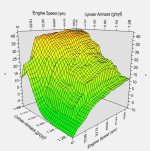
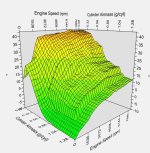
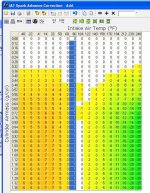
Tossed some pics from HP Tuners from my old LSJ for the OEM Stage 2 tune, my 100 Octane tune and the IAT modifier table. It can get really interwoven depending on the OEM's approach.
 

Attachments

  • 100OctaneTiming.jpg
    100OctaneTiming.jpg
    101.1 KB · Views: 688
  • StageTiming.jpg
    StageTiming.jpg
    101.2 KB · Views: 680
  • IATTimingModifier.jpg
    IATTimingModifier.jpg
    87.8 KB · Views: 688
Last edited:
I just commented on another thread about this.

A few years ago I posted about how my truck bogged down drastically when city driving in 90+ degree temps. I could almost put the peddle to the floor and it seemed to take several seconds to get any type of response.

Someone here suggested running a higher octane. I've been doing it ever since when temps get high.

The 4runner scoots around like it should, no bogging. When the temps cool off I go back to regular.

The explanation was the timing adjusted with the increased octane. I don't know if this is true but my problem was solved.

It's a pretty immediate effect. It's very noticeable to me too, I certainly would not be spending the extra money if not.
 
You’d think it would have been settled long ago with a dyno, but I’ve asked several times and nobody has anything.

If I didn't have full time 4WD (Limited), I'd volunteer as tribute. :D

Until then, it's really just lots of testimonies, supposed to's, and I read somewhere about something. Oh well, still fun to discuss.

And btw, I mainly run 91 in mine too lol.
 
This makes no sense to me. Knock is load-dependent, and there is no load at idle. I've never heard an engine knock at idle, and that includes old-school carbureted engines with no timing controls and plenty of advance. In fact, the only reason advance mechanisms were necessary before computers was to prevent kicking back during start-up. Once running, the engine could tolerate tons of advance without knocking as long as it was not under load.

The most challenging situation for managing knock is low RPM, high load (i.e., "lugging"). Low RPM, low load with the throttle closed shouldn't be a problem for any engine.

I think - just guessing - that it needs to run very lean at idle to meet emissions targets. Running lean at idle is hard to manage is my guess. Also that engine is 11.8:1 compression ratio - to it's a good bit higher than the 1GR. But... the 2GR FKS has variable compression via the extended valve timing. So it may run at 8:1 or something during idle.
 
I just commented on another thread about this.

A few years ago I posted about how my truck bogged down drastically when city driving in 90+ degree temps. I could almost put the peddle to the floor and it seemed to take several seconds to get any type of response.

Someone here suggested running a higher octane. I've been doing it ever since when temps get high.

The 4runner scoots around like it should, no bogging. When the temps cool off I go back to regular.

The explanation was the timing adjusted with the increased octane. I don't know if this is true but my problem was solved.

It's a pretty immediate effect. It's very noticeable to me too, I certainly would not be spending the extra money if not.


Maybe useless info, but do you live in an area affected by different seasonal blends?

5b83ab811dd4a1b554c4fc40e86bf7b3.png
 
i kinda feel that way too.. i leave the house in the early morning and my 4runner definitely has more pep? As mid day comes along and temps rise to triple digits it drags like a slug. A/C on or off, sometimes i just drive windows down in 100+ weather for fun... AC kicks on when my kids are with me..

could be the same idea with cold air intakes and the colder air in the morning yadi yadi la bla bla
 
Maybe useless info, but do you live in an area affected by different seasonal blends?

5b83ab811dd4a1b554c4fc40e86bf7b3.png

Not sure what the numbers mean on that map but being in Dallas I'm in either the pink or brown area.

it's pretty consistent, the closer we get to 100 degrees, the more heat soaked the engine gets and she bogs down. Put in 93 and she bogs no more.

I will note this is for big city driving, lots of stop and go in the sweltering Texas heat. Highway or small town driving probably isn't as noticeable.
 
i kinda feel that way too.. i leave the house in the early morning and my 4runner definitely has more pep? As mid day comes along and temps rise to triple digits it drags like a slug. A/C on or off, sometimes i just drive windows down in 100+ weather for fun... AC kicks on when my kids are with me..

could be the same idea with cold air intakes and the colder air in the morning yadi yadi la bla bla

I'd be curious to see if you find a change putting in the higher octane.

Not sure if humidity makes a difference though, looks like you are in Nevada. Here it's 97 degrees with 80% humidity sometimes.
 
I just commented on another thread about this.

A few years ago I posted about how my truck bogged down drastically when city driving in 90+ degree temps. I could almost put the peddle to the floor and it seemed to take several seconds to get any type of response.

Someone here suggested running a higher octane. I've been doing it ever since when temps get high.

The 4runner scoots around like it should, no bogging. When the temps cool off I go back to regular.

The explanation was the timing adjusted with the increased octane. I don't know if this is true but my problem was solved.

It's a pretty immediate effect. It's very noticeable to me too, I certainly would not be spending the extra money if not.

What's likely here is that your engine was pinging when the temp got hot. You won't hear it, the ECU will detect it long before it's audible to your ears. The ECU detected pinging and retarded the timing. When you put higher octane in, the ECU could return the timing to the proper advance.
 
Basically this.

The ECU is generally always trying to get to max desired spark advance. Without access to the maps, we can all guess how it works, but generally speaking it's always trying to get to a certain advance at a certain load. Though there's usually several tables that further modify that, intake air temps, coolant temps, open loop vs closed loop, etc.

The ONLY place I'm curious if it can gain a degree or so of advance, is because it can handle some Ethanol. For those that have never run E85 and had access to a tune, you can dial in a lot more advance on E85 (generally speaking). Of course, the difference would be almost impossible to notice, but I am curious if running E0 91/93 would get you the same advance as running say 87 E10.

Tossed some pics from HP Tuners from my old LSJ for the OEM Stage 2 tune, my 100 Octane tune and the IAT modifier table. It can get really interwoven depending on the OEM's approach.

The stock ECU maps are typically pretty conservative. It's one of the main ways tuners extract more power with "chips" (Chips are no longer used, the ECU can be reprogrammed through the diagnostic port. But people still use the word chips or chipped.).

The new maps will have more advance at any given spot on the map. This will get you more power, but at the risk of pinging. Increasing octane can reduce the pinging.
 
Here it's 97 degrees with 80% humidity sometimes.

Wow, that is deadly stuff right there. In the east/northeast when that happens people die. It’s not talked about a lot, and it seems to be better than it used to be, but when it gets that hot in big northeastern cities the elderly actually die from the heat. Others, too, from working outside, getting stranded, etc. Dangerous stuff.
 
Wow, that is deadly stuff right there. In the east/northeast when that happens people die. It’s not talked about a lot, and it seems to be better than it used to be, but when it gets that hot in big northeastern cities the elderly actually die from the heat. Others, too, from working outside, getting stranded, etc. Dangerous stuff.

We call it a typical summer day in South Louisiana. It was 95F in the shade, 110F everywhere else, with 85% humidity and a dew point of 77 yesterday. You MUST hydrate and adapt to it. I went to Navy boot camp in Florida in the summer (forever ago), the guys from up North were having trouble...I thought it was nice to not have such thick humid air and it was cooler there than my hometown.
 
Engine management will adapt and advance timing based on ambient conditions and new sensor data from the change in octane. Adaptation will happen faster when driven in a more aggressive manner. Especially WOT events.

On daily drives I run Nuvu's 88 Octane Regular. On days when I run the Silver Lake Sand Dunes I dump in a can of Royal Purple MaxBoost once I'm at a half full tank then I fuel up with 93 octane. On Dune days when I can fuel up from a quarter tank I fill up with 93 and I skip the booster. Quick numbers puts those mixes just under 92 octane. I live roughly 90 miles from Silver Lake. I can usually feel difference in acceleration halfway through the trip there. When I stop before the entrance to put my flag on I can feel and hear the difference in the engine idle. On rare Dune days when I fuel up with the low-fuel light on, I fill up with 90 octane Rec Gas. Call me crazy, the butt-dyno says the Rec Gas is the best performance of all.
 

Members online

Forum statistics

Threads
278,317
Messages
3,554,129
Members
248,016
Latest member
Advally Service

Trending content

Back
Top