So what exactly happens if you run Premium in a 4Runner?

There are a lot of people saying their 4Runners have some form of "improvement" by running 91 or better. A lot of people. And it's on many different platforms (not just here). maybe 35/65 split. If 35% of people are saying Premium improves performance, that's a strong minority. What's more is they provide technical explanations as to why this is. I always thought there was no affect.

I will investigate and use premium for the next two months and see what happens.

My suspicion though is that if anyone is seeing an improvement, it is likely more to do with the premium gas in your area having lower ethanol content. Just a guess. In Los Angeles, it appears that all grades using only 10% ethanol. I think we may switch to 15%. I wonder if 91 would stay at 10% though. I can't imagine these turbo'd, high performance cars loving more ethanol. If that happens, then 91 would be the move for me.
 
Ethanol reduces fuel economy and power. Period.
If people were to put there 4runners on a dyno, and run 87 octane, then 91-93 super unleaded octane, that will be the answer.
Seat of the pants can change from cool morning air to afternoon hot air.
Lower the octane your car can burn, the more power it will make.
The less alcohol in there, the better the fuel economy.
 
Ethanol reduces fuel economy and power. Period.
If people were to put there 4runners on a dyno, and run 87 octane, then 91-93 super unleaded octane, that will be the answer.
Seat of the pants can change from cool morning air to afternoon hot air.
Lower the octane your car can burn, the more power it will make.
The less alcohol in there, the better the fuel economy.

Not sure what claim you are making. Are you ultimately trying to say, that in the case of a naturally aspirated 4Runner, the difference maker is not the octane but the percentage of ethanol?
 
Not sure what claim you are making. Are you ultimately trying to say, that in the case of a naturally aspirated 4Runner, the difference maker is not the octane but the percentage of ethanol?
Alcohol lowers the HP, as it takes almost twice as much alcohol to make same power as gasoline.
Alcohol also lowers fuel economy since it makes less HP.
Higher octanes do not make more hp in a car designed, ie tuned, to run on 87 octane. It just doesnt, and wont.
If you retune your car to use higher octane, by increasing timing for example, you can make more hp/tq..
Lets say the 4runner has 9 to 1 compression. If you mechanically increases it to 11 to 1 compression, you will then probably need higher octane to prevent detonation.
Octane, the lower you can get away with, will make more power. Thats been known for years in the racing community.
Alcohol in our fuel was a BS attempt by US government to decrease emissions. It reduces fuel economy, and power. And to produce the ethanol takes a considerable amount of energy to produce. The only positive in any of it is the farmers and politicians bank accounts who bought into it.
Here is a pretty good video, with same engine running and split to use two different fuels. Note, this car has a ECU that is capable of changing timing on the run. Most cars are set with maps and wont do this..
https://www.youtube.com/watch?v=gqvhaPLuTPI&feature=youtu.be
 
Last edited:
I agree with the last posts. Getting rid of the ethanol is the thing I would guess would make a difference.
When I lived in coastal Oregon, I often did use 100% gasoline as the difference in price was not too bad.
 
Alcohol lowers the HP, as it takes almost twice as much alcohol to make same power as gasoline.
Alcohol also lowers fuel economy since it makes less HP.
Higher octanes do not make more hp in a car designed, ie tuned, to run on 87 octane. It just doesnt, and wont.
If you retune your car to use higher octane, by increasing timing for example, you can make more hp/tq..
Lets say the 4runner has 9 to 1 compression. If you mechanically increases it to 11 to 1 compression, you will then probably need higher octane to prevent detonation.
Octane, the lower you can get away with, will make more power. Thats been known for years in the racing community.
Alcohol in our fuel was a BS attempt by US government to decrease emissions. It reduces fuel economy, and power. And to produce the ethanol takes a considerable amount of energy to produce. The only positive in any of it is the farmers and politicians bank accounts who bought into it.
Here is a pretty good video, with same engine running and split to use two different fuels. Note, this car has a ECU that is capable of changing timing on the run. Most cars are set with maps and wont do this..
https://www.youtube.com/watch?v=gqvhaPLuTPI&feature=youtu.be

So I read your post and everything makes sense. Then I watch the video and my conclusion from the video appears to be different than yours. And like your previous post, I am confused as to the point your trying to make. It sounds like you are making two contradictory points at the same time?

The video appears to suggest there may be a tangible benefit to running premium. Your post suggests I should have come to a different conclusion after watching your video. I watched, and my take away was different. I then went on to read the comments and it seems like the commenters agreed with my takeaway (that there is benefit to 91).

Lastly, the subsidized corn-farming does a lot of harm. They also engineer other substances out of it for the purposes of putting it in our food. It gets worse still but I’ll just leave it at that. It’s why nobody trusts the FDA. They approve a lot of crap that turns out to be harmful and only begin to reverse their stances on the crap they approved for the public once other countries begin banning the things that the FDA had approved in the first place. There is no reason for us to expect the FDA to have even a few of the country’s best scientists, or any thing else for that matter.
 
Last edited:
So I ready your post and everything makes sense. Then I watch the video and my conclusion from the video appears to be different than yours. The video appears to suggest there may be a tangible benefit to running premium?
The ecm in that particular VW they used can adjust for different octanes as the wide band O2 sensors are able to check aling with kncok sensors.
Most ecms cant do this as many ecms in cars dont use wideband O2 sensors. Expensive to have wideband O2 sensors. They need to be replaced more often.
It really is simple. I think I went to far in explaining this.
 
Last edited:
The ecm in that particular VW they used can adjust for different octanes as the wide band O2 sensors are able to check aling with kncok sensors.
Most ecms cant do this as many ecms in cars dont use wideband O2 sensors. Expensive to have wideband O2 sensors. They need to be replaced more often.
It really is simple. I think I went to far in explaining this.

Gas grades, Premium vs. Regular comparison notices

Read post 17. A lot of people are expressing the same sentiments. It appears to me that 91 octane will provide me tangible benefits. I will switch for a month and see what happens.
 
I will say though, in all these octane debates, nobody ever seems to disclose the ethanol content of the different octanes they are trying when they say they feel differences (or lack there of) in switching to higher octane. The ethanol might be the thing. In a lot of states is it not true that ethanol is 15% except for 91+, which is 10%? Here in California all gas is 10%.
 
There are a lot of people saying their 4Runners have some form of "improvement" by running 91 or better. A lot of people. And it's on many different platforms (not just here). maybe 35/65 split. If 35% of people are saying Premium improves performance, that's a strong minority. What's more is they provide technical explanations as to why this is. I always thought there was no affect.

I will investigate and use premium for the next two months and see what happens.

My suspicion though is that if anyone is seeing an improvement, it is likely more to do with the premium gas in your area having lower ethanol content. Just a guess. In Los Angeles, it appears that all grades using only 10% ethanol. I think we may switch to 15%. I wonder if 91 would stay at 10% though. I can't imagine these turbo'd, high performance cars loving more ethanol. If that happens, then 91 would be the move for me.

Ethanol has a higher threshold for detonation thus forced induced cars love it. The issue with ACN 91 is that it's 91 and full of special air quality "improving" additives that can rob performance. LOTS of late model turbo owners run a gasoline and E85 mix in their modified turbo cars, typically to get around E30-E50.

In a naturally aspirated, lower compression, and lower revving motor like the 4Runner, you're wasting your time running 91+ plus wasting a TON of money. Any improvement in power is mental.
 
Last edited:
There are a lot of people saying their 4Runners have some form of "improvement" by running 91 or better. A lot of people. And it's on many different platforms (not just here). maybe 35/65 split. If 35% of people are saying Premium improves performance, that's a strong minority. What's more is they provide technical explanations as to why this is. I always thought there was no affect.

I will investigate and use premium for the next two months and see what happens.

My suspicion though is that if anyone is seeing an improvement, it is likely more to do with the premium gas in your area having lower ethanol content. Just a guess. In Los Angeles, it appears that all grades using only 10% ethanol. I think we may switch to 15%. I wonder if 91 would stay at 10% though. I can't imagine these turbo'd, high performance cars loving more ethanol. If that happens, then 91 would be the move for me.

I appreciate the sacrifice your wallet is making in the name of science :playball:
 
Wow, 7 pages of guessing and anecdotes...

Until measured with data collection, we won't really know what differences there are.

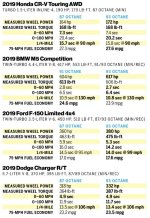
Car and Driver did a somewhat recent comparison on a varied set of vehicles. Now while there are some differences in the 4R with these, there is one big takeaway from this: not much is gained from higher octane in these run of the mill production vehicles. Even when there was improvement, it was not significant.

Is Premium Gas Worth It? We Test High Octane on 4 Popular Vehicles
 

Attachments

  • octane comparison.JPG
    octane comparison.JPG
    118 KB · Views: 566
Wow, 7 pages of guessing and anecdotes...

Until measured with data collection, we won't really know what differences there are.

Car and Driver did a somewhat recent comparison on a varied set of vehicles. Now while there are some differences in the 4R with these, there is one big takeaway from this: not much is gained from higher octane in these run of the mill production vehicles. Even when there was improvement, it was not significant.

Is Premium Gas Worth It? We Test High Octane on 4 Popular Vehicles

Sport Compact Car did a similar test on a Honda Accord V6 at the time (2000ish). Anytime they ran 91 the car consistently lost 10hp at the wheels. This was after running a couple of tanks through it back and forth between 91 and 87. So they would switch fuels and "let the ECU see it" as everyone claims.
 
Sport Compact Car did a similar test on a Honda Accord V6 at the time (2000ish). Anytime they ran 91 the car consistently lost 10hp at the wheels. This was after running a couple of tanks through it back and forth between 91 and 87. So they would switch fuels and "let the ECU see it" as everyone claims.

Not surprised. Higher octane fuel is it's resistance to ignite. The 4G motor is not designed or tuned to the necessitate the need for higher octane fuel. Chances are it will result in marginally less power and lower mpgs.
 
Sport Compact Car did a similar test on a Honda Accord V6 at the time (2000ish). Anytime they ran 91 the car consistently lost 10hp at the wheels. This was after running a couple of tanks through it back and forth between 91 and 87. So they would switch fuels and "let the ECU see it" as everyone claims.

That's interesting. And that's a monster drop off. 10HP on a 2000ish Accord is a big number.
 
Not surprised. Higher octane fuel is it's resistance to ignite. The 4G motor is not designed or tuned to the necessitate the need for higher octane fuel. Chances are it will result in marginally less power and lower mpgs.

I started to run 91 in my 2010 Tacoma because I had experienced some minor pinging at low RPM/high load situations (AC on and accelerating). Eventually I supercharged so I needed to run it anyway.

That's interesting. And that's a monster drop off. 10HP on a 2000ish Accord is a big number.

It was the 6th gen when the 2 door had the optional 3.0 V6 with dual exhaust. I have long since thrown out the issue but this has been a debate for years. People seem to think the ECU can see octane and change the tune enough to make more power but it wouldn't make sense for a manufacture to tune for a higher octane but recommend the lower octane.

Toyota did have "91 for better performance" listed in the early Tacomas (05/06) but it was removed probably because it didn't do anything.
 
I started to run 91 in my 2010 Tacoma because I had experienced some minor pinging at low RPM/high load situations (AC on and accelerating). Eventually I supercharged so I needed to run it anyway.


It was the 6th gen when the 2 door had the optional 3.0 V6 with dual exhaust. I have long since thrown out the issue but this has been a debate for years. People seem to think the ECU can see octane and change the tune enough to make more power but it wouldn't make sense for a manufacture to tune for a higher octane but recommend the lower octane.

Toyota did have "91 for better performance" listed in the early Tacomas (05/06) but it was removed probably because it didn't do anything.

I agree with you, but manufacturers do things like that. They sometimes opt to be stealth with respect to certain features/benefits/functions. For example, VW always understates its 0-60 times. In the 2022 Golf R, they say the 0-60 is 4.7 seconds. Literally every reviewer, be it Canada, US, UK, is achieving about 4.2. That is a big difference.

And does Toyota not say their transmission fluid is for "life?" It's not. Why would they do that? I'm not going to doubt a theory because I do not know the answer to why Toyota would or would not do something. Enough people are saying premium makes a difference to give me pause. It's a very large minority of people and they can't all be stupid or unreasonable (not saying you are accusing them of being stupid or unreasonable). I will try 91 for a while. I will feel a difference if there is one. I'm pretty in-tune with the vehicles I drive regularly.
 
I use premium exclusively, 91 pure gas. I believe the Dual VVT does adjust the timing. To protect the engine it takes about 1000 miles of consistent premium gas for the ECM to make the full adjustment. If you use one tank of of 87 octane the ECM adjusts back (retards) the timing immediately and you'd need another 1000 miles of premium to regain the ecm timing adjustment. Im not sure this is 100% accurate but it is what I've pieced together. My truck is fast! I'm getting 18.9 MPGs all summer.


There's not truth to this


Sent from my iPhone using Tapatalk
 
I agree with you, but manufacturers do things like that. They sometimes opt to be stealth with respect to certain features/benefits/functions. For example, VW always understates its 0-60 times. In the 2022 Golf R, they say the 0-60 is 4.7 seconds. Literally every reviewer, be it Canada, US, UK, is achieving about 4.2. That is a big difference.

And does Toyota not say their transmission fluid is for "life?" It's not. Why would they do that? I'm not going to doubt a theory because I do not know the answer to why Toyota would or would not do something. Enough people are saying premium makes a difference to give me pause. It's a very large minority of people and they can't all be stupid or unreasonable (not saying you are accusing them of being stupid or unreasonable). I will try 91 for a while. I will feel a difference if there is one. I'm pretty in-tune with the vehicles I drive regularly.

Toyota has since modified the maintenance interval with the trans fluid. Also Toyota doesn't underrate their modern engines. There's no need because people buy their product anyway. The ECU cannot see octane since there's no sensor for it. No the knock sensors do not see octane, they see knock and if there is none then all is good. This doesn't put the ECU into "make more power because this guy put in the good stuff" mode.

Don't feel anything, get it scientifically proven with a dyno.
 
Last edited:

Members online

Forum statistics

Threads
278,317
Messages
3,554,129
Members
248,016
Latest member
Advally Service

Trending content

Back
Top