Solid Front Axle Fascination (SFAF): Help Me Understand

Yeah, be careful, you could be treading on thin ice. But some do get fanatical about it...like Chevy vs. Ford, Coke and Pepsi, Democrats vs. Republicans, etc.

This whole solid axle vs. IFS...you can write several books (I think they have) on the pros and cons of each. There is no 'one size fits all'...like off road tires, there are several types for different 'applications'. People like to ask which is best for 'off roading'. Well, what kind of off roading...sand dunes, desert running, mud, dirt trail, rock hopping, etc.

I think some of it comes down to 'tradition'...<imagine old man salty voice> "my grandfather had solid axles, my father solid axles, and by gum I'm gonna have solid axles". Some of that might be due to ignorance.

However, from what I've seen (and experienced)...with all things being equal...a solid front axles (with what's available) are easier to upgrade as far as things like lifts and strength. Anything more than a mild lift on a IFS requires things like dropping the diff, extended CVs, relocation or new control arms, new springs, struts, (getting it realigned) etc. It can be quiet involved. As for solid axle...just slip in some blocks and you're good...actually, that's not the proper way...you do need to springs, shocks, etc., but it is easier to do...you drop the whole thing as a single unit. Also, given what's available today, pound for pound, solid axle can be configured to handle higher loads. I'm not saying you can't make a IFS as strong as a solid axle, but the cost involved would be prohibited to most people. Overall, solid axle are easier to work with and cheaper.

There is even division within the solid axle factions...leaf springs or coil (over) springs...OMG!

I could go on. But the question comes down...what do you want to do, what is going to be your application, how you going to use it (how much do you have to spend?)? Each has its place.

Even the military knows this...see the H1 Hummer...it has independent suspension all around.

The 4runner is suppose to be a 'all around' vehicle...it fits in between vehicles like the Wrangler (solid axles all around) and something like the Highlander (independent all around). You get a decent ride and control on road while still being able to take the road less traveled.
 
Last edited:
my offroad rig is a '92 Bronco with a solid D44 front axle (coil spring, extended radius arms, so on and so forth) that I swapped over the notorious Ford twin traction beam IFS..now don't get me wrong, IFS has some good qualities, it rides nicely and can be set up to do probably 98% of what most people would consider off-roading.

That aside, in my humble opinion, you can't be the solid axle for reliability or articulation. I've been wheeling my Bronco for close to 20 years..With the IFS you could just look at it wrong and the alignment would get jacked..I can beat on that solid axle all day and it will still drive straight as an arrow down the road..the best part is I can do an alignment in my driveway..

With a rig like my 4R that's primarily pavement and some light trails, I wouldn't ever consider going solid axle..but to each his own..
 
It's simple geometry. Solid axles have longer travel possible and usually better weight distribution at higher flex so that results in better traction (lower ground pressure). They are typically not as comfortable at higher speeds. For example no stock class IFS vehicle has ever finished the easiest route at King of the Hammers. Many solid axles have. In fact, the winners the last two years were also both on leaf springs. I'll take empirical results over theoretical every time. At speed the IFS solid rear axle perform the best. Less unsprung weight. IF you want a street car - IFS IRS is the best.

In short:
ifs-vs-sas-jpg.299246


If you don't actually go off road, you should probably look for a more highway oriented choice.
 
Last edited:
as others have said solid front axles provide much more flex, I plan to upgrade to a dana 30 after an experience I had while navigating some trails in front of the local JC Penny. I was flexing my suspension on one of the curbs and ended up getting stuck, and when the local police arrived to pull me out they claimed to have found a crack pipe among my recovery gear and I got arrested. I won't have this problem again once I get solid axles under my corolla.
 
Stock class? Which stock class?

... For example no stock class IFS vehicle has ever finished the easiest route at King of the Hammers. Many solid axles have. In fact, the winners the last two years were also both on leaf springs. I'll take empirical results over theoretical every time. At speed the IFS solid rear axle perform the best. Less unsprung weight. IF you want a street car - IFS IRS is the best.

It's not surprising the a modern stock vehicle with IFS wouldn't finish KoH.

$ Unnamed Stock Class <<<$Class 1 I'm sure of this

I dont even know which stock class you are talking about

Here's some links for them maybe you could be more specific.

Class Levels and Vehicle Numbers | SCORE-International.com
Rulebook | Ultra4 Racing

4 wheel independent, purpose built, from the ground up is the way to go. IMHO. If you are a weekend warrior with limited funds that chooses leaf springs and solid axles thats fine too.
 
Last edited:
I'm a bit confused. You drove 4R Limited, didn't like it. Spent several pages talking about what you didn't like, then drove a SR5 and seemed to like it.

Here, you are asking about a solid front axle (which I suspect you thought the 4R had), then went on to discuss about how bad the rear axle is.

I've never bought a car (and I've bought plenty) based on suspension design (or most anything else), but I've selected cars based on capabilities and features.

If I were you, I'd pick your next car based on ride, features and capabilities.

I drove a Limited and was underwhelmed. The nosedive on braking, combined with the sloppy braking, the steering wheel wiggle on the highway and the not so great gas mileage took it mostly off the list for me - although your comments on the SR5 may make me try the other models before I write the 4r off entirely.

Back on topic - I snickered just a bit was the comment a few posts back that solid axles give better gas mileage. Does that mean that the 4R would get even worse gas mileage if it had an independent rear suspension?
 
If the straight front axle has hubs that unlock, yes.
Hubs unlocked, the front wheels aren't turning the axles, differential, or driveshaft.

Sent from my SM-G955U using Tapatalk
 
4Runner Write a check

I fully intend to buy a 4Runner SrR5 Premium with a sunroof when we are ready. Great truck that meets our requirements

The topic of the thread is Solid Front Axle Fanaticism
 
Last edited:
Yeah, be careful, you could be treading on thin ice. But some do get fanatical about it...like Chevy vs. Ford, Coke and Pepsi, Democrats vs. Republicans, etc.

This whole solid axle vs. IFS...you can write several books (I think they have) on the pros and cons of each. There is no 'one size fits all'...like off road tires, there are several types for different 'applications'. People like to ask which is best for 'off roading'. Well, what kind of off roading...sand dunes, desert running, mud, dirt trail, rock hopping, etc.

I think some of it comes down to 'tradition'...<imagine old man salty voice> "my grandfather had solid axles, my father solid axles, and by gum I'm gonna have solid axles". Some of that might be due to ignorance.

However, from what I've seen (and experienced)...with all things being equal...a solid front axles (with what's available) are easier to upgrade as far as things like lifts and strength. Anything more than a mild lift on a IFS requires things like dropping the diff, extended CVs, relocation or new control arms, new springs, struts, (getting it realigned) etc. It can be quiet involved. As for solid axle...just slip in some blocks and you're good...actually, that's not the proper way...you do need to springs, shocks, etc., but it is easier to do...you drop the whole thing as a single unit. Also, given what's available today, pound for pound, solid axle can be configured to handle higher loads. I'm not saying you can't make a IFS as strong as a solid axle, but the cost involved would be prohibited to most people. Overall, solid axle are easier to work with and cheaper.

There is even division within the solid axle factions...leaf springs or coil (over) springs...OMG!

I could go on. But the question comes down...what do you want to do, what is going to be your application, how you going to use it (how much do you have to spend?)? Each has its place.

Even the military knows this...see the H1 Hummer...it has independent suspension all around.

The 4runner is suppose to be a 'all around' vehicle...it fits in between vehicles like the Wrangler (solid axles all around) and something like the Highlander (independent all around). You get a decent ride and control on road while still being able to take the road less traveled.

It's funny how the solid axle fanbois come out of the woodwork when their paradigm is challenged.

I think the above post nails it. Depends on what kind of off-roading you do and even then, there can be benefits/drawbacks to each.

From a production car standpoint with durability and overall cost taken into consideration, I think the solid rear axle makes the most sense for the 4Runner. I also think IFS is the best choice for the front.

Doesn't mean I wouldn't mind one with IRS, but at least the current ones are linked.

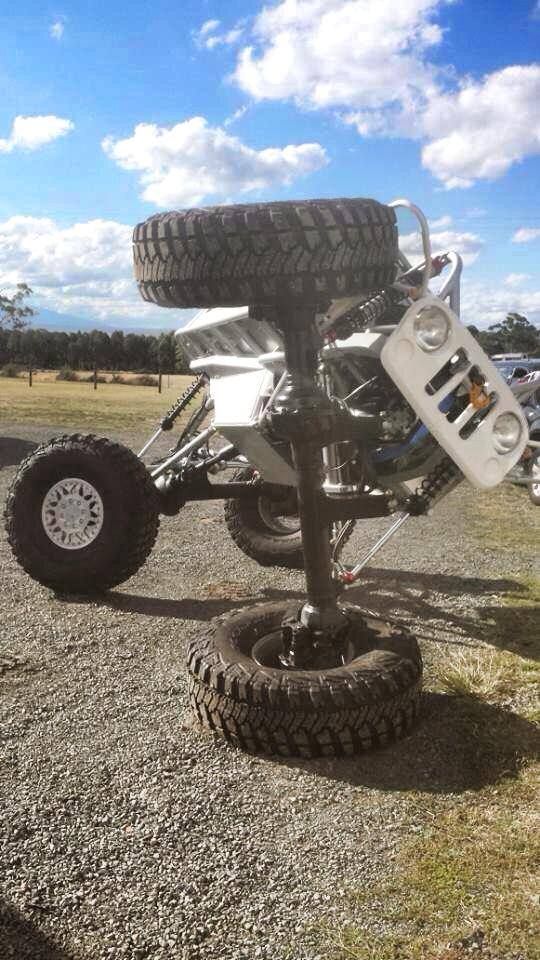
Did someone say articulation?

c24da4972e9ec855c7d8ae7fbf5feca8.jpg
 
Last edited:
Did someone say articulation?

c24da4972e9ec855c7d8ae7fbf5feca8.jpg

I don't think you'll ever see that much articulation on the trail except if all of the weight is on the front end in which case you have larger problems hitting a 4ft rock at that much of a downward incline.

Keep in mind there are no springs in that system shown.

SFA by its nature will always articulate better than IFS when rockcrawling. I wish IFS was better but at this point the technology isn't there.

The force used to push one tire up is directly used to push the drooping tire down which gives solid axle a traction advantage. You can get just as much wheel travel or more from IFS but it will never be the same in the rocks.
 
I don't think you'll ever see that much articulation on the trail except if all of the weight is on the front end in which case you have larger problems hitting a 4ft rock at that much of a downward incline.

Keep in mind there are no springs in that system shown.

SFA by its nature will always articulate better than IFS when rockcrawling. I wish IFS was better but at this point the technology isn't there.

The force used to push one tire up is directly used to push the drooping tire down which gives solid axle a traction advantage. You can get just as much wheel travel or more from IFS but it will never be the same in the rocks.

This isn't a rock crawler. It's a desert racer.

Also, think about your tire footprint with an articulated straight axel. The tire tilts and you have less footprint touching the ground. With IRS, your footprint remains flat.
 
This isn't a rock crawler. It's a desert racer.

Also, think about your tire footprint with an articulated straight axel. The tire tilts and you have less footprint touching the ground. With IRS, your footprint remains flat.

We're talking about in general, not just desert racing, but rock crawling and road manners too.

That's assuming the body remains perfectly flat when crawling over rocks. IFS sucks at that like I've been saying. At least in practical application like with our rigs, which this conversation is about. SFA has more usable articulation/geometry in the rocks, I didn't think anybody could deny that until this thread. Keep in mind real world applications. I'm not saying anything about clearance or weight, just articulation/grip. It's a benefit to have the tires connected together in certain situations. Exactly what sway bars try to accomplish.
 
We're talking about in general, not just desert racing, but rock crawling and road manners too.

That's assuming the body remains perfectly flat when crawling over rocks. IFS sucks at that like I've been saying. At least in practical application like with our rigs, which this conversation is about. SFA has more usable articulation/geometry in the rocks, I didn't think anybody could deny that until this thread. Keep in mind real world applications. I'm not saying anything about clearance or weight, just articulation/grip. It's a benefit to have the tires connected together in certain situations. Exactly what sway bars try to accomplish.

If you look at my first post, I say they both have benefits and drawbacks. But if we are talking solely about ride characteristics for general use, I have to give the nod to IFS/IRS. That's because most 4Runner owners use their trucks on road and on fairly mild trails. Only a small percentage of enthusiast use a 4Runner to do actual rock crawling where solid axle front and rear would benefit them.

However, like I said in my first post and others have already stated here, there is a caveat to IRS......the cost of production, maintenance, and durability when compared to a solid rear axel. Solid axels are cheaper for the manufacturer and the consumer.
 
It's not surprising the a modern stock vehicle with IFS wouldn't finish KoH.

$ Unnamed Stock Class <<<$Class 1 I'm sure of this

I dont even know which stock class you are talking about

Here's some links for them maybe you could be more specific.

Class Levels and Vehicle Numbers | SCORE-International.com
Rulebook | Ultra4 Racing

4 wheel independent, purpose built, from the ground up is the way to go. IMHO. If you are a weekend warrior with limited funds that chooses leaf springs and solid axles thats fine too.

This is the overall winner in 4400 (the fastest most extreme class). Take a look at what is underneath. Even purpose built unlimited class vehicles are not always IFS. And obviously this year the double solid axle setup beat all of the IFS vehicles in every class. Similarly there's never been an IFS rock crawler that's been competitive in rock crawling. Maybe some day they will be - but so far no one has figure out how to make it competitive.

josh-blyler_41_2020_drivingline_4400-race_ryan-del-ponte_the-redline-projects-42-of-57-copy.jpg
 
Did someone say articulation?

c24da4972e9ec855c7d8ae7fbf5feca8.jpg

That's cute. It's about half way there!

02042bdf03e4c87c9ad74e587144bc31.jpg


It's actually a very neat irs. My next off road trail rig may be IFS/IRS. But im doing sip accepting that it will almost certainly be less capable in the last mile of trail in trade for more comfort the rest of the time. And the plan is rear engine. The packaging works easier without a divorced transfer case.

Independent suspension does a lot of things well. Going fast is one of them. Maintaining distributed force evenly on all the wheels on uneven terrain is not. Horses for courses.

As far as OEM ifs - it's really hard to do much with short suspension arms.
 
Last edited:
This is the overall winner in 4400 (the fastest most extreme class). Take a look at what is underneath. Even purpose built unlimited class vehicles are not always IFS. And obviously this year the double solid axle setup beat all of the IFS vehicles in every class. Similarly there's never been an IFS rock crawler that's been competitive in rock crawling. Maybe some day they will be - but so far no one has figure out how to make it competitive.


My first response is that this sport doesn't have the sponsorship money to make developing IFS/IRS machines possible. These guys are still operating out of their pocket. More money spent on the truck more wenching from the wife. The inexpensive solid axle wins.
 

Forum statistics

Threads
278,312
Messages
3,554,089
Members
248,016
Latest member
Advally Service

Trending content

Back
Top