RichinRidgewood
New member
...cute..
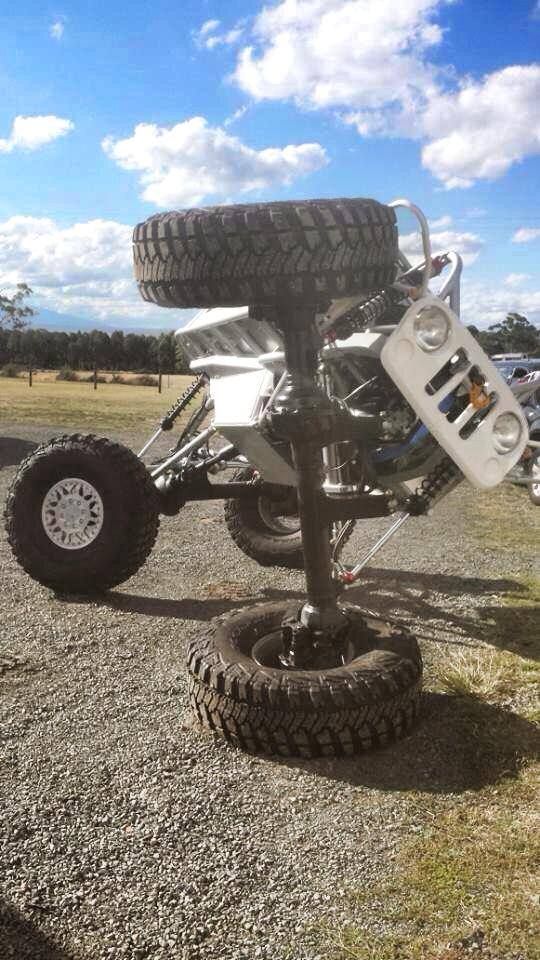
...this one has some shiny parts on it...

...cute..

My first response is that this sport doesn't have the sponsorship money to make developing IFS/IRS machines possible. These guys are still operating out of their pocket. More money spent on the truck more wenching from the wife. The inexpensive solid axle wins.
facepalm

Yes Im aware the front suspension is independent and rear is not on 4Runner. I don't care for the solid rear on the 4Runner.

I wouldn't want a solid front in my 06. conversely, I wouldn't want independent in my 85. they have purposes. my 06 will NEVER go where my 85 will.
but, im not sure you really wanted to have this discussion...
since you started out talking about SFA, but immediately called out disliking SRA...
That's simple physics. You don't like physics? Or you don't believe in physics?
Op needs to guy buy a highlander or some crap.
I want a 5th gen 4 linked on Ton's, detroit lockers, and 40" tires.
It's not about me it's about the fanaticism.

Fixed it for you.It's about you.
I have a lot of actual experience and a degree in physics. I know how both systems work. You seem to be the person who denies physics or doesn't want to understand. I'm happy to help educate you if you're actually trying to get a better understanding of why solid axles have advantages in some situations.
Fixed it for you.
That aside, I'd love a short tutorial on when a solid axle has advantages (aside from articulation)

Thats how it should be done. It's like artwork.
I'm not really a champion of any specific design. I think all the different designs have their merit in the right situations.
The inherent benefits of a solid axle are the a combination things.
The first is travel. IFS is inherently limited by a center differential. So... for the axle shafts to remain a static length, you can only travel through an arc around the inner cup of the shaft assembly. A solid axle generally will have a slip-shaft drive shaft that is much longer than a typical CV axle assembly. The axle as a unit has significantly more range of travel available by the geometry of that system. I'm not aware of any IFS or IRS systems with a floating differential. Maybe that exists?
You then add to that motion the articulation range. The result is the potential for wheel travel that significantly exceeds that of IFS/IRS. I'd say at least double the travel is pretty easily attainable. The real limit is mostly one of wheel base of the vehicle and the length of the suspension links and/or the springs.
The articulation advantage is pretty obvious. What's not as intuitive is what you can't see. The two tires on a solid axle are not independent of each other. And sometimes that's a benefit. The axle beam acts as a beam that will transfer forces from one side to the other. In the situation of extreme articulation the axle beam will transfer a significant force to what I'll call the drooping tire. The result is a more even balance of weight between the two tires. While the simple formula for friction suggests that we should be agnostic to ground pressure on each tire, more granular analysis would show that that is not actually the case and lower ground pressure over greater area generally provides greater friction. In short - two vehicles with all 4 tires on the ground don't necessarily have similar loading of each corner. Solid axles generally do a better job of load distribution through a greater range of articulation. The result is better traction in the rocks and other high articulation scenarios. I'm sure there are many FEA models of this. It's a complex system that depends on spring rates on both sides and spring location on the beam along with spring angles and mounting etc.
Another common advantage is that when articulated the tire tread tends to match the terrain better. In general IFS is designed around vertical wheel travel, so the tread would remain roughly parallel to the plane of made by the bottom of the frame rails. Off camber trails rarely exist in the form of a LEGO type pattern with flat tops and ledges between the two tracks. Most of the time the trail its self is sloped roughly similar to the angle of articulation. This is scenario specific, but this photo gives you the idea of how IFS tire contact patch is often pretty poor in the real world at the greater limits of articulation. A solid axle would generally be expected to follow the slope of the ground much closer and have a significantly better tire tread contact patch.
The other easy advantage is axle strength. The inherent strength advantage is the result of less angle on the outer joint (or no angle on the rear axle). As CVs get stronger this is less and less important, but it can be meaningful at the limit. A solid front axle can have a tighter turning radius than IFS. Part of the angle of the outer CV joint is used by the vertical offset between the spindle and the differential. In a solid axle you can use the entire available angle of the CV for turning. The result is either less stress on the joint at the same steering angle or greater available steering angle.
Those are a few of the advantages a solid axle has.
Of course there's a ton of advantages of independent suspension as well. Lower unsprung weight. Offset differential from spindle height (more ground clearance). Static steering assembly (steering rack) instead of a steering assembly that must compensate for a moving axle assembly. Rigidity of the differential mount on the frame eliminates torque effects on suspension.
Solid axle rear with IFS is a great balance of handling, comfort, capability, and packaging for an all around performance vehicle that does well off road. The packaging for an IRS that would have the same travel and performance of a solid rear axle would be really trick to do without some really creative engineering or intrusion into the cabin space. That's the reason no OEM IRS vehicle has a lot of rear suspension travel. They can be designed to have more than they do - but they don't because in order to do so, you'd need something like a long coilover to get a spring rate soft enough to have good balance all the way out to the limits of the articulation range. With a solid axle and relatively far inbound springs like the 4Runner has, you can have that articulation and load distribution with relatively firm spring rates - because you get the advantage of the lever arm effectively adding additional downward force to the drooping side of the axle.
Hope that helps. It's a quick stream of consciousness. I could probably put some math behind it at some point.
The first is travel. IFS is inherently limited by a center differential. So... for the axle shafts to remain a static length, you can only travel through an arc around the inner cup of the shaft assembly. A solid axle generally will have a slip-shaft drive shaft that is much longer than a typical CV axle assembly. The axle as a unit has significantly more range of travel available by the geometry of that system.
You then add to that motion the articulation range. The result is the potential for wheel travel that significantly exceeds that of IFS/IRS. I'd say at least double the travel is pretty easily attainable....
The articulation advantage is pretty obvious....
Solid axles generally do a better job of load distribution through a greater range of articulation. The result is better traction in the rocks and other high articulation scenarios. I'm sure there are many FEA models of this. It's a complex system that depends on spring rates on both sides and spring location on the beam along with spring angles and mounting etc. ....
The other easy advantage is axle strength. The inherent strength advantage is the result of less angle on the outer joint (or no angle on the rear axle). As CVs get stronger this is less and less important, but it can be meaningful at the limit. A solid front axle can have a tighter turning radius than IFS. Part of the angle of the outer CV joint is used by the vertical offset between the spindle and the differential. In a solid axle you can use the entire available angle of the CV for turning. The result is either less stress on the joint at the same steering angle or greater available steering angle.
No springs and there isn’t even a shock on one side. It’s easy to articulate on a display when nothing is in the way. Show me that same articulation with a shock on both sides and I’ll be more impressed. Wouldn’t surprise me to see actual usable travel at 60-70% of what’s shown in the picture when shocks and springs are added.
It is pretty, I’ll give you that.
Sent from my iPhone using Tapatalk
What?
?
I don't know what to say here. I don't really have time to go though all of this and correct it.
It's about you.
I have a lot of actual experience and a degree in physics. I know how both systems work. You seem to be the person who denies physics or doesn't understand. I'm happy to help educate you if you're actually trying to get a better understanding of why solid axles have advantages in some situations.
Originally Posted by Jetboy
...doesn't want to understand...
Fixed it for you.
Here we go with the personal attacks.
It's great you have a degree.
Many of us have here have one or two I'm sure. Some maybe more.
It's not about me its about Solid Front Axle Fascination.