'splain to me something bout lifts...

Vulgarian

New member
How's this work?

I just had my lift put on and was surprised about how much more ground clearance I got. So I called ICON and if I got this right, they stated that my front coil overs come preset at about 2.1" and that amount of lift actually yields about 3.5" in additional clearance. Since my tires net me about .6" in additional lift taken at the radius my measuring sticks start making sense. I still don't know how 2.1 nets 3.5 but perhaps [MENTION=66316]1engineer[/MENTION] or any other of you who are more informed than I (and that's a pretty low bar) can elucidate further or correct any misinformation, I would appreciate it.

The amount of actual clearance gained from the tires upsizing and 3" lift surprised me. I was expecting about 5/8" less.

 
Register to hide this ad
I think they mean 2.1" on the threads? Can you take a picture of your Coilover threads?
So 8 1/4 to 12 1/4 . 4" total. I figured the coilovers came set with 2.5" lift + .6 from your tires would be 3.1" more clearance. Not sure here the extra inch comes from
 
Last edited:
Don't forget springs will also settle after installation. If you re-measure in a week or so I almost guarantee it would be a touch lower than it was immediately after install. Suspension angles before a post install alignment could also be affecting overall ride height and ground clearance.

EDIT: A 2.5" change in spring length/spring seat height would/could change the suspension angles in a way that yields more ground clearance relative to the spring/seat change.
 
Last edited:
Don't forget springs will also settle after installation. If you re-measure in a week or so I almost guarantee it would be a touch lower than it was immediately after install. Suspension angles before a post install alignment could also be affecting overall ride height and ground clearance.

EDIT: A 2.5" change in spring length/spring seat height would/could change the suspension angles in a way that yields more ground clearance relative to the spring/seat change.

Okay, I think I've figured this out. Thinking, in oversimplified terms here, the assumption of say a two inch lift as it applies to our vehicles must be applied to an independent front suspension system. The key being the distance from the origin of the radius of the lower control arm to where the two inch lift is applied to the radius. Moving the connection point further away from the origin yields less net ground clearance. So in terms of IFS, a lift of x-inches will yield a net lift of x plus (the math of the radius) in ground clearance. However, my initially flawed assumptions of a 2" lift yielding a 2" gain in ground clearance does more appropriately apply to a straight axle vehicle, the angles of the shocks or clearance taken at axles not with standing.

And I do expect the truck to settle. I'll measure it over time and post the outcome.
 
Last edited:
2.1" is the shock bore diameter.
Icons are pre-loaded to lift a stock weighted truck 2.5".
Icons can be pre-loaded to lift from 0-3.5".
The ratio between lift to threads adjustment is close to 1.8 to 1.
Mathematically, the difference between lift of an E rated 285 and a P rated 265 is 0.6". It is actually greater because the sidewall flex is less.
I have had 4 vehicles run Icons and I have never experienced springs settling with them. They use quality springs.
The setting is noticed after the alignment and the geometry is corrected.
I typically see 38.0-38.5" from the ground to the bottom of the fender inner opening with an Icon lift on 285s.
 
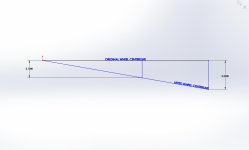
Mathematically, it's similar triangles. Speaking normal American, it works like a lever.

Imagine you are holding a stick. It can be a shovel, rake, broom, two-handed sword, or just a stick. whatever feels best in your hands. Put one hand on the end of the stick and hold it stationary. Put the other hand somewhere between the first hand and the other end, but not all the way to the other end. If you move your second hand 2", the free end of the stick will move more than 2".

This is how an IFS lift works. The stationary hand is the point where the control arm is mounted to the frame. The moving hand is the coilover column that is getting longer. The tire is the free end. As Misterquad said, on our vehicles it's about a 1.8:1 ratio.

This is also how a "long travel" front suspension works. You're making the control arms longer, so the wheel movement to shock movement ratio increases.

A rear lift on a solid axle is a direct 1:1 ratio. For my 2.5/1.5 spacer lift, the front pucks (2.5" lift) were actually thinner than the rear pucks (1.5" lift).


Incidentally, I've always heard that a 2.5" front lift is about as far as you want to go with stock CV joints. If your lift is more than this you might consider a diff-drop kit... or maybe I'm misinformed.
 
Last edited:
2.1" is the shock bore diameter.
Icons are pre-loaded to lift a stock weighted truck 2.5".
Icons can be pre-loaded to lift from 0-3.5".
The ratio between lift to threads adjustment is close to 1.8 to 1.
Mathematically, the difference between lift of an E rated 285 and a P rated 265 is 0.6". It is actually greater because the sidewall flex is less.
I have had 4 vehicles run Icons and I have never experienced springs settling with them. They use quality springs.
The setting is noticed after the alignment and the geometry is corrected.
I typically see 38.0-38.5" from the ground to the bottom of the fender inner opening with an Icon lift on 285s.
Icon said they were preset at 2.1 and perhaps they misspoke or I misunderstood. In either case I misrepresented my lift by casually stating 3". It's not as Demello told me it's a somewhere between 2.1" and 2.25" That tire information is helpful as well. - Thanks!

Mathematically, it's similar triangles. Speaking normal American, it works like a lever.

Imagine you are holding a stick. It can be a shovel, rake, broom, two-handed sword, or just a stick. whatever feels best in your hands. Put one hand on the end of the stick and hold it stationary. Put the other hand somewhere between the first hand and the other end, but not all the way to the other end. If you move your second hand 2", the free end of the stick will move more than 2".

This is how an IFS lift works. The stationary hand is the point where the control arm is mounted to the frame. The moving hand is the coilover column that is getting longer. The tire is the free end. As Misterquad said, on our vehicles it's about a 1.8:1 ratio.

This is also how a "long travel" front suspension works. You're making the control arms longer, so the wheel movement to shock movement ratio increases.

A rear lift on a solid axle is a direct 1:1 ratio. For my 2.5/1.5 spacer lift, the front pucks (2.5" lift) were actually thinner than the rear pucks (1.5" lift).


Incidentally, I've always heard that a 2.5" front lift is about as far as you want to go with stock CV joints. If your lift is more than this you might consider a diff-drop kit... or maybe I'm misinformed.

Right, that is what I was trying to state above in even simpler terms. And your comment about the spacers is a great illustration of this principle. Thanks for your input. And in no case will these get adjusted over 2.5. It would be my goal to stay comfortably under that.
 
Triangles

jwkilgore is on the right path. I felt that an image would help explain further.
The pivot point for your lower control arm is fixed on the frame. The top spring seat is also a fixed position. If the distance between the spring seat and the lower control arm connection with the bottom of the shock increases the result that the wheel will move down in relation to the frame. This results in the truck being lifted higher. Since the shock/spring assembly is between the pivot point and the wheel, the wheel will change height in relation to the frame by more that the height change made by the shock/spring "lift". Again, I hope the image helps more than what I wrote.
 

Attachments

  • Lift angles.jpg
    Lift angles.jpg
    32.9 KB · Views: 437
Icon said they were preset at 2.1 and perhaps they misspoke or I misunderstood. In either case I misrepresented my lift by casually stating 3". It's not as Demello told me it's a somewhere between 2.1" and 2.25" That tire information is helpful as well. - Thanks!

I would have sworn that I read Icons were preset at 2.5" but cannot find it to save my life. But anyway, Demello would be the most reliable source on this.
 
I have had 4 vehicles run Icons and I have never experienced springs settling with them. They use quality springs.

Not questioning the quality of the springs but it would be my understanding that all suspension springs typically have an initial settle. Icons might just be high enough quality that its a negligible difference. I'm not saying you would lose inches to settling, but maybe a 1/4"-1/2" overall depending on the vehicle and the quality of the springs. Even if it is just the new springs settling in to any rubber components they are in contact with, like spring seat insulators. In the end though, all springs wear out and will eventually sag over time.

If I learned anything from being an alignment tech is there are no strict rules for how any one suspension component will behave, there are far too many variables.

As a side note, something I am starting to love about this forum is intelligent, informed conversations about the technical aspects of vehicle dynamics. Seriously, it's awesome. Thanks guys.
 
jwkilgore is on the right path. I felt that an image would help explain further.
The pivot point for your lower control arm is fixed on the frame. The top spring seat is also a fixed position. If the distance between the spring seat and the lower control arm connection with the bottom of the shock increases the result that the wheel will move down in relation to the frame. This results in the truck being lifted higher. Since the shock/spring assembly is between the pivot point and the wheel, the wheel will change height in relation to the frame by more that the height change made by the shock/spring "lift". Again, I hope the image helps more than what I wrote.

Exactly, this is a simple illustration of the principle that jwkilgore and others have stated and a visual version of what I was stating above. Here's my quick NOT TO SCALE sketch:


Later, I'm off today and going climbing and wheeling to try this new stuff out!
 
[MENTION=128190]Vulgarian[/MENTION]


..your handwriting. Is that a course you took in college? Seems like every engineer and/or architect writes the same way. Hell, even AutoCADs default font is similar.
 
[MENTION=128190]Vulgarian[/MENTION]


..your handwriting. Is that a course you took in college? Seems like every engineer and/or architect writes the same way. Hell, even AutoCADs default font is similar.

Hahaha! Yeah, they used to teach it in architecture school. I don't think they still do, at least not to the rigor that they used to prior to AutoCAD. That obviously betrays my age. ;)
 
As a side note, something I am starting to love about this forum is intelligent, informed conversations about the technical aspects of vehicle dynamics. Seriously, it's awesome. Thanks guys.
:iagree:
That's nice and all. :nerd:
But it would quickly get boring without the snarky comments from the peanut gallery. :rockon:


And yes, back in the day when they taught hand drafting, they did teach that specific block font.
 
I think most parts mfgs state additional lift numbers in terms of (center of wheel hub to top of fender measurements). Not at the coil over..

3" of lift is a very safe and reliable for the CVs on the 5th gens. The diff drops that people speak of make no noticeable difference in the angles. They only lower the front portion and it results in almost no change for the cv shaft position.

The term ground clearance is very vague... Technically, you only gain ground clearance with larger tires (the rear Diff and front knuckles stay in the same position with a suspension lift). You do still gain a tremendous amount of usable clearance with a lift though. But it would be technically referred to as improved approach, departure, and breakover angles. There is not really an official measurement for what I would call usable ground clearance... To me it is the lowest point on the vehicle that is not parallel with an axle.
 
How's this work?

I just had my lift put on and was surprised about how much more ground clearance I got. So I called ICON and if I got this right, they stated that my front coil overs come preset at about 2.1" and that amount of lift actually yields about 3.5" in additional clearance. Since my tires net me about .6" in additional lift taken at the radius my measuring sticks start making sense. I still don't know how 2.1 nets 3.5 but perhaps [MENTION=66316]1engineer[/MENTION] or any other of you who are more informed than I (and that's a pretty low bar) can elucidate further or correct any misinformation, I would appreciate it.

It has nothing to do with lift and everything to do with geometry, trig and algebra lol. Several of the previous answers are correct so no need for me to expound any deeper.
 
:iagree:
That's nice and all. :nerd:
But it would quickly get boring without the snarky comments from the peanut gallery. :rockon:


And yes, back in the day when they taught hand drafting, they did teach that specific block font.

For us architects, the font is Helvetica.
 
2.1" is the shock bore diameter.
Icons are pre-loaded to lift a stock weighted truck 2.5".
Icons can be pre-loaded to lift from 0-3.5".
The ratio between lift to threads adjustment is close to 1.8 to 1.
Mathematically, the difference between lift of an E rated 285 and a P rated 265 is 0.6". It is actually greater because the sidewall flex is less.
I have had 4 vehicles run Icons and I have never experienced springs settling with them. They use quality springs.
The setting is noticed after the alignment and the geometry is corrected.
I typically see 38.0-38.5" from the ground to the bottom of the fender inner opening with an Icon lift on 285s.

Is that 1" of threads = about 1.8" of lift ?
 
I rounded but it is pretty close. To be more precise, 1 inch of threads equals 1.92 inches of lift.

The spacer for a 3 inch lift is 1.5625 inches tall. (1-9/16")
 

Members online

Forum statistics

Threads
278,316
Messages
3,554,111
Members
248,016
Latest member
Advally Service

Trending content

Back
Top