Talk me through brake bleed/fluid replacement

I did mine with ignition on. The M/C pump will assist in the bleeding. On the rear brakes you can press and hold the brake pedal until clear fluid comes out. On the front you have to press-release-repeat. You'll hear the pump cycle as you press the pedal.

I did not use and toyota SST. Look up "one man-brake bleeder" as an alternative to speed bleeders There's a YT user named "Chris Fix" who has a good video as well as "Eric the Car Guy" if I remember correctly. An old jar of some type and some length of vinyl tubing from Lowes or HD. I THINK I had 1/4" ID but I'd have to double check. I just bought a few short diameters to test fit, then went and bought about 6' of the correct size.

I had problems with my speed bleeders (but many have had good experiences). A 1-man bottle makes it every bit as easy as speed bleeders. Just ensure the bottom of your bleeder hose remains immersed in fluid in the jar.

I don't think a vacuum bleed is necessary.

On 4th gens, the left/right order is not important, but I seem to remember the fronts are done 1st then the rears (look in the FSM).

Make sure your bleeder hose travels in an upward arc after the bleeder plug so any air bubbles can get trapped and not get back into your lines.
 
I have always pumped the brake pedal til it is stiff, then release the valve while someone else is holding the pedal down until they get their foot to the metal, then once it is down, tighten up the bleeder valve, have them pump it until stiff again and repeat a few times on each or until you can tell that there is no more air coming out.

You could damage the seals in the master cylinder this way. When it's pushed past where it normally goes there could be debris or something inside the cylinder that damages a seal. If it has worked for you on 4runners that would be good to know, but it doesn't seem like the best way to do it. The whole MC assembly and all the electronics and stuff is $2000 for the part alone, and there's not really any way to service it or replace just a part of it.
 
There's a lot of confusion in this thread. It probably doesn't matter much if you find a way that works for you.

Here's a thread on doing it without a scan tool:
http://www.toyota-4runner.org/4th-gen-t4rs/145716-brake-bleeding-w-abs-w-o-sst-tool.html

I tried it with a scan tool, and it wasn't really worth it over the FSM procedure. It might be worth a try if you are having problems, or if you replace the brake boost assembly and it's empty.
http://www.toyota-4runner.org/4th-gen-t4rs/189108-diy-brake-fluid-change-bleed-using-scan-tool.html
There are still some useful notes there about the tools you'll need.

Having the key on lets the pump push fluid through to the rears, which makes bleeding those very easy. No speed bleeders needed, even doing it by myself. I haven't found any way for it to do the same for the front, even with the SST. I still did it by myself on 3 wheels without speed bleeders, and I needed help to do the front passenger side wheel. With someone helping there's no need for speed bleeders unless you are having problems getting air out for some reason.

Having the key on also lets it beep for sometimes. It's unclear why it beeps, but it probably means it's unhappy. Maybe it senses when the fluid gets too low, or when the valves have been open for too long, or something like that?

Vacuum and pressure bleeding are alternatives to pumping the pedal. They might be good to eliminate any risk of damaging seals since you don't have to touch the pedal. But they require buying special tools (vacuum or pressure bleeder) that take up space in the garage and only get used once every few years.
 
I've used a mightyvac from harbor freight for many years and everything from a school bus, bmw, f150, gmc 2500, motorcycles, and atvs. I haven't tried it on the 4runner yet because I just bought it. It is $40-50 and makes bleeding most any brake system really easy and quick. Start with the brake furthest from the M/C and work closer as you go.
Mityvac Vacuum Pump - Save on Mityvac Pumps at Harbor Freight!

This would appear to be the best solution imho.
 
Follow up

I went back yesterday and re-bled and got a much better result, here is what I did:

1) Emptied master cylinder as much as possible with turkey baster, filled with new fluid to MAX line

2) Rear: With ignition ON, cracked rear caliper bleed screw, then let accumulator pump fluid out until much clearer fluid was visible. Collected maybe 10oz out of each rear caliper

3) Front: Had a helper pump pedal 5 times, then hold while I opened the front caliper bleed screw, then signal me when pedal was approaching floor so I could close line. Did this 5-6 times per front caliper

4) Topped off master cylinder and enjoyed a much firmer pedal stroke

In total I collected about 40oz of old brake fluid, and obviously put the same amount back in. Hope this helps.
 
I guess my question is why buy speed bleeders that stay on a vehicle when you can buy a vacuum pump for the same price which you can keep and use on future vehicles as well?

Seems like the vacuum is an easier process too.
 
I do it this way too and so far, I did not have any problems. bled the rear first so I can get rid of old fluid with the key on and a brake/release/repeat for the front. worked pretty well.

I did mine with ignition on. The M/C pump will assist in the bleeding. On the rear brakes you can press and hold the brake pedal until clear fluid comes out. On the front you have to press-release-repeat. You'll hear the pump cycle as you press the pedal.

I did not use and toyota SST. Look up "one man-brake bleeder" as an alternative to speed bleeders There's a YT user named "Chris Fix" who has a good video as well as "Eric the Car Guy" if I remember correctly. An old jar of some type and some length of vinyl tubing from Lowes or HD. I THINK I had 1/4" ID but I'd have to double check. I just bought a few short diameters to test fit, then went and bought about 6' of the correct size.

I had problems with my speed bleeders (but many have had good experiences). A 1-man bottle makes it every bit as easy as speed bleeders. Just ensure the bottom of your bleeder hose remains immersed in fluid in the jar.

I don't think a vacuum bleed is necessary.

On 4th gens, the left/right order is not important, but I seem to remember the fronts are done 1st then the rears (look in the FSM).

Make sure your bleeder hose travels in an upward arc after the bleeder plug so any air bubbles can get trapped and not get back into your lines.
 
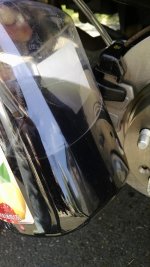
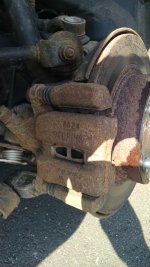
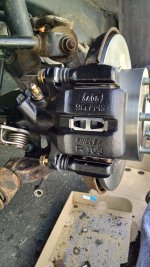
Just as a reminder to flush your brake fluid every so often. Over the weekend, I replaced a seized caliper, rotor, and brake pads on my girlfriend's honda accord. I made sure to bleed the brakes while everything was apart, and since I installed the caliper with a speedbleeder.

Here's what came out, it was black as used motor oil. I'm guessing it turned this way from excess heat from the seized calipers.

2015 Cell 009.jpg


Here's a before and after shot:

2015 Cell 001.jpg

2015 Cell 006.jpg
 

Attachments

  • 2015 Cell 001.jpg
    2015 Cell 001.jpg
    139.3 KB · Views: 1,433
  • 2015 Cell 006.jpg
    2015 Cell 006.jpg
    144.1 KB · Views: 1,435
  • 2015 Cell 009.jpg
    2015 Cell 009.jpg
    137.3 KB · Views: 1,430
Sorry to pull this thread from the depths of the abyss, but would this procedure also work for a caliper replacement? Will the pressure supply have enough pressure to fill an empty caliper?

Many thanks!

Yes the Motive one man process should work for this as well. I havent tried it personally though. Thanks for the thread revival and reminder...I need to do another flush soon!
 

Members online

Forum statistics

Threads
278,310
Messages
3,554,078
Members
248,016
Latest member
Advally Service

Trending content

Back
Top