The 3.4L TRD Supercharger Thread

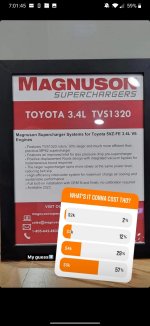
I saw this video right after SEMA this year. I'm definitely interested. The TVS system is more efficient like Phattyduck said.

We shall see.

Would have been nice to be intercooled though.
 
I may stop contemplating a 2JZ or 2UZ swap if this becomes real for the same/similar price as the current supercharger they offer... It'll be way more efficient, so more HP and fewer tuning challenges at the same time.

-Charlie


I'm in the same boat as you. Love the machine, just want more power. The 5vz definitely feels anemic after driving in a 23' tundra....

Moving the fuel requirement down to non-premium, or getting more power for the same effort as now would be good in my opinion.
 
does anyone have footage of normal bypass valve operation?

My diaphragm holds a vacuum fine but i feel as tho it opens too quickly once i get on throttle.

now that i think about it... i suppose i could do this backwards take a video of my own and let you folks tell me if it seems "normal"...

anyway, i'm trying to diagnose this slight hesitation when i throttle up quickly. It was much worse before i cleaned the heavy corrosion on the coil pack terminals.

MAF, spark plugs, wires, fuel pump, fuel filter, and fuel injectors including 7th have all been serviced recently according to URD specs

Besides the above, I've also heard of people having the same kind of issue with a faulty FPR (still havent checked)
 
Last edited:
does anyone have footage of normal bypass valve operation?

My diaphragm holds a vacuum fine but i feel as tho it opens too quickly once i get on throttle.

now that i think about it... i suppose i could do this backwards take a video of my own and let you folks tell me if it seems "normal"...

anyway, i'm trying to diagnose this slight hesitation when i throttle up quickly. It was much worse before i cleaned the heavy corrosion on the coil pack terminals.

MAF, spark plugs, wires, fuel pump, fuel filter, and fuel injectors including 7th have all been serviced recently according to URD specs

Besides the above, I've also heard of people having the same kind of issue with a faulty FPR (still havent checked)

Do you have the white/clear check valve installed on the hose going from the IAC to the tops of the lower intake manifold? It's a hose that splits like a Y. Without that it'll have a boost leak and not make power until high RPM.

The hesitations I've encountered helping other people with repairs normally have to do with the ignition system but it seems you got that covered. Spark plug gaps should me 0.032", not the factory 0.045" gap.
 
Do you have the white/clear check valve installed on the hose going from the IAC to the tops of the lower intake manifold? It's a hose that splits like a Y. Without that it'll have a boost leak and not make power until high RPM.

The hesitations I've encountered helping other people with repairs normally have to do with the ignition system but it seems you got that covered. Spark plug gaps should me 0.032", not the factory 0.045" gap.

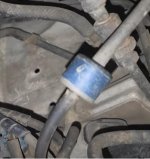
not sure which valve that is but the only check valve on a vacuum line i could find is on a line that goes from either side of the throttle body (IAC i guess?) to some solenoid lookin thing near the back of the battery.

Here's a short clip showing the vacuum line and the valve.
 

Attachments

  • Screen Shot 2023-02-15 at 6.25.52 PM.jpg
    Screen Shot 2023-02-15 at 6.25.52 PM.jpg
    39.1 KB · Views: 2,674
not sure which valve that is but the only check valve on a vacuum line i could find is on a line that goes from either side of the throttle body (IAC i guess?) to some solenoid lookin thing near the back of the battery.

Here's a short clip showing the vacuum line and the valve.

I believe the one you have in the video is the check valve for the 4WD VSC if it's the same routing as mine. The one I am mentioning would be coming off the bottom of the throttle body. There's 3 hoses total, 2 of them are coolant lines with clamps and the other one is the hose in question. It then tucks itself very neatly underneath the supercharger going from left to right.

If I did it right, I attached a page from the TRD installation manual. It's the paragraph and image at the top of the page.
 

Attachments

Where the heck are they going to fit intercooler pipes on a new supercharger though? That housing it tiny. Intercooler might fit behind the grill though.


I agree, the mock up that they presented at SEMA, to me, doesn't look intercooled. But we shall see.
 
Where the heck are they going to fit intercooler pipes on a new supercharger though? That housing it tiny. Intercooler might fit behind the grill though.
Hoses. AWIC. Look at the similar designs for the newer engines. With intercooler, it'll be $5k+ which will hurt sales, but be much better for performance. It'll still have the low RPM ping issues because of the OEM ECU knock sensor limitations...

-Charlie
 
For future reference, what would be considered too low of compression for adding a s/c? I always see people recommend you check compression if you're high mileage but I never see a baseline mentioned. I don't have any figures now but I plan on doing a test sometime this spring when I get more free time
 
For future reference, what would be considered too low of compression for adding a s/c? I always see people recommend you check compression if you're high mileage but I never see a baseline mentioned. I don't have any figures now but I plan on doing a test sometime this spring when I get more free time

The actual number does not matter that much and depending on what brand of tool you use, that number can change. Harbor Freight sells a kit that most people buy and that I also own. What is important is the variance between the numbers. Toyota states that any variance more than 15 PSI less than the highest compression is out of spec. This is also based on:

  • A fully charge battery reading 12.8V when off
  • The engine being spun at 250 RPM by the starter
  • The maximum compression being no higher than 174 PSI
  • The maximum pressure reading being above 145

Since that list is really hard to duplicate, most of us stick to the 15PSI or 10% difference between cylinders. So if you do a check and you get say, 150-160 PSI across all 6 you're doing great. Don't get thrown off by guys saying they have 200 PSI or those that say they have 140 PSI, as there's too many variables between the tool being used and the conditions listed above.

 
I'm prepping to replace my valve cover gaskets and the supercharger will be coming off (black supercharger if that matters). I figure that'll be a good time to change the supercharger oil that has about 100K miles on it. Supercharger sounds good, runs quiet, makes plenty of boost with the 2.1 pulley so I don't think it needs anything else?

Is the GM oil still the stuff: Amazon.com
P/N 12345982

I found spec is 130ml which is right at 4oz so one bottle?

For whatever reason the "Toyota oil change kits" are like $150! No thanks.
 
The actual number does not matter that much and depending on what brand of tool you use, that number can change. Harbor Freight sells a kit that most people buy and that I also own. What is important is the variance between the numbers. Toyota states that any variance more than 15 PSI less than the highest compression is out of spec. This is also based on:

  • A fully charge battery reading 12.8V when off
  • The engine being spun at 250 RPM by the starter
  • The maximum compression being no higher than 174 PSI
  • The maximum pressure reading being above 145

Since that list is really hard to duplicate, most of us stick to the 15PSI or 10% difference between cylinders. So if you do a check and you get say, 150-160 PSI across all 6 you're doing great. Don't get thrown off by guys saying they have 200 PSI or those that say they have 140 PSI, as there's too many variables between the tool being used and the conditions listed above.

There wouldn't happen to be some way to check the condition of your transmission aside from full on disassembly, would there? I can't imagine so, but I've said that about this car more times than I can count. That's what I'm more concerned about really; dropping all that money just to burn up my gears :brick:
 
Last edited:
There wouldn't happen to be some way to check the condition of your transmission aside from full on disassembly, would there? I can't imagine so, but I've said that about this car more times than I can count. That's what I'm more concerned about really; dropping all that money just to burn up my gears :brick:

It's not exactly a quick job but dropping the transmission pan would be what you are after. The transmission is all fluid, gears and clutch plates and is fairly mechanical. The first thing you'll notice with a failing transmission is metal shavings in the fluid that is caught by the magnets on the bottom of the pan. Fine powder that doesn't overwhelm the magnet is fine but any shiny brass or large slivers. This is what a healthy pan and magnet looks like:

57749d1328763574-do-not-use-aftermarket-transmission-filters-defective-p1210610.jpg


This is what a failing transmission pan looks like. Note the large fragments strewn about:

a340f-jpg.21710
 
99 problem

I just bought a 99 4runner s/c. It's in really great shape, no rust. 160k on it. First Gen charger. I've personally changed oil, oil filter, fuel filter, new belts, plugs, plug wires, coil packs. Re checking plugs tomorrow. New intake system. Cleaned TB. Cleaned the maf and iac.The problem is at low idle is will try to die out. If I put the pedal to the floor, it will line right out. But no check light. It spots and sputters under 2500 and as soon as I floor it, it will run strong. Tries to die out at low idle everytime. Sorry for the poor Grammer. Any help would be greatly appreciated. It also has been sitting for 1.5 years in a building. Mostly happens while driving. Parked and in neutral it will low idol but I can give just a tap of the throttle and it will be fine.
 
Last edited:
I just bought a 99 4runner s/c. It's in really great shape, no rust. 160k on it. First Gen charger. I've personally changed oil, oil filter, fuel filter, new belts, plugs, plug wires, coil packs. Re checking plugs tomorrow. New intake system. Cleaned TB. The problem is at low idle is will try to die out. If I put the pedal to the floor, it will line right out. But no check light. It spots and sputters under 2500 and as soon as I floor it, it will run strong. Tries to die out at low idle everytime. Sorry for the poor Grammer. Any help would be greatly appreciated. It also has been sitting for 1.5 years in a building.


I’m not sure about the first gen SC, but the 2nd gen for sure needs a check valve installed on the IAC vacuum hose. They run funky without
 

Members online

No members online now.

Forum statistics

Threads
278,316
Messages
3,554,112
Members
248,016
Latest member
Advally Service

Trending content

Back
Top