Hey audio buffs,
I know that quite a few of you are getting interested in
'Audio engineering theory' which is a complicated field to understand and requires much time to get under the belt. I've been studying the subject for many years (still no engineer), but I didn't get involved with it to become an engineer, but rather to better understand the field that I was working in, which was
Studio recording and Pro-Sound audio. But my main passion was 'and still is' the bass because that's my instrument of study and interest!
As some of you may know there is a phenomenon that takes place in sound reproduction known as
'Phase cancellation'. It can be a mother to fully understand and a Bi^ch to control. Phase cancellation doesn't only happen on the stage or in close proximity of the sound system, it also happens 'in room' in the listening area. As soon as the wavefront leaves the the speaker, they are already on their way to be "phased out" by other soundwaves; which are out of phase with them travelling in the room.
When soundwaves leave the speaker of origin they will not all leave the driver's cone at exactly that same moment. There is what's known as
'Off axis' projection; where soundwaves leave the speaker from a different part of the cone (Off-axis) an so may take longer to reach the listener's seat. This is why you'll see some high frequency drivers that use a
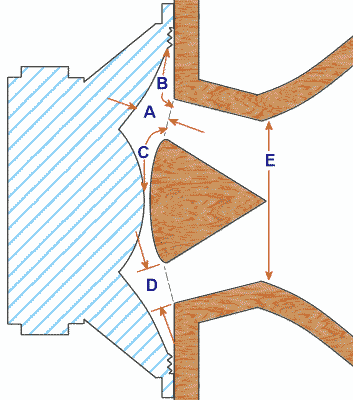
Phase plug. If time arrival issues crop up in multi-speaker systems, a time delay can be employed or a simple speaker repositioning can be used to eradicate the problem, but when it happens using a single component driver, that won't work; "see the illustration below":
How the phase plug works is, it's placed directly in front the of the voice-coil where the highest frequencies are projected. The highest frequencies (being smaller and on-axis) are able to leave the center of the driver faster (sooner) than the lower mid frequencies; which project from the driver's surrounding (cone) area, and so take more time to reach the audience! So the phase plug impedes those very high frequencies, forcing them to go around it and to join the lower frequencies which project from their
'Off axis' vantage point!
My point: There will be phase cancellation both on-stage and off, in the living room, the bedroom, basement... etc, because sound bounces on objects in the room. This is just a product of
'Room modes (standing waves) and boundary effect'. Theory is this: If you have two soundwaves that are 180 deg out of phase and they are allowed to cross paths
'BEFORE' they travel one quarter of their own full length, then they will combine destructively (phase null)!
But if they are able to travel beyond the 1/4 wavelength threshold and do meet, then they will not cancel out completely, but may noticeably lose some amplitude at some point in the room. But again, this will happen in the listening area anyway because of boundaries, walls, furniture, the floor, the ceiling...etc. This is far more problematic where bass is concerned, due to the extremely long wavelengths e.g.,
40 hz = 28 ft, 30 hz = 37.5 ft, 25 hz = 40 ft.... It's very easy to create phase cancellation conditions with wavefronts as long as these; even a quarter wave length of these can be problematic e.g., 40 hz = 28 ft (1/4 wave) = 7 ft, Can you imagine two 7 ft waves (180 deg out of phase) in the truck; there's no way for them to peacefully coexist, so PC is inevitable!
In your suv you'll surely have some PC going on; just because the sound is bouncing off of items in the cabin and then returning to the areas where the sound originated, so you will have some listening areas in the truck that sound better than others as a result! So with short soundwaves as in high frequency reproduction e.g., 200 hz (mid-bass) = 5.6 ft and a quarter of that would be 1.4 ft; not much chance of soundwaves crossing each other's paths, 1/4 wave being only 1.4 ft long. I hope this helps those who are going crazy worrying about phase cancellation happening in your truck... it's already been happening, even when the music's sounded fantastic, so now you can relax!
rig
Cheers