
octanejunkie
Elite Member
Can you measure each individual cables and post here?I ordered the smaller 2 gauge
Big favor, I know
Last edited:

Can you measure each individual cables and post here?I ordered the smaller 2 gauge
What about when upgrading to the CS144 alternator?Gonna take the other route and say it's entirely unnecessary for 99% of rigs, let alone 99% of 4Runners. Big 3 is already pretty unnecessary with 1 or 1/0 AWG, you'll NEVER ever in 100 years see anything even close to warranting such heavy duty cable - not even if you were running triple winches all at once - and especially so considering these do, what? Upgrade your starter cables and fuse box wiring? Yeah $145 well spent alright, people definitely have loads of problems with those... :crazy:
And I say that as someone with a Big 3 made from 1/0 welding cable. The saying "just because it's sold doesn't mean you have to buy it" rings familiarly here to me.
To that, personally I think it speaks volumes when people try to sell these kits under the guise of "adding lights" down the road, because these people know very damn well how tiny of a load LEDs impart and how much of a non-issue that is. And if they don't... is that really someone you want to purchase and take advice from?

Yeah, 2 GA is enough to run 7 induction cookers simultaneously. Even if you had a fridge, a winch, lights, a cooktop, and whatever else, it still wouldn't near the rating. Chances are you wont be running all those things at once anyway.Gonna take the other route and say it's entirely unnecessary for 99% of rigs, let alone 99% of 4Runners. Big 3 is already pretty unnecessary with 1 or 1/0 AWG, you'll NEVER ever in 100 years see anything even close to warranting such heavy duty cable - not even if you were running triple winches all at once - and especially so considering these do, what? Upgrade your starter cables and fuse box wiring? Yeah $145 well spent alright, people definitely have loads of problems with those... :crazy:
And I say that as someone with a Big 3 made from 1/0 welding cable. The saying "just because it's sold doesn't mean you have to buy it" rings familiarly here to me.
To that, personally I think it speaks volumes when people try to sell these kits under the guise of "adding lights" down the road, because these people know very damn well how tiny of a load LEDs impart and how much of a non-issue that is. And if they don't... is that really someone you want to purchase and take advice from?
I've been poking around and found a few sources, American Wire Gauge Chart and AWG Electrical Current Load Limits table with ampacities, wire sizes, skin depth frequencies and wire breaking strength it seems 0 AWG can carry 150 amps maximally while 2 AWG only 94 amps...Yeah, 2 GA is enough to run 7 induction cookers simultaneously. Even if you had a fridge, a winch, lights, a cooktop, and whatever else, it still wouldn't near the rating. Chances are you wont be running all those things at once anyway.
Wire gauge only needs to meet the demand of the amperage output by the alternator. So, 4 gauge is sufficient enough for a 150 amp alternator. If I remember correctly 1/0 is good for up to 250 amps. Also, the amperage output by the alternator is not the amperage output at engine idle speed, it is far less. So factor that in when choosing a bigger alternator for electrical demands. Most winching is done at idle speed. That CS144 probably has an output of 50-60 amps at idle.
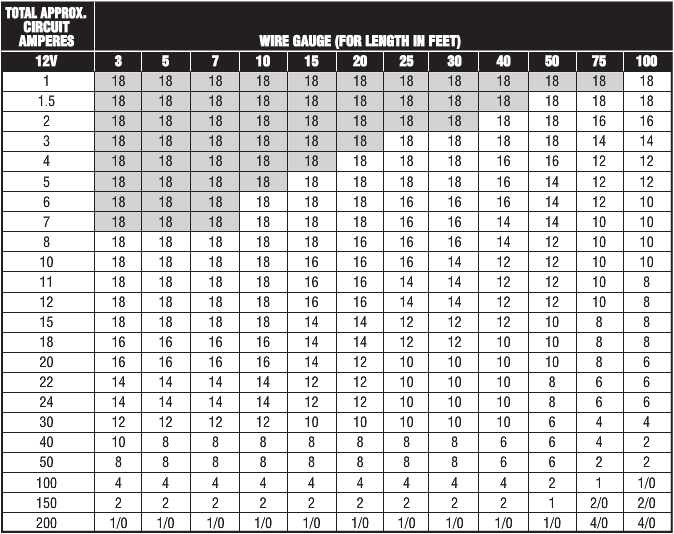
The other consideration is the length of the run for the cable. When consulting a chart for wire gauge decisions, find one that shows amp ratings that relate to cable length. For example, the cable from the starting battery to the starter of my '87 VW Westfalia is about seven or eight feet long. The same cable for my T4R is a quarter of that. My Westfalia needs a much larger gauge cable only to satisfy the length of the run.
Choosing the Correct Wire Size for a DC Circuit

….It is "never ok" to run a power wire bigger than the ground wire. ..

The only thing I can think of on this one is Amp capacity of wires. Must be thinking the user will exceed the Amp rating if the smaller wire. Thus heat it up or melt it as a rule of them.Curious. Why? For any complete circuit, amp flow is the same anywhere in the circuit, start to finish, positive source to negative termination.

The entire vehicle, all the metal that's not specifically insulated, frame body and engine block are a ground plane and conduct negative current. You can't get a bigger conductor than that lolCurious. Why? For any complete circuit, amp flow is the same anywhere in the circuit, start to finish, positive source to negative termination.
The entire vehicle, all the metal that's not specifically insulated, frame body and engine block are a ground plane and conduct negative current. You can't get a bigger conductor than that lol
Sent from my Pixel 4 XL using Tapatalk
I’m curious why the person I quoted said it’s “never ok” for a bigger positive cable. Everything starts and ends at the battery (with alternator wired essentially in parallel) therefore all cables to/from battery carry the same overall amperage for the system as a whole. So I’m curious as to why a negative cable is allowed to be larger but the person I quoted said the positive is never ok.
I’m on board with these types of upgrades. I just find the overall misinformation astounding.
Some truth to that. It really depends on the surface area and oxidation state of the wire. If the wire is black or green it's not going to conduct as if it was clean copper.Everything I have ever read suggests using the "correct" size wire for the load expected, sustained and burst. Bigger isn't always better, and too small is definitely not good.
Here's a curious chart I found specific to automotive wiring at "www.sherco-auto.com/battery-cable-starter-wire-10-awg-gauge.html"
For grins and giggles, I may use 1 AWG between my CS144 alternator and Bat+, and between the Battery and the winch, but again, that seems to be overkill when 2 AWG is rated to carry 150 amps up to 50 feet
I’m curious why the person I quoted said it’s “never ok” for a bigger positive cable. Everything starts and ends at the battery (with alternator wired essentially in parallel) therefore all cables to/from battery carry the same overall amperage for the system as a whole. So I’m curious as to why a negative cable is allowed to be larger but the person I quoted said the positive is never ok.
I’m on board with these types of upgrades. I just find the overall misinformation astounding.
So if you had two batteries, separated but sharing a common ground would you size the negative connections the same on each battery or sized the same as the positives of each battery, respectively?Sorry for the late reply...The main ground wire on a DC system is the return path between the alternator and battery negative. Because of this it needs to be as "big" or "bigger" than the power wire. For example, the current flows like water and if you have a 3/4" pipe feeding water down into 1/2" drain pipe the drain pipe wont keep up and there will be some resistance... However if the drain pipe was the same size or even over sized to the main feed it will keep up and provide some headroom. Too much resistance creates heat and a potential fire. That why I said the power wire should never be bigger than the ground wire. I don't understand how this appears to be misinformation to you? Wasn't trying to be controversial.

Sorry for the late reply...The main ground wire on a DC system is the return path between the alternator and battery negative. Because of this it needs to be as "big" or "bigger" than the power wire. For example, the current flows like water and if you have a 3/4" pipe feeding water down into 1/2" drain pipe the drain pipe wont keep up and there will be some resistance... However if the drain pipe was the same size or even over sized to the main feed it will keep up and provide some headroom. Too much resistance creates heat and a potential fire. That why I said the power wire should never be bigger than the ground wire. I don't understand how this appears to be misinformation to you? Wasn't trying to be controversial.
Sorry for the late reply...The main ground wire on a DC system is the return path between the alternator and battery negative. Because of this it needs to be as "big" or "bigger" than the power wire. For example, the current flows like water and if you have a 3/4" pipe feeding water down into 1/2" drain pipe the drain pipe wont keep up and there will be some resistance... However if the drain pipe was the same size or even over sized to the main feed it will keep up and provide some headroom. Too much resistance creates heat and a potential fire. That why I said the power wire should never be bigger than the ground wire. I don't understand how this appears to be misinformation to you? Wasn't trying to be controversial.


