Theory Re: Thermostat Jiggle Orientation

So I read all the hundreds of posts and threads on thermostat jiggle valve.

Of note was this one:
"Rehashing an old thread here but I just replaced the timing belt on my 98 tacoma 3.4L with all OEM parts.

My old tstat kept me at 195-204, now I'm running at 198 to 212.

So I asked two different techs at toyota, one's been there 17 years and the other 10.

They said they have always installed the jiggle at 12. Thats the way they come from the factory so that air can permeate from the coolant. They also said that they found the warmer engines are more efficient. That the dash needle doesn't even start to move until you get close to the danger zone of 250.

They also said the GM not too long ago changed thier tstats across the board to operate the coolant to 212. There may be a possibility that Toyota did the same. They weren't really sure since they are happy with the 195-212 range.

And they also said the temp runs cooler with the jiggle at 6 because the jiggle keeps coolant flowing.

Just for added insight, I also asked a buddy of mine that's a master tech at Infiniti. He said all Nissan's run the jiggle at 12. That's the industry norm. "


This has me wondering -- is it possible that the drop in coolant temp is actually a BAD thing... meaning -- is air getting trapped in the coolant system, leading to hot pockets of metal in the engine, and that heat is not being "swept away" and absorbed by the coolant, leading to a hotter engine, but lower, less efficient coolant system?

My 2 cents.
 
Register to hide this ad
with a new rad and new coolant i put my j-valve at 12
a short while later i rotated it to 6

temps dropped a little. but that was it. nothing major.

i know the 84 corvette i had ran really hot from the factory for emissions BS.
 
Last edited:
I run mine at 12 like it was when I bought it. Warmer heat in the winters. You will get the crazy temp nazis I'm sure that say it's so much better to run out at 6 but it's no different just slightly lower Temps.
 
Last edited:
So I read all the hundreds of posts and threads on thermostat jiggle valve.

Of note was this one:
"Rehashing an old thread here but I just replaced the timing belt on my 98 tacoma 3.4L with all OEM parts.

My old tstat kept me at 195-204, now I'm running at 198 to 212.

So I asked two different techs at toyota, one's been there 17 years and the other 10.

They said they have always installed the jiggle at 12. Thats the way they come from the factory so that air can permeate from the coolant. They also said that they found the warmer engines are more efficient. That the dash needle doesn't even start to move until you get close to the danger zone of 250.

They also said the GM not too long ago changed thier tstats across the board to operate the coolant to 212. There may be a possibility that Toyota did the same. They weren't really sure since they are happy with the 195-212 range.

And they also said the temp runs cooler with the jiggle at 6 because the jiggle keeps coolant flowing.

Just for added insight, I also asked a buddy of mine that's a master tech at Infiniti. He said all Nissan's run the jiggle at 12. That's the industry norm. "


This has me wondering -- is it possible that the drop in coolant temp is actually a BAD thing... meaning -- is air getting trapped in the coolant system, leading to hot pockets of metal in the engine, and that heat is not being "swept away" and absorbed by the coolant, leading to a hotter engine, but lower, less efficient coolant system?

My 2 cents.

it depends...

I have a lifted truck, with a full set of aftermarket skids, many times a roof top tent, camping gear, recovery gear, steel bumpers... so my truck is sitting much heavier than stock. I was loosing coolant from time to time, not overheating but 212+ because I'm working the truck much harder going places than a normal driver. especially when driving off-road.

Once I flipped to 6, things run a bit cooler and I stay well within the 190-200 range, even when fully loaded.

I know we all want a one size fits all solution to life's mysteries but it just does not worth like that, IMO. it depends on how you use your truck, what extra stuff you have in it or on it, where your driving it, how you drive it....
 
Hee, hee, hee! Jiggle Valve Nazis. We should have a congressional subcommittee looking into these guys. :hunter:
 
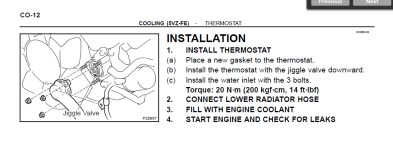
Per FSM
 

Attachments

  • Capture.PNG
    Capture.PNG
    46.1 KB · Views: 1,852
I run mine at 12 like it should be. Warmer heat in the winters. You will get the crazy temp nazis I'm sure that say it's so much better to run out at 6 but it's no different just slightly lower Temps.

Oh yea..... be prepared for that

My truck runs 194-197 on normal days. On a hot humid summer day with AC on in traffic. It Reaches I think 205-207. Never pass that though. Then it drops few degrees. Not worried.
 
Last edited:
Oh yea..... be prepared for that

My truck runs 194-197 on normal days. On a hot humid summer day with AC on in traffic. It Reaches I think 205-207. Never pass that though. Then it drops few degrees. Not worried.

I've hit 212* on a 100*+ day in stop and go. My talon hits 230 because the intercooler is 4" thick and provides no airflow.
 

We all know that the Factory Service Manual can have mistakes in it, mainly with torque specs. But, I don't think the FSM made a mistake here. I've seen first hand it makes a 10+ degrees difference in the coolant temp. The Toyota engineers suggest having the jiggle valve at the 6 o'clock position for a reason.

I'd personally rather have my engine run a little cool than a little hot. When do engines have big problems? When they overheat. That 10 degrees difference might not be a big deal over the short term but after thousands of heating and cooling cycles, maybe it would. This could be the difference to ending up with a cracked head or a blown head gasket. Why do some engines make it to the 400k range while others have major issues at half that mileage? This could be one of the reasons.
 
We all know that the Factory Service Manual can have mistakes in it, mainly with torque specs. But, I don't think the FSM made a mistake here. I've seen first hand it makes a 10+ degrees difference in the coolant temp. The Toyota engineers suggest having the jiggle valve at the 6 o'clock position for a reason.

I'd personally rather have my engine run a little cool than a little hot. When do engines have big problems? When they overheat. That 10 degrees difference might not be a big deal over the short term but after thousands of heating and cooling cycles, maybe it would. This could be the difference to ending up with a cracked head or a blown head gasket. Why do some engines make it to the 400k range while others have major issues at half that mileage? This could be one of the reasons.

That 10* won't do anything. It's too insignificant IMO. I've put over 100k miles on it this way.

My talon has hit 230+ many times. The stock bottom end has 380k miles and has been making over 400whp at 30psi for 12 years. Never had a failed headgasket or cracked head.
 
That 10* won't do anything. It's too insignificant IMO. I've put over 100k miles on it this way.

My talon has hit 230+ many times. The stock bottom end has 380k miles and has been making over 400whp at 30psi for 12 years. Never had a failed headgasket or cracked head.

Well, you said it. It's just your opinion and your experience with a totally different engine means nothing. For me and many others, I've decided to follow the FSM spec. You want to be a rebel? Go right ahead. It's your engine.
 
... They also said that they found the warmer engines are more efficient.

This, of course, it old true news but it comes at a price, more engine heat = less motor oil life which = shorter engine life span.

Probably not much difference between 190 and say 205 but now 15 degrees of safety margin have been removed. In tougher cooling conditions that margin could make a big difference, who knows? Luck all. :cowboy:
 
Well, you said it. It's just your opinion and your experience with a totally different engine means nothing. For me and many others, I've decided to follow the FSM spec. You want to be a rebel? Go right ahead. It's your engine.

100k miles on my motor in my 4runner is pretty good experience. And from me tuning and building high horsepower 4 bangers I've found many motors work the same with slight difference.

My point being no one needs to run out and redue the thermostat of its in the 12 position. Just a waste of time.
 
I put mine at the 12 o'clock position because that's what everything I read said to do. 10 degrees isn't gonna make a difference and 212 isn't gonna hurt anything. If I have issues offroad in the summer I guess I'll flip it to see how it goes, but I don't foresee a problem.
 
100k miles on my motor in my 4runner is pretty good experience. And from me tuning and building high horsepower 4 bangers I've found many motors work the same with slight difference.

My point being no one needs to run out and redue the thermostat of its in the 12 position. Just a waste of time.

Again, waste of time in your opinion but maybe not for others.

I think it's a waste of time and money to put on a bunch of expensive suspension components and big tires to look cool driving through the mall parking lot, but for others, it's worth the time and expense to look totally rad.

Anyway, to each his own I reckon.
 
Last edited:
split the difference.

run it at 3 or 9

id be interested to see if the result is only a 5 deg difference... lol

then we'd know for sure.
 
Everybody with some experience wrenching on other cars (even other Toyota's) knows that 12 o'clock is the norm. *BUT* the FSM specifically states something different than the norm, and it makes a well-documented difference in coolant temps...

The OEM thermostat is a 180*F (well, actually 82*C or 179.6*F) thermostat, which is the temp that the coolant should be going into the engine - by design and Toyota specification. The coolant gains temp/heat as it runs through the motor and comes out in the 188-191* range in most circumstances.

If the temps are much above that (read via the ECU or sensor in the top radiator hose), you are running out of cooling capacity (insufficient cooling or other problems) or your thermostat isn't doing its job correctly.

Before my most recent thermostat change, my coolant was actually running too cool (180-183*F) due to a worn-out spring in the thermostat. It was last replaced by a Toyota dealer in ~'03 - and yes, it had the jiggle valve down.

-Charlie
 
I just removed a 2016 t-stat because I suspected it might be in the incorrect position, with respect to the FSM.

I consistently saw 204 to 209 F coolant temps, on a cool night, no grade, me driving alone. I'm accustomed to seeing those temps on hotter days, stuck in traffic (various vehicles). Heat has a cumulative effect on fluids and components over time...

Our ATF is cooled from the radiator too. One can then surmise that those temps will be a little higher than otherwise. I'll be taxing the Runner pretty hard with a family of four and a lot of gear in the coming months and years. I'll be keeping an eye on the transmission temps. Someday an external cooler...
 

Members online

No members online now.

Forum statistics

Threads
278,315
Messages
3,554,104
Members
248,016
Latest member
Advally Service

Trending content

Back
Top