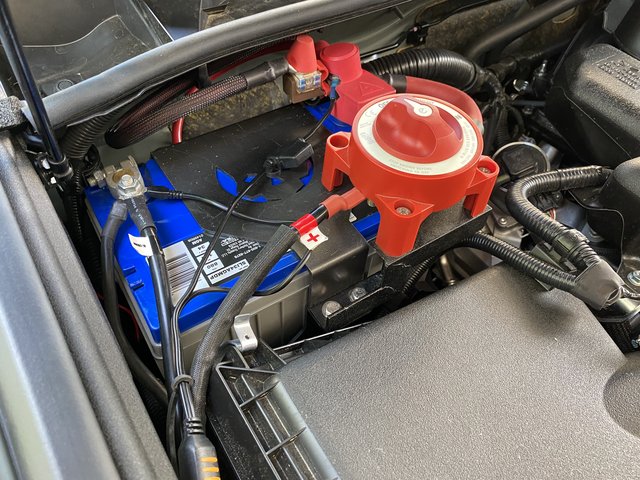
Where are people mounting their winch power cutoff solenoid/switch

jdm-v35

Member
I have a Warn bumper I am going to put on but the winch has not arrived yet. In trying to plan the install I was wondering where in the engine bay people are mounting the master power cutoff switch/solenoid?

It is a HF Badland Apex 12k which comes with that manual knob switch box to cut off the power feed. I also purchased a Warn power solenoid just in case I wanted to mount that and activate it with my Switchpro 9100. Either method is fine with me depending on the best mounting location.

At this point I would probably prefer the included manual knob as this would take up my last button on the switchpro. The manual knob also has no exposed terminals like the Warn Solenoid does.

I am curious where others have mounted their power cutoffs? Thanks in advance.
 
Register to hide this ad
Most people wire their winches directly to the battery without a cutoff. Some will run a Blue Sea 6006 switch somewhere under the hood.
 
Most people wire their winches directly to the battery without a cutoff. Some will run a Blue Sea 6006 switch somewhere under the hood.

Thanks. I figured without some type of power cutoff it would be a constant small drain on the battery. I didn't know that leaving it hot all the time was really an option. I probably would still want a cutoff on it for safety purposes but did not know that was even an option.
 
I’ve seen most power switches, like Blue Sea, next to or on top of the battery. I placed mine next to the window washer fluid reservoir. I’ll try to add pics.
 
I’ve seen most power switches, like Blue Sea, next to or on top of the battery. I placed mine next to the window washer fluid reservoir. I’ll try to add pics.

Yea I think that would be optimal. I seem to be running low on space in the engine bay though with the additions I have. Shrockworks dual battery with dual odyssey 34's, bandi mount with ARB twin compressor and the smog pump relocated under it, switchpros 9100 on driver side SDHQ mount, and I have a magnuson coming as well.

The only open space left may be right on top of the fuse box on drivers side
 
Yea I think that would be optimal. I seem to be running low on space in the engine bay though with the additions I have. Shrockworks dual battery with dual odyssey 34's, bandi mount with ARB twin compressor and the smog pump relocated under it, switchpros 9100 on driver side SDHQ mount, and I have a magnuson coming as well.

The only open space left may be right on top of the fuse box on drivers side

you can also mount it near passenger side headlight in space between radiator and bumper skin. Take off the engine/radiator splash guard, and look down.

Look for shrockworks front bumper installation instructions if you really want step by step instructions on how to do it. Alot of aftermarket bumpers require the solenoid box to be relocated there.

You have to cut a hole in your splash guard to access it, or keep the splash guard off.


I have a SSO slimeline bumper and i was able to mount my shittybilt solenoid box offset on the drum to the passenger side, and I had to bend the power steering line out of the way.

Not sure if that is possible with your winch or not.
 
Mounted Blue Sea E-series switch on simple custom bracket mounted on the side of my second box battery on passenger side using the same bolts that secure the top bracket on the battery box for securing the battery. The switch is secured to the bracket using two of the four supports. The other two supports just rest on top of the battery/battery box. Very secure and plenty of hood clearance.
F20418-FE-492-B-43-C6-87-B3-3-CCAD0-B126-DB.jpg
 
Last edited:
Thanks! So you have something like this located with the winch:

Warn Upright Switch Solenoid Terminal | 72631|Northridge4x4

with that master switch controlling it?


You don't need another solenoid to disconnect power to the winch. The solenoid set that comes with the winch already does that. It's an open circuit until the remote signals the solenoid in the normal winch control box to close the circuit. In my under hood box is a smaller size Bosch style relay then a fuse block that has fuses for the wired remote and the wireless controller module. The relay in the box isn't necessary if the switch can handle the relatively low load of the winch control wires. But those common cheap toggle switches like that are pretty weak, so I added one just to make sure it wouldn't be an issue.

So when the toggle switch on top of the box is "off" everything in the box is disconnected and you can't operate the winch wired or wirelessly. When is "on" then both will work.

I have IIRC a 200 amp fuse on the battery terminal connecting the winch positive cable. So a short circuit is protected by a fuse.

You could certainly use a relay like the one you showed inline on the positive cable as well. But my general experience those relays aren't all that reliable. So they end up more trouble than it's worth. I'd use a mechanical disconnect instead if you're doing that. There are also 12v circuit breakers you could use as an easy disconnect that also protect the circuit.

Also - a switch or relay cutting the big power wire is still not a replacement for a fuse or circuit breaker inline on the main power wire to the which. You still need one. A short on that heavy gauge wire will get really bad really fast.
 
Last edited:
You don't need another solenoid to disconnect power to the winch. The solenoid set that comes with the winch already does that. It's an open circuit until the remote signals the solenoid in the normal winch control box to close the circuit. In my under hood box is a smaller size Bosch style relay then a fuse block that has fuses for the wired remote and the wireless controller module. The relay in the box isn't necessary if the switch can handle the relatively low load of the winch control wires. But those common cheap toggle switches like that are pretty weak, so I added one just to make sure it wouldn't be an issue.

So when the toggle switch on top of the box is "off" everything in the box is disconnected and you can't operate the winch wired or wirelessly. When is "on" then both will work.

I have IIRC a 200 amp fuse on the battery terminal connecting the winch positive cable. So a short circuit is protected by a fuse.

You could certainly use a relay like the one you showed inline on the positive cable as well. But my general experience those relays aren't all that reliable. So they end up more trouble than it's worth. I'd use a mechanical disconnect instead if you're doing that. There are also 12v circuit breakers you could use as an easy disconnect that also protect the circuit.

Also - a switch or relay cutting the big power wire is still not a replacement for a fuse or circuit breaker inline on the main power wire to the which. You still need one. A short on that heavy gauge wire will get really bad really fast.

Thanks for the detailed info. I didn't think about it but one of those circuit breakers would be a good dual purpose fix for swtched power as well as safety while it is on. I use them in my dual battery setup but did not think they were needed on a winch, and not sure if that load rating is high enough. Can't winches pull up to 400A? I would just need to fab up a mount for the breaker.

I got the winch installed yesterday and just need to get the power connected.
 
Thanks for the detailed info. I didn't think about it but one of those circuit breakers would be a good dual purpose fix for swtched power as well as safety while it is on. I use them in my dual battery setup but did not think they were needed on a winch, and not sure if that load rating is high enough. Can't winches pull up to 400A? I would just need to fab up a mount for the breaker.

I got the winch installed yesterday and just need to get the power connected.

Your probably right on amps. For some reason I thought 10klb class winches draw less than they claim. I don't remember why I was thinking that. But maybe I'm totally wrong and my fuse set is higher than I remember. I know my warn 8274 will pull a lot more amps than my super winch 9500. It'll kill a battery fast!

I've never blown my fuses. Most winches come with a fuse set in the box, but not all do. Obviously they size the fuse to roughly match the winch draw. The main goal is to stop a fire if the wire short circuits. So the fuse needs to be low enough to burn through with a direct short and high enough not to blow during normal use. Your winch probably has a spec sheet available that'll tell you the minimum amperage you'll need.

Circuit breakers come in a lot of sizes. I think you'll find them up to 400 amps of you look. I know I have a 300 amp on my camper system.

The only down side there is that I'm not sure how many cycles they're good for. The switch on a circuit breaker isn't made for thousands of on/of toggles. But how often will you turn it on and off? I probably use my winch 20 times a year or less. So it'd be fine I think. But I just use a fuse on mine.

You can also use fuses or circuit breakers in parallel to increase capacity. So if you find 50 or 100 amp fuses readily available, you can combine 2 x100 amp fuses for a 200 amp circuit. That's actually how mine is because it's what was included in the box with the winch. But it's worked well for 6 years so far.

Edit: I went and looked at the manual. I was wrong. My winch came with a set of I think 4 x 100 amp auto-recloser circuit breakers that I have always assumed were just fuses. They're mounted in parallel on a set of buss bars into a single package. I never paid much attention to what was really there. Haha. They look like one time use fuses. I learned something new!
 
Last edited:

Members online

Forum statistics

Threads
278,317
Messages
3,554,128
Members
248,016
Latest member
Advally Service

Trending content

Back
Top