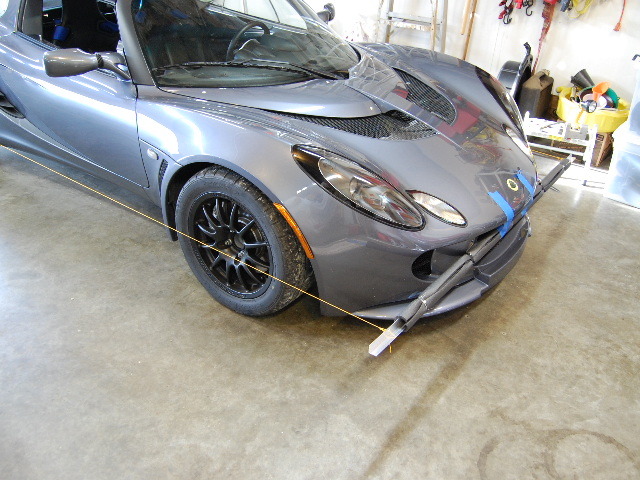
Where do you buy your tools for checking front camber at home on your 4runner?

Status
Not open for further replies.
you need guide plates to allow the tire to set in a neutral position.

Do you mean something like the leveled greased or talcum lubricated linoleum tiles or these more professional turnplates?

Lubricated tiles:
8984663.jpg


Professional turnplates:
8984662.jpg


as well as a way to properly connect the caster/camber gauge to the wheel

I was wondering about which attachment type to get.

Many camber gauges seem to be magnetic:
8984676.jpg


Others, as you say, seem to be clamped or bolted to the wheel ... but many of the DIY caster gauges appear to simply be hand held against the wheel.
8984675.jpg


for the price of the correct tools, you would be able to purchase a dozen alignments.

Hmmm.... here in the Silicon Valley, a dozen alignments would be about $88 · 12 ~= $1,000 (as described already).

Assume two cars in the family. How often do you check alignment? Assume, oh, say, every three years? So, over your sixty-year driving life, that's about 40 alignments.

At $88 per alignment, that's about $3,500 for alignments in our lifetime.

say you have a 1/4" difference and a 16 inch rim you can solve for the angle with some basic trig.

Now that is a very interesting idea! Remember SohCahToa?

Plenty used strings, but most were horizontal, like this:
8984699.jpg


Or like this:
8984701.jpg


But lots of people built vertical devices that were held against the wheel to measure camber:
8984710.jpg


For example, in this home alignment DIY, the guy measured the distance of the top of the wheel and the bottom to a straight vertical pipe (akin to your straight string hanging from the ceiling) to calculate the camber.

Here is the straight bar (akin to your vertical string):
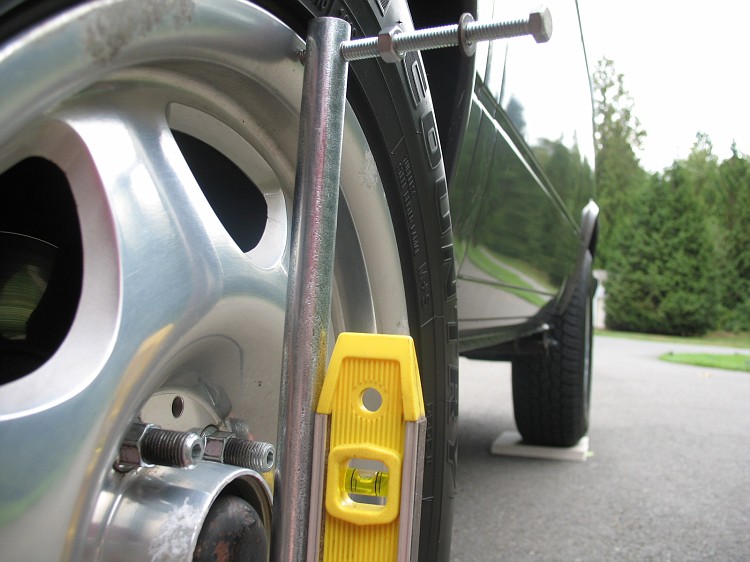
IMG_7512-vi.jpg


Then they simply measure the distance of the bolts, using our old friend SohCahToa, to calculate the angle in degrees!
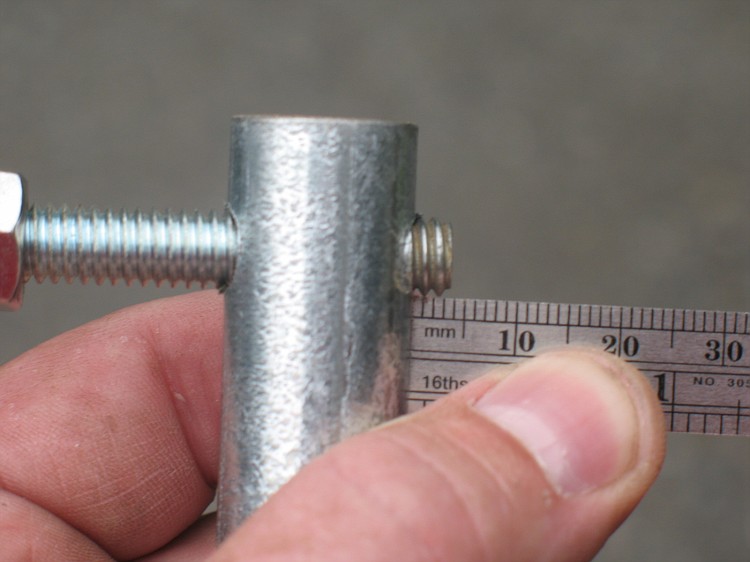
IMG_7516-vi.jpg


And, this home alignment DIY uses the same method you did for measuring camber:
Camber

Hold a string with a weight on the bottom to droop down at the same outward distance as the string until it crosses it and forms a + at the wheel hub level. Usually you’ll want a buddy to help you hold it off the top of the tire for this part. You then measure to the top of the wheel and the bottom of the wheel and make your adjustments based on your measurements.
 
Last edited:
I asked that question and "Norman" at Capitol Toyota said that they will do the alignment whether or not the components are bad. That's why (he said) I needed the additional $145 checkup.

Ouch :redbrick:

You should really start a thread titled "does anyone know of a good independent Toyota shop in Cupertino CA?"

The stealership is part of the issue here. If I recall correctly most Toyota dealers in the bay area charge $140 - $160 / hour.

The shop I go to in San Diego only charges $85 an hour, $75 for an alignment with a full printout. I drive 30+ mins to take my truck there but it is worth it.

While DIY are great, you will eventually need to find a good competent independent Toyota mechanic that isn't going to rip you off.
 
Q: What is the target 'accuracy' for a 3rd-gen T4R camber gauge?

Again, drop the accuracy talk. You can't say you can achieve 1/2deg accuracy. Just because you measure it as Xdeg doesn't mean it is actually Xdeg.

Let's clarify the desired & achievable 'accuracy' - because it is paramount!

I've clearly (and repeatedly) been asking the team what the accuracy needs to be for a 3rd-gen T4R camber gauge given the Toyota front camber spec of -¼° ±¾° for my model.

I'm not telling the team I can definitely achieve anything by way of accuracy or repeatability. I haven't even selected any camber tool yet ... nor have we looked in detail at a single tool (to see what the manufacturer claims), nor have we deeply explored any particular measurement methodology (to see if it can achieve the accuracy the manufacturer claims).

The key reason for bringing up the important issue of 'accuracy' was/is to ask what needs to be achieved ... and then ... to find a tool & approach that achieves (at least) the desired values in the real world.

For example, fact is an iPhone didn't even exist when you and I had our first ten or twenty alignments; but now a 99¢ Clinometer App can potentially be used to measure camber as shown below.

Point is that the technology of measurement has (may have?) improved over the years:
3025271110_ffee13e89e.jpg


BTW, some of the DIYs imply the accuracy "they" can achieve with their tool and measurement approach. For example, this HotRod Magazine Alignment DIY posits "it's actually very easy and cheap to set your wheel alignment at home".

Specifically, for camber, they propose "Camber measurements are easy with this ... highly accurate, caster/camber gauge ... about $60".

While "highly accurate" wasn't defined in the article ... we can easily see what 'accuracy' the manufacturer claims by Googling for "Maximum Motorsports caster camber gauge" where we find the $59.95"Part #MMT-3" pictured below described as:
With accuracy better than 1/8-degree, it easily matches the performance of much more expensive gauges. The range of camber adjustment is from seven-degrees positive to seven-degrees negative.
Rehash: When I asked YOU what accuracy we needed, you said ±½° should be ok.

Assuming that's still correct, then the 'claimed' accuracy of this gauge of 1/8° should be within the needed range (but only 'if' that claimed accuracy can actually be reliably achieved in the real world).
8990356.png

There are lots of ways you can measure camber, you have to decide which way is best for you at home (meaning which can you get the most accurate, reliable measurement with) ... Less than 1° accuracy is decently tight.
... 1/2° is probably acceptable, but I doubt that you can really achieve that in your driveway. You may be able to "measure" within 1/2°, but that will be with an unverifiable, un-calibrated measurement system.

Having taken college physics, biology, chemistry, organic chem, biochem, and a host of other post graduate lab sciences, I fully agree that just because a camber gauge reads -¼° and that its claimed accuracy is, say ±1/8°, doesn't actually mean any of that is true.

That's exactly why we need to discuss the claimed accuracy of any selected tool.

Note:
a) accuracy = how close we get to the true value
b) precision = the repeatability & reproducibility of the measured value
c) resolution = the smallest real-world change that produces a response

Unfortunately, we'll be lucky to find published 'accuracy' for the gauges under consideration, let alone precision & measurement resolution ... so let's just clarify the desired & achievable accuracy for now.

Are we still under the assumption (based partially on what you said above), that the target accuracy for a T4R camber gauge, should be at least ±½° in real-world conditions?

Note: The iPhone 99¢ Clinometer App has an 'implied accuracy' that 'may' be in the range we need:
IMG_0323_thumb.png
 
Last edited:
My tires are Firestones with a warranty for 80,000 km. I get my alignment done there. That's as much as I can trust. If they wear out wrong, still, and I don't get a fair deal on the warranty, I'll worry about trust then.
 
I am the most DIY person that I know of. I do all my own work on vehicles, have rebuilt engines, build computers, have repaired televisions, printers, plumbing, appliances of all kinds, etc... I never pay someone to do something I could do myself.

I'm 33yo and have never needed to do an alignment on a vehicle until last month. I did a driveway toe adjustment and then I took it to a shop and happily paid to have it done. That is what I advise you to do.

However, since an alignment shop doesn't seem to be an option, I suggest that you find a way to measure caster first. Caster is an important part of a proper alignment, it is harder than camber to measure, and it shares the same adjustment bolts as the camber so you can't avoid messing with it.

For a camber measurement tool I would recommend the type that clamps to the edges of the wheel. The magnetic type that sticks to the hub is dependent on the hub cover being perfectly true to the wheel and is bound to be less accurate due to the mounting method.
 
Gee, I am glad you can google and find random magazines and DIY's that claim they can achieve certain accuracies. You have proven my point though, you're are reposting claims that are unverified, and you are just adding to the pool of **** out there that newbies have to sift through to actually understand the risks of at-home precision measurement.

And I said 1/2° should be ok if you actually have 1/2° accuracy. I then said that you cannot verify that you are getting 1/2° accuracy, so it was a moot point anyway.

Yeah, I took those classes in high school too. Have you ever done or even heard of measurement systems analysis? Do you have any idea how you actually measure accuracy, repeatabillity and reproducability? These are real, well defined terms, so unless you actually understand them and didn't just google their definitions, then don't talk about them.

Maybe that $60 gauge is accurate enough, and maybe it's a great product. Just buy it and give it a try. Hell, I'd be interested to hear how it works for you. I just don't quite understand what you are looking for if you have already found products that are within your price range, that claim to achieve the accuracy needed. Are you asking if anyone has actually used them and had it solve their tire wear problem? Are you asking if anyone has done an MSA on them and verified their accuracy claims (the answer to that one is no)? Just drop $60 and give us a review.
 
You all are getting way too deep on this one. just get it close. Doing alignments at home is supposed to be cheap, not perfect. I would not buy any fancy tools for it. all you need is string and a tape measure. And i truly don't think you can notice the stability from proper caster with a 4runner on 35's and no sway bars. Long story short it drives not all that good. My alignment is destined to be out of whack so as long as its close enough I'm good with that.

same deal with toe in and out. just use a tape measure and get it close enough. give yourself about 1/8" of toe in and your good to go. then drive it and if it pulls left or right adjust and needed.
 
I suggest that you find a way to measure caster first.

This is great advice for a tool & methodology to test camber at home before and after getting the vehicle professionally aligned!

Thanks. Your recommendation to do both caster & camber makes sense so our gauge should be able to handle both caster and camber shop at the desired accuracy.

What is that desired accuracy?

  • We already established we desire at least ±½° accuracy for camber measurements
  • Adding caster requirements to the tool, and given Toyota specs for caster of 3¼°±¾°, should we assume the desired accuracy for caster measurements to be the same ±½°?
How does this sound for a starting point on tool 'requirements'?

  1. The tool/approach should measure camber & caster to at least ±½° accuracy
  2. The cost should be under about $250
  3. Mounting should be as flat to the wheel as possible (e.g., a clamp may be better than magnetic depending on the hub shape)
  4. The tool/method has to take into account the level of a typical cement garage floor
Do we have any other major requirements for measuring camber before and after going to an alignment shop?


All you need is string and a tape measure.

Understood.

Basically, as others stated, we drop a line from the ceiling and measure the wheel at the 12 o'clock and 6 o'clock positions to the line and then use high-school trig to compute the camber angle.

Since the camber should be from -1° to ½°, the goal would be to see if it's grossly off from that spec both before and after we take it to the shop for alignment.

P1110544.jpg~original
 
Last edited:
Status
Not open for further replies.

Members online

Forum statistics

Threads
278,316
Messages
3,554,121
Members
248,016
Latest member
Advally Service

Trending content

Back
Top