Why Does the Thermostat Jiggle Valve Position Make Such a Big Difference?

Not worth pulling it all apart just to flip it around, if putting it at 12 o'clock was a big issue then we'd see overheating 4Runners all over the place. You are good, drive happy. Now, if later down the road you happen to work on the cooling system and have the lower coolant hose and housing off, sure, give it a try.

Jerod, the issue isn't overheating at all. It's running at a higher temperature than you need to be day in and day out. It's my belief this could have a cumulative negative effect on the life of your engine. These engines have been known to blow head gaskets or have the heads crack. They are not notorious for it like the 3.0 liter engine but it does happen with a fair amount of frequency with these engines.

When it comes to overheating, from what I've heard, you should start worrying if you get to the 230+ degrees range. I could be talking out of my ass on this but it's not a stretch at all that running 10-20 degrees hotter all the time could have detrimental effect on the longevity of the engine. Why bother to run a lower temperature thermostat with a supercharger? The way I understand it, you run the cooler thermostat to offset the engine running hotter due to the supercharger. If running hotter isn't a big deal, why install the cooler thermostat?

This is straight from the Supercharger thread:

Cooler thermostat
The stock thermostat is rated at 180* F and keeps the engine around 193-195*. However, The stock thermostat is known to be unable to keep the engine in the optimum range of temperatures with a supercharger. With a supercharger, you will notice temps above 200* very often.

Stant 14077 is a 170* thermostat and will maintain a cool engine despite whatever high performance runs you are doing on the supercharger. With a supercharger, expect to see temps of 185-190*


A flipped thermostat will cause you to run in the 200's just like a supercharger will. Are you starting to see why I'm suggesting people not to wait to change the orientation of the thermostat. Why wait 30k miles to do something that you know will allow your engine to run cooler?

But, like they say, "You can lead a horse to water but you cant' make them drink." Knowledge is power. People will spend all day doing something useless like a "Satoshi Mod" or putting a lift on their rigs so they can cruise the mall but it's considered optional to spend the time to allow your engine to run at a more optimum temperature. I don't get it.
 
Flip the damn jiggle valve to the 6pm position and be done with it.......minimal work and time to ensure the correct engine temps........it's that simple really. Put on an incline and burp it............
 
Bumping the thread because I am a new believer of having the t-stat jiggle valve in the 6 o’clock position.

I recently got a diagnostic phone app and noticed that my water temp was at 196 on the road and 201 on the fwy. Both with AC off. So today I turned the jiggle valve to 6 and wow...temps dropped big time!! Driving with the ac on in 90 degree LA traffic the temp went from 183-185. I was amazed!! About a 13 degree decrease.

Thanks to Tim and Sean for your informative vids!!! Thanks also to the members for chiming in on their experiences on this subject!

I am one happy guy!!!
 
Here in 2020, and would like to thanks to Tim, for all the times he wrote here and for his YT video.

Just inverted the jiggle valve (job done at a Toyota dealer - at 12 o'clock), now it is at the 6 o'clock position.

I have read a lot of things, and unfortunately discovered that the Haynes book used the 4 cil illustration only, which it assumed both engines where like it.

The two pdfs from FSM show the two positions for the two engines. Compare the 4 cil one with the book diagram :-(.

Thanks all again for this old thread!

#6oclock!
 

Attachments

I had it at 12 on my 96 and 6 on my current 97 with 2 separate engines in it and all 3 engines behaved the same.


Sent from my iPhone using Tapatalk
 
I had it at 12 on my 96 and 6 on my current 97 with 2 separate engines in it and all 3 engines behaved the same.
The gauge on the dash will always read right in the middle no matter jiggle valve position - did you check coolant temps with an OBD-II reader to verify this?

-Charlie
 
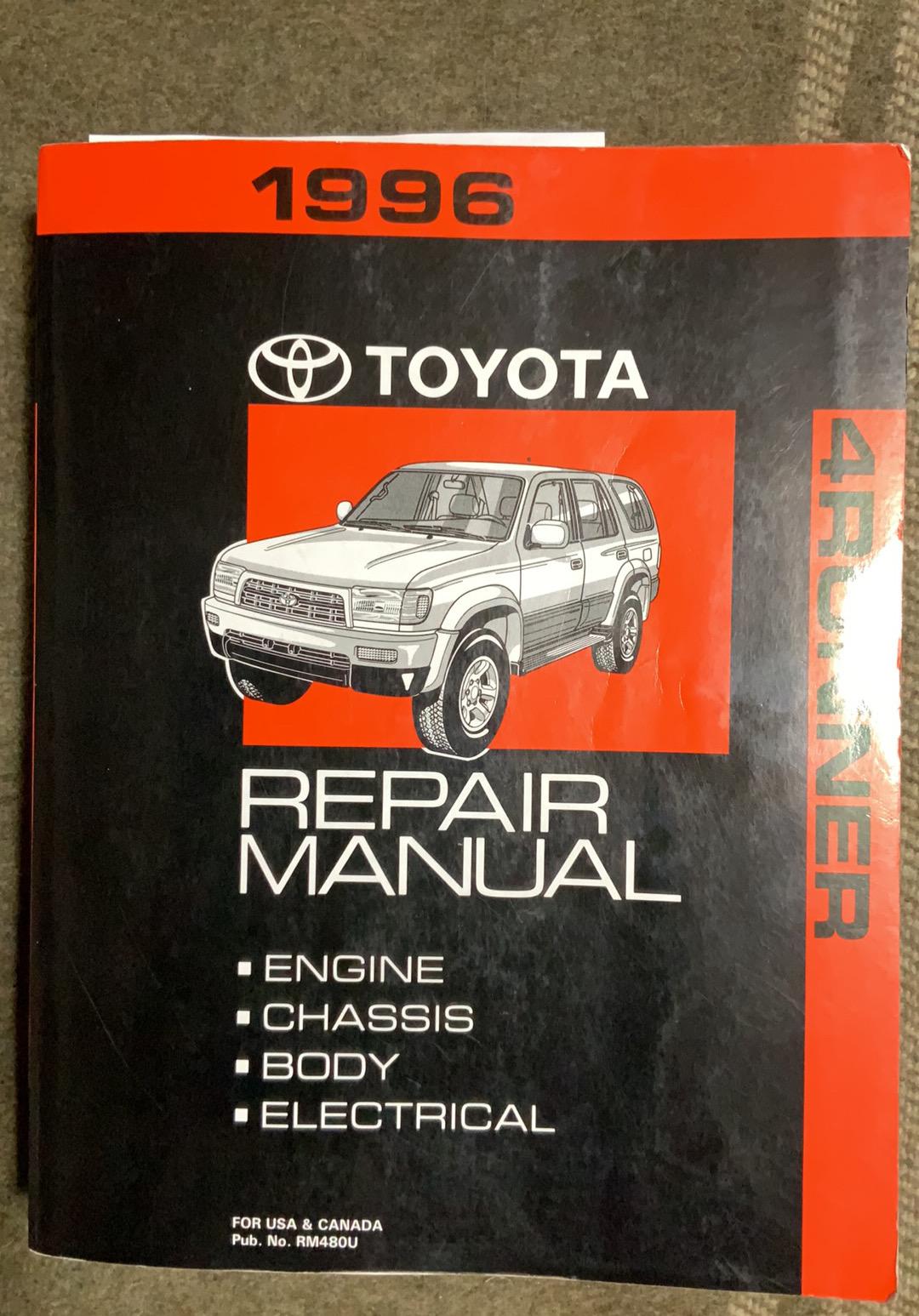
Weird the Haynes repair manual specifically says must be installed
“Within 15 degrees of 12:00”……

Throw that Haynes manual in the trash and buy yourself an OEM set. You'll be better off for it. You can find the OEM books for sale usually on Ebay.
 
A couple of years back when I had my timing belt and water pump done by a Toyota "master mechanic" I noticed that my Scan Gauge read 210-215F after the job and suspected (hoped) it was the jiggle valve. When I got home, I drained the coolant and sure enough, it as at high noon, flipped the valve to 6pm and 190F solid.
 
Any of you wanna buy this?
c5c4685a80b15d32bdf4e851eae1f42c.jpg


Sent from my iPhone using Tapatalk
 
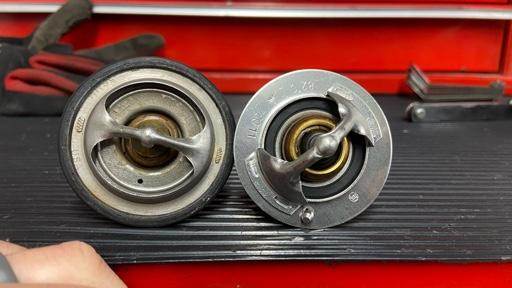
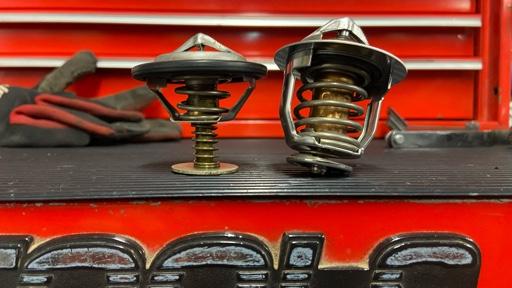
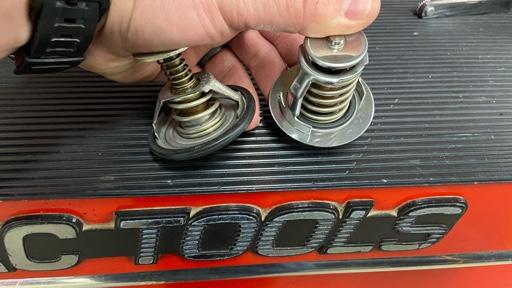
Timing of this thread is great, I just actually happen to have mine apart. Aftermarket USA manufacture, probably stant thermostat on the left. I drilled a hole into it when I installed it earlier this year with the radiator. Helps to prevent air locking when a jiggle pin is not present. Trick my old diesel school instructor showed me.

Toyota new OEM on the right. One thing to note that the aftermarket does have a larger passage than the Toyota. The sensing bulb and spring for the Toyota is much larger. I placed my homemade vent on the aftermarket thermostat at 6 o’clock for what it’s worth.

If I had to take a guess on the why 6 o’clock from looking at it right now, my guess is that it has something to do with the location of the oil cooler and the fact that the block passage is nearly open entirely above the thermostat. There must be some type of air pocket that gets created. You would think being on the suction side it wouldn’t matter that much.

There isn’t anything else on this thermostat visually to me that would indicate that it would even matter. So I guess the mystery continues.

8d9787354ddb239f6267047271ad7f0a.jpg

ca5696759a510274dba55ef1992037a3.jpg

00859f870a402692f7fdca924b64f127.jpg
 
Found mine to be at the 5 o'clock position and its never been taken apart in its 22 years of service so I installed it at the 6 o'clock position like said in the factory service manual. No problems so far.
 
You know though, most systems do have thermostats on top, not the bottom. The passenger side of the chamber feeds directly into the water pump it looks like from here. Cavitation and flow has to have some kind of an effect here for it to matter so much as to how the thermostat is oriented.

Not an engineer. Just a redneck former farmer/diesel tech looking at a tore apart Toyota wondering if I’ll make my ride tomorrow or not for what it’s worth…. Lol.
 
My 96 I put it at 12 since that’s where all other vehicles I’ve owned wanted it and never had a temp problem. Stayed at 190 or lower.

I did start putting it a 6 on my other 4Runners.


Sent from my iPhone using Tapatalk
 

Members online

Forum statistics

Threads
278,316
Messages
3,554,113
Members
248,016
Latest member
Advally Service

Trending content

Back
Top