Why does Toyota say the frame is the WRONG spot to put jack stands in the rear?

Status
Not open for further replies.

foo

Banned
Why does Toyota say the frame is the WRONG spot to put jack stands in the rear?
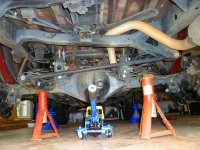
232179d1482694136-advice-requested-those-you-who-have-mounted-tires-balanced-wheels-home-safety_stands.jpg


I looked up all the related threads in the 3rd-generation forum:

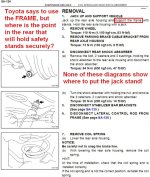
Everyone posts these two pictures, which both say the same thing with respect to the placement of the rear safety stands:
232165d1482644248-advice-requested-those-you-who-have-mounted-tires-balanced-wheels-home-where_to_place_jack_stands.jpg


I recently replaced all four tires on a 2WD 4Runner where I intuitively shunned the frame rail as being too close to the fuel tank, so I placed the rear jack stands in the wrong location (I had wrongly placed the two 6-ton safety stands on the frame itself, just in front of the rear wheels, on the lower control arm attachment housing).

Here is the procedure I used to put the SUV on four 6-ton jack stands:
  1. I generally set the parking brake first & chock the rear
  2. Then I jack the front from under the crossmember
  3. I put the two 6-ton stands under the frame in the front (just aft of the wheels)
  4. I then move the jack to under the rear differential and jack it from there
  5. Then I position the two safety stands in the rear (I put them in the wrong spot on the frame instead of the axle)
  6. Then I shake the vehicle like a Brazilian dancing girl!
  7. I leave the jack just touching the differential
  8. Sometimes (but rarely) I leave a wheel under the car also (if it's already removed and doing nothing else)

Using the frame just in front of the rear tires "worked" but Toyota is very clear in their diagrams that the rear frame is the wrong spot for safety stands.

So my only question here is WHY.

Why does Toyota specifically state NOT to use the frame for the rear safety stands?

What we need is academic rigor here.
  1. A description by Toyota why they say not to do what everyone already does
  2. A diagram by Toyota showing where to place rear jack stands on the frame
  3. A photo with measurements to the fuel tank showing a conventional jack stand in the conventional position
 
Last edited:
Register to hide this ad
who knows, but i jacked my car up on skid plates, all over the frame, lbj, rear axle you name it i did it. No issues. And when you off road and get stuck. That little oem jack fits ANYWHERE!
 
So my only question here is WHY.


My guess would be liability.

You said you put it ON the bushing, which is not a great idea.

People might try to put it on the control arm as well, resulting in slip.

The STOCK jack probably doesn't go up high enough to get the tire off the ground using the frame in the rear, too much droop.

Then, you have a very small surface area, supporting a very heavy vehicle, far from its COG, which could result in the jack slipping and damaging something in the truck.

The axle sits lower than the frame.

The front doesn't have nearly as much droop as the rear does, so that's why they suggest using it on the frame there.


Just my .01¢.


Sent from my iPhone using Tapatalk
 
It's obviously referring to the rear lower link mount as a stand placement- not the frame itself.

I don't think the stock jack is relevant here, because it's not like safety stands are included in the vehicle.
 
Last edited:
That diagram is different from what's in my owner's manual.

I have a 2002, and it shows jacking up the front, either side, on the crossbar that sits a bit behind the front axle. Not dead center right under the axle, which I'm pretty sure on mine is not a spot you could even use the jack. The crossbar on mine even has little dimples on either side where the jack is supposed to go. I'm talking about the *2 position in the second diagram, that's where I've always used the jack for the front.

For the rear I use a floor jack on the rear diff to lift the whole thing, and jack stands where they say to use them on the axle housing. That's just how I always lift and support the rear of a RWD vehicle. The front, depends on what the manual says.
 
who knows, but i jacked my car up on skid plates, all over the frame, lbj, rear axle you name it i did it. No issues. And when you off road and get stuck. That little oem jack fits ANYWHERE!
I don't think the jack placement is relevant here since we're talking about placement of the two safety stands in the rear.
You said you put it ON the bushing, which is not a great idea.
I'm not sure what to call the spot I used, but it is the lowest spot in front of the rear wheel on the frame, which has a round "thing" which I assume is a swing arm bushing but I don't even know what a swing arm is so I could be calling it the wrong thing.

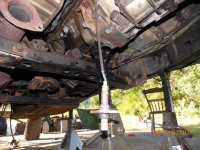
Here is a picture of where I had placed the jack stands:
232207d1482726981-advice-requested-those-you-who-have-mounted-tires-balanced-wheels-home-01_rear_mount_point.jpg


People might try to put it on the control arm as well, resulting in slip.
I'm not sure what a control arm is.
All I can find is that one spot shown above.
The rest of the underside of the 2WD looks like this - which is all flimsy stuff.
232208d1482727281-advice-requested-those-you-who-have-mounted-tires-balanced-wheels-home-00_rear_mount_point.jpg


The STOCK jack probably doesn't go up high enough to get the tire off the ground using the frame in the rear, too much droop.
I think jacking is a totally different question, completely unrelated to the placement of the jack stands.

Then, you have a very small surface area, supporting a very heavy vehicle, far from its COG, which could result in the jack slipping and damaging something in the truck.
The jack is not related to the jack stands.

The axle sits lower than the frame.
This is a good observation as the axle seems to sit a lot lower than does the frame.

The front doesn't have nearly as much droop as the rear does, so that's why they suggest using it on the frame there.

The confusing part is that Toyota, in those two diagrams, does NOT recommend using the frame for the safety stands in the rear.

I don't think the stock jack is relevant here, because it's not like safety stands are included in the vehicle.

I agree with you wholeheartedly that this thread has absolutely nothing to do with any jack.

The thread is simply asking WHY Toyota doesn't want us to use any part of the frame for the jack stands in the rear (when that's the exact part that we'd intuitively use)?

We may not know the reason; but there must be a good reason.
 

Attachments

  • jack_stands_for_4runner_rear.jpg
    jack_stands_for_4runner_rear.jpg
    92.1 KB · Views: 64,248
Last edited:
That diagram is different from what's in my owner's manual.
It would be nice to see a photo of your diagram as those two diagrams are the only ones I found in the threads asking where to put the safety stands in the rear on the 4Runner.

I have a 2002, and it shows jacking up the front, either side, on the crossbar that sits a bit behind the front axle.
This thread is about jack stands, so, it's my fault if I didn't make that clear.

For the rear I use ... jack stands where they say to use them on the axle housing. That's just how I always lift and support the rear of a RWD vehicle.

I only now, belatedly, realize that the point I used, which I don't know the name to call it, is the WRONG point to use for jack stands.

Here is the point that I used.
232207d1482726981-advice-requested-those-you-who-have-mounted-tires-balanced-wheels-home-01_rear_mount_point.jpg


What do we call that particular point (so we all have a correct frame of reference)?

The reason Toyota says not to use that particular point for a jack stand is not because it's not strong enough. After all, they indicate that it is strong enough to lift the vehicle from that point using a 2 or 4 post swing-arm lift. Rather, that point is unstable when using a jack stand. The suspension arm moves relative to the frame, and when the suspension droops it can push the top of the jack stand forward and cause it to pop out of position. That's not a concern with a swing arm lift.

This is the first answer that makes sense!

What you're saying is that the point (whatever it is called) in the photo above is intuitive for jack stands, but it's not intuitive that for certain jobs, that point will be unstable.

1. So, for most jobs, we should support the rear at the axle, but,
2. For some (suspension) jobs, we need to support the rear "at the frame".

Is that correct?
If so, the question arises where that 'at the frame' point is, because, intuitively, I see only a single reliable point, which is where the yellow arrow is in my photo.

I'll stand by my original advice. Use the rear axle if you're changing tires or doing brakes, wheel bearings, etc. If you're working on the rear suspension you will have to support the vehicle by the frame. It's safe to do so as long as you make sure the support is secure and stable.

Oh oh. Here is a picture of the underside of the vehicle at the same point as in the photo above, but all the way out to the painted side of the SUV.

Where specifically is the support point on the frame in the rear?
Other than the one spot I used, everything else in the rear looks mighty flimsy or too steep to put a jackstand on.

232208d1482727281-advice-requested-those-you-who-have-mounted-tires-balanced-wheels-home-00_rear_mount_point.jpg
 
Last edited:
Well, if you are doing a job that requires the diff to droop, Toyota WANTS you to put safety stands on the frame. See Item 1 on how to change the rear springs from the '02 FSM

Thanks for that PDF (reproduced below).

I see the words "support the frame" and I understand your point which is that some jobs require jackstand support on the rear FRAME.

But I can't find a good point that is a FRAME in the rear that jackstands will hold on to.
Everything looks flimsy (see photos above) except that one spot I found that has a bushing in it.

The only point I can find (I wish I knew what to call it) is the one where the yellow arrow in my photo points to?

Two questions:
a. Is that the frame point that Toyota is suggesting in your PDF?
b. If not, where is the frame point that Toyota is suggesting (because everything else is flimsy)?
 

Attachments

  • 00_support_frame.jpg
    00_support_frame.jpg
    137.1 KB · Views: 21,616
Last edited:
It's obviously referring to the rear lower link mount as a stand placement- not the frame itself.

I'm sorry but I don't know the terminology but looking underneath the 2WD 4Runner, this is the ONLY point that I see that seems reasonable to put a jackstand under.
232207d1482726981-advice-requested-those-you-who-have-mounted-tires-balanced-wheels-home-01_rear_mount_point.jpg


Is that spot called the "rear lower link mount" point?
 
I'm sorry but I don't know the terminology but looking underneath the 2WD 4Runner, this is the ONLY point that I see that seems reasonable to put a jackstand under.

Is that spot called the "rear lower link mount" point?

It's not really a "spot"; it's the actual rear lower link itself.
This is not the frame; it is a suspension component that is bolted to the frame.
Supporting the rear of your vehicle by the frame rail itself- directly in front of the rear lower link mount- would be a fine place to support it.
It would be especially dangerous to use the rear lower link to support your vehicle if you were working on the rear suspension- like changing springs or shocks.
There is a good reason they recommend you do not use the link to support your vehicle- depending on what you are working on, this would be a VERY bad spot to place the safety stands.
If you use your rear differential as a jacking point- and set your stands under the front of the lower links- when you set the vehicle down on the stands, the axle will continue to droop, the stands are on a suspension component that is moving- definitely not a good thing.
And just for a little bonus info- 2WD and 4WD 4Runners have the same frame/chassis/suspension. The front knuckles, spindles, and wheel hubs are different, as well as the obvious 4WD transmission and front differential. [emoji1360]
Please be safe while working on your vehicle.
 
Last edited:
I have a friend who teaches auto shop. If a student is unable to properly lift and support a car in the first semester, he fails them and they are unable to continue any subsequent classes until they pass that class.
 
I'm sorry but I don't know the terminology but looking underneath the 2WD 4Runner, this is the ONLY point that I see that seems reasonable to put a jackstand under.
232207d1482726981-advice-requested-those-you-who-have-mounted-tires-balanced-wheels-home-01_rear_mount_point.jpg


Is that spot called the "rear lower link mount" point?
I always call it lower control arm mount but same thing basically

Sent from my SM-G935T using Tapatalk
 
It's not really a "spot"; it's the actual rear lower link itself.
I confess I don't even know what a lower link does (is there an upper link, for example?).
Just by the looks of it, intuitively anyway, it seems to be a 'sway bar' of sorts, only it's in the front-to-back direction instead of a side-to-side direction.

Googling, it's a "suspension link", so it must work in conjunction with the springs in the rear, as a suspension component where, according to this reference "the rear lower control arm' (LCA) links the rear axle to the frame to keep [the rear axle] in place".

This is not the frame; it is a suspension component that is bolted to the frame.
I'm not the expert so I take your word for it that this is not the frame.

However, I have stared at the underside of the 2WD 4Runner, pondering where a jackstand might go, where I see nothing else in the vicinity that merits Toyota's reference that TheDurk found which says to put jack stands under the "frame".

Everything else that I see is as flimsy as the running boards themselves, or, angled like a ski slope, or far too close to the fuel tank shield so as to seem to be utterly useless for safety stand purposes (at least mounted crosswise, perpendicular to the frame, which is how I prefer my safety stand heads to be).
232250d1482774220-advice-requested-those-you-who-have-mounted-tires-balanced-wheels-home-02_rear_frame.jpg


Supporting the rear of your vehicle by the frame rail itself- directly in front of the rear lower link mount- would be a fine place to support it.

I understand everything you say now, where I realize my impasse is that the jack stands don't fit nicely on the rail in the position you want them to be in naturally (due to the proximity of the gas tank and concomitant shield).

I would like to see a photo of someone using that frame rail in front of the rear lower link mount point, since the gas tank is dangerously close to that frame rail such that the only viable way to place the jack stand is in the parallel position, which I have never done in my life except in emergency conditions.

It would be especially dangerous to use the rear lower link to support your vehicle if you were working on the rear suspension- like changing springs or shocks.
This insight you have about the danger is not intuitive to me, as I admit openly that I don't understand suspensions, but certainly if I were to work on the suspension, this information would come in handily.
There is a good reason they recommend you do not use the link to support your vehicle- depending on what you are working on, this would be a VERY bad spot to place the safety stands.
The danger you decree is most likely the reason Toyota does not recommend using the frame anywhere in the rear in their jack-placement diagrams.

If you use your rear differential as a jacking point- and set your stands under the front of the lower links- when you set the vehicle down on the stands, the axle will continue to droop, the stands are on a suspension component that is moving- definitely not a good thing.
I'm glad that you explained that as I don't understand what exactly that suspension component does.

But, I do know that Toyota only recommends swing-arm supports at that location.

For others to benefit, we really should have a list of major jobs that would negate use of jack stands on the axle, as then all these factors come into play.
232251d1482775182-advice-requested-those-you-who-have-mounted-tires-balanced-wheels-home-05_rear_frame.jpg


2WD and 4WD 4Runners have the same frame/chassis/suspension. The front knuckles, spindles, and wheel hubs are different, as well as the obvious 4WD transmission and front differential.
Thank you for letting me know that the frame is the same on both the 2WD and 4WD (as plenty of other things are different).

Is the gas tank just as close to the frame in the 4WD as it is in the 2WD?

Please be safe while working on your vehicle.
It's not my vehicle, but the whole reason for asking the question is for my safety, and for the safety of others who have the same question (which was NOT fleshed out in the aforementioned threads, AFAICT).
 
Last edited:
I have a friend who teaches auto shop. If a student is unable to properly lift and support a car in the first semester, he fails them and they are unable to continue any subsequent classes until they pass that class.

I understand your expressed sentiment that people need to take their training seriously. My only automotive training was when I was in high school, where I was college prep (e.g., calculus, physics, biology, chemistry, etc.), but for my electives, I took wood shop, typing, home economics, and auto mechanics (where I think I learned more real-world tasks than in any other time in my life).

However, most of the students did NOT take these elective classes seriously.

In the auto mechanics class, we mostly worked on an engine mounted in the middle of the classroom (which was a fantastic way to see everything), and we had various stands mounted for brakes (in those days, it was all drum brakes since disc brakes were relatively new at the time as I recall).

Almost all the time was spent inside the classroom, where the only cars we worked on were the occasional teacher's car which needed an oil change, or a student's ride which needed something or other (I remember bringing in a 1968 Chrysler New Yorker, which was my Dad's car, to work on the horn relay, which turned out to have a thin coil wire broken, which I soldered in place, and the thing worked fine thereafter.)

However, I don't remember how we jacked up the vehicles, but basic safety was always inculcated into all our instructional lessons.

Oddly, and unexpectedly, I found most of the kids in the class (whom we geeks usually called the "motorheads") seemed to take everything extremely nonchalantly, in that, as a group, they didn't seem to care all that much about the "why" of anything (whereas I asked why about almost everything).

As a whole, the auto mechanics class was as easy as any high school elective could ever be, of course, so they may have just been taking it for the free ride; but the instructor was so frustrated by the lack of academic rigor in the students that he'd angrily give us pop quizzes nearly every week, often on stuff we never literally covered (for whatever reason, he simply curtly said to "do as well as you can"), I think - merely to prove the point that the students should take this class more seriously. In the end, my grade was so high that I could skip the final project and still get an A, which, it turned out, upset the teacher because he had expected me to build a jig for brakes for his future classes from a junk-shop car he had arranged the kids to destroy. (In those days, the suspension was all slip-leaf suspensions, as I recall, as "struts" didn't seem to exist, at least not in my memory space.)

Interestingly, I never ran into the same cavalier attitude until after I graduated college with a rather useless bachelor's of arts degree. I mistakenly had gone to a government-run "employment agency", where, much to my surprise, only one or two out of about 30 people signed up at the time I was signed up actually cared to find a job. (I remember, to this very day, the poignant "come-to-Jesus" speech the guy gave all of us, to the effect of "you'll never get anywhere expecting a free ride the whole way".) It was shocking that they didn't care to find a job (so what the heck were they there for, I still don't know to this very day, except they certainly seemed to want to sign in eagerly so as to "punch the clock" so to speak.)

Anyway, my point in these remarks is that we need to take this jack-stand thing seriously, from an academically sound engineering standpoint so I agree with your comment that the most basic task is to lift and support the car properly.

Which is why this question must be answered correctly - not with mere guesses - but with actual facts that support those guesses.

After reading all the 3rd-generation threads I could find on the subject, I didn't find this question answered; hence I asked it.

The answer, even at this very moment, seems to be still unclear from Toyota's standpoint, in that:
  1. Fact is, the Toyota diagrams do NOT recommend jack stands in the rear anywhere other than on the axle itself;
  2. Yet, TheDurk clearly found a Toyota reference with the words to use "the frame" (but zero advice as to where exactly to place them on that frame);
  3. However, the frame is, IMHO, far too close to the gas tank for perpendicular-seated jack stands to fit without risking damage to the fuel tank and/or shield (IMHO).

If others use the typical 6-ton jack stands that I use when working on the rear suspension, then it would be instructive to see a photo of how others safely orient the head of the jack stand on that frame, due to the innate proximity of the fuel tank.
 
Last edited:
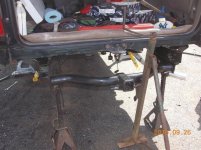
For 17 years, I've been placing my 6-Ton stands right in the spot against the fuel tank forward of the control arm point and never knew it wasn't possible. Yes, iI put that one parallel. I just did my frame swap supporting it there and I was underneath it for days connecting and disconnecting. I also had a backup in place using my 1961 Olds station wagon bumper jack plus two more stands on the tow hitch. It alone can lift the whole rear end that way. And I like having a few thick logs in strategic places that will keep me from getting crushed even if they fall over.

Having one turned parallel with a total of seven stands and an engine crane did not bother me at all.
 

Attachments

  • DSCN0334 (Medium).jpg
    DSCN0334 (Medium).jpg
    140.4 KB · Views: 1,442
  • DSCN0461 (Medium).jpg
    DSCN0461 (Medium).jpg
    132.3 KB · Views: 1,397
Last edited:
For 17 years, I've been placing my 6-Ton stands right in the spot against the fuel tank forward of the control arm point and never knew it wasn't possible.
Like you, until I searched for Toyota's recommendations, I didn't realize that the jackstand point I had chosen, was not the Toyota-recommended location for rear jack stands.

Yes, iI put that one parallel....Having one turned parallel with a total of seven stands and an engine crane did not bother me at all.

That pretty much answers the question of what people do.
We still have unanswered the question as to what Toyota recommends (specifically, with a diagram or photo anyway).

The fact that it's problematic to put a typical jack stand in the proper orientation under the rear frame is likely why Toyota doesn't seem to recommend ANY spot on the frame in their diagrams.
 
Last edited:
I confess I don't even know what a lower link does (is there an upper link, for example?).
Just by the looks of it, intuitively anyway, it seems to be a 'sway bar' of sorts, only it's in the front-to-back direction instead of a side-to-side direction.

Googling, it's a "suspension link", so it must work in conjunction with the springs in the rear, as a suspension component where, according to this reference "the rear lower control arm' (LCA) links the rear axle to the frame to keep [the rear axle] in place".


It's not my vehicle, but the whole reason for asking the question is for my safety, and for the safety of others who have the same question (which was NOT fleshed out in the aforementioned threads, AFAICT).

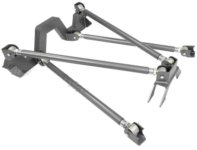
1- Search "4 link suspension" on YouTube, or Google "How does 4 link suspension work", and watch some videos to better understand how it works. It would probably be very helpful in understanding that Toyota's recommendation- to not place stands there- is VERY valid.
2- If this is not even your vehicle, what are you doing to this vehicle that you need to support it on jack stands- on a location other than the Toyota-recommended location under the axle? Unless you are working on suspension components, supporting under the axle should be sufficient. Please don't take this as rude or snarky- I think that everyone should be able to ask a question here without being flamed- but since you don't seem to be familiar with the suspension at all, I am assuming you aren't working on the suspension.
 
Frankly, I'm mystified that this thread even exists. Put the jackstands on the frame rails (or under the axle if that suits whatever purpose you have) and be done with it. The OP is making waay too much of the factory "recommendation".
 
1- Search "4 link suspension" on YouTube, or Google "How does 4 link suspension work", and watch some videos to better understand how it works. It would probably be very helpful in understanding that Toyota's recommendation- to not place stands there- is VERY valid.
I'm familiar with leaf-spring suspensions, but not these Toyota 4-link suspensions.
Googling for "how does the 3rd-generation toyota 4runner 4-link suspension work", I find this article which states that Toyota switched the 4Runner from leaf spring to 4-link in 1990 (with Panhard bar).

2- If this is not even your vehicle, what are you doing to this vehicle that you need to support it on jack stands- on a location other than the Toyota-recommended location under the axle?

The vehicle is owned by a relative who asks me to do minor repairs such as replacing belts, oxygen sensors, valve cover gaskets, etc.

I never claim to be an expert, but I do assume we should all be able to do simple repair tasks on the vehicle, at home.

For example, I just recently unmounted, patched, balanced, and remounted five tires, as explained here, where my approach is to ask questions before, during, and after the job, and then to compile a complete answer to the original question so that the thread serves as a viable reference for all who follow in our footsteps.
Given that I'm no expert, and that I only sporadically work on this vehicle, I always run a search first - where - unfortunately - I'm often appalled at the lack of knowledge by most people about common problems (where I'm also pleased and enlightened by the very few who actually know what they're talking about).

For example, I was one of the first people on this forum to replace the front swaybar bushings with the correct sizes with a single kit in the first shot.

Who knows why nobody followed up with the manufacturers, but, it seems that for years upon years, people put the wrong-sized bushings in, until mntbiketim and I solved this problem for everyone, working directly with multiple aftermarket bushing manufacturers, providing them measurements and pictures, over a period of months, until they finally fixed their bushings sizes such that 4Runner owners could get the right sized bushings in a single kit from a single supplier.

What I found was that, in many cases, people put the wrong parts on, and left it at that.
Or, they bought two duplicate kits, using the correct parts from each, and throwing away the wrong parts.

What amazed me was the habitual lack of followup after they had done the job, which would have prevented any others from running into the same problems!

I found the same curious lack of attention to engineering detail with many of the people who ran into the problem of the QPQ bushings failing in the clutch pedal return spring redesign.

In all these cases, I found a ton of bad, wrong, and incorrect advice on this forum, sprinkled sporadically with the correct advice; so I decided to make a thread that solved the problem completely, once and for all.

Even though these are all very simple repair tasks, I found the same lack of thought and lack of correct or complete information when I looked up where to place the jack stands (as noted in the original post).

My next simple repair task will be to do a static alignment (front camber, caster, and toe) at home, which will be my first foray into adjusting the suspension on this SUV. Luckily, the people on that thread have thought about the problem a lot, so, I hope that the simple task of aligning the front end at home goes smoothly and without undue error.

Unless you are working on suspension components, supporting under the axle should be sufficient.
I agree with you.
The only reason I asked the question is that I have been using the lower control arm connection to the frame for my 6-ton jack stands, but I was uneasy with that location (as I prefer a nice solid frame).

However, I was just as uneasy with using the frame because it is just too close to the fuel tank for the jack stands to be placed in the conventional crosswise position.

It didn't even occur to me to use the axle; but that's what I will use moving forward.

Please don't take this as rude or snarky- I think that everyone should be able to ask a question here without being flamed- but since you don't seem to be familiar with the suspension at all, I am assuming you aren't working on the suspension.

I'm not working on the suspension. If I were to work on the suspension, I'd ask where to support the body properly.

One disconcerting discovery when I searched for the correct place to put the jack stands was that in the dozen threads I found on the topic, NOBODY mentioned the jack stands go in different places depending on whether you're working on the suspension or not in the threads.

Worse, there apparently is no good place to put the jack stands when working on the rear suspension, in that Toyota recommends only the axle or the frame, but Toyota shows only the axle and there is no picture or diagram yet of what Toyota considers a good place on the frame (that doesn't imperil the fuel tank).
 

Attachments

  • 4link.jpg
    4link.jpg
    69.7 KB · Views: 1,321
Last edited:
Status
Not open for further replies.

Members online

Forum statistics

Threads
278,315
Messages
3,554,130
Members
248,016
Latest member
Advally Service

Trending content

Back
Top