Official Lower Ball Joint Write Up Thread

The golden rule is NEVER use aftermarket LBJ on a 3rd gen...

It's been covered elsewhere, but the suspension design differences on the 2nd gens make them unlikely to have a catastrophic failure as has been documented here. They still should be proactively replaced, the stakes are somewhat lower.

I posted this in the Classics section, but this thread is more likely to come up for those searching outside the site for LBJ info, so I'll repeat it here:

A data point for those looking to replace their LBJs, at least on the 2nd gens: I replaced them on my 1993 with OEM Toyota ones. Spendy, but they're solid. FWIW the autozone LBJs listed for the 2nd gens (part number FA2054) DO NOT FIT. The bolt hole pattern / template on that LBJ for the four bolts into the bottom of the steering knuckle do NOT match the knuckle. They don't line up. So don't waste your time :)

The OEM part numbers are:
4334039245 (left)
4333039835 (right)

Hope this helps someone!
 
Has anyone ever tried to contact aftermarket companies (like MOOG) that sell these half-asses replacements? It seems everyone who uses them reports failures or near-misses. I understand being able to get away with selling bushings that wear out 10x faster than OEM but not an item (LBJ) that poses such a safety hazard if it goes bad.
 
Has anyone ever tried to contact aftermarket companies (like MOOG) that sell these half-asses replacements? It seems everyone who uses them reports failures or near-misses. I understand being able to get away with selling bushings that wear out 10x faster than OEM but not an item (LBJ) that poses such a safety hazard if it goes bad.

That's the whole problem right there. If every single one that failed was returned to Moog, they would figure out why there are failing and fix the problem. Instead they fail, people don't bother to exercise the warranty, and the problem never gets fixed.

I know if I go pull an aftermarket bumper cover for a 2011 Toyota Camry from any of a dozen suppliers in town, it will not fit like the original part. It will go on, but it doesn't quite line up perfectly. This has been an issue for 7 years, but no one reports it to the relavent manufacturers, so the same shitty parts keep getting put on.

They can't fix the defects if they don't know about them. Believe me, they want to fix the problems.
 
Has anyone ever tried to contact aftermarket companies (like MOOG) that sell these half-asses replacements? It seems everyone who uses them reports failures or near-misses. I understand being able to get away with selling bushings that wear out 10x faster than OEM but not an item (LBJ) that poses such a safety hazard if it goes bad.


I think people by Moog. they break, then people find out “shoulda bought OEM Toyota ones” and don’t bother with the warranty....Of course there are always the stubborn ones who refuse to accept the reality about this part for some reason and always have problems. And if you ever bought Detroit Axle ones you should probably be slapped by every Toyota engineer that ever lived for eternity and beyond.


Sent from my iPhone using Tapatalk
 
That's the whole problem right there. If every single one that failed was returned to Moog, they would figure out why there are failing and fix the problem. Instead they fail, people don't bother to exercise the warranty, and the problem never gets fixed.

This is an excellent point. When your aftermarket Moog LBJs fail, you are likely on the side of the road and trying to get a warranty on them is the last thing on your mind. You're probably going to ring up the parts store and get whatever they have rather than trying to dig up receipts, make a claim, etc... You do have to actually return the defective part to the store first before they send it back to the manufacturer.
 
2nd issue in a year after replacing with Moog. First one actually failed on the trail leaving me stuck. Find this one yesterday after my elk hunt. [emoji849]

Does anyone know if OEM LBJ will fit into Moog lower control arms?


Sent from my SM-N960U using Tapatalk

LOL after the first failure, you figured it was still a good product? Just go OEM. Get the part number and find them on ebay.
 
I did a little math and research on my lBJ issue it added up to buying the OEM ones even though the cost 3 times as much as Moog. A lot of people I talked to did Moog first then they later failed so the went back to the OEM LBJ some are still on the Moogs and are watching cautiously. I have stock control arms and sent OEM ball joints. It was the stories of failing at 50k or replacing them every year that people were telling me versus my OEM ones going almost 200k the math added up for me. I heard from tacoma and 4runner drivers. I spoke to only one pl erson who installed Moog lower control arms and bushings and they said they have OEM KBJ in them. They replaced the lower control arms do the did not have to fight the bushing replacement. Hope this helps...

Sent from my SM-N950U using Tapatalk
 
Spotted in San Diego - Another Lower Ball-Joint Failure

Around 1600 hours, on Freeway 15, just south of Carmel Mountain Road. A red first-gen Tacoma with right front wheel off. Certainly another lower ball-joint failure.
Sorry, no pics as I was driving.
 
Why only this generation?

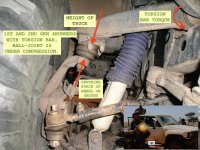
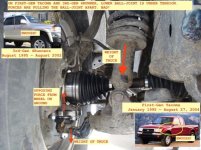
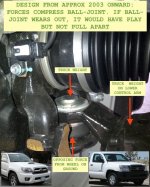
BASICS: COMPARING BALL-JOINT SETUPS BETWEEN GENERATIONS
I hope this simple explanation clarifies why the 3rd gen 4Runners and 1st-gen Tacoma LBJ's are problematic, while the others are not.
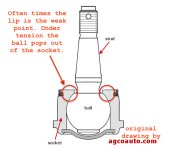
Where BJ's are under tension, they could fail and PULL apart (usually the lip of the socket is the weakest point).
Where BJ's are under compression, if they have wear, they would have play but stay in one piece.
The stud under tension could also fail - more likely than a stud under compression.

==============
Addendum:
Found this on NHTSA site:
https://static.nhtsa.gov/odi/rcl/2005/RCONL-05V225-6542.pdf

"During the manufacturing process, there is a possibility that the surface of the ball portion of the Front Suspension Ball Joint in your vehicle may have been scratched. "

THIS^^^ exact statement is B.S. Toyota lawyers and engineers must have been scratching their balls, err... heads, how to come up with a solution to downplay the real problem - LOL!

It's an attempt to make the problem seem lighter. The root cause of this problem is the design that puts the LBJ under tension as shown below.
Scratches may cause looseness and play but if LBJ were under compression like other designs, it will not PULL APART.

Therefore, the recall should not only apply to certain years but to all vehicles where the LBJ is under tension as shown above.
 

Attachments

  • 1st_Gen_4Runner_Torsion_Bar_Forces.jpg
    1st_Gen_4Runner_Torsion_Bar_Forces.jpg
    112.3 KB · Views: 2,920
  • 3rd_gen_4Runner_Ball_Joint_Forces.jpg
    3rd_gen_4Runner_Ball_Joint_Forces.jpg
    106.6 KB · Views: 6,081
  • 4th_Gen_4Runner_Ball_Joint_Forces.jpg
    4th_Gen_4Runner_Ball_Joint_Forces.jpg
    118.1 KB · Views: 2,805
  • Ball_Joint_Cross_Section_Weak_Spot.jpeg
    Ball_Joint_Cross_Section_Weak_Spot.jpeg
    51 KB · Views: 3,820
Last edited:
Great explanation, I especially like the 'swoosh' part. As someone who has suffered an LBJ failure, it's pretty disappointing that this design flaw wasn't picked up by Toyota, as it really is the biggest problem with owning a 3rd Gen.
 
Toyota recall 50J - replace front ball joints

Tnx, Mate!
...I especially like the 'swoosh' part....
LOL! I like simple straight lines, boxy design like the FJ 70's, the Defender's, the FJ80's, the G-Wagon's. That's why that swoosh, that looks like Toyota is trying to make the truck aerodynamic, was the first thing that turned me off about the 3rd-gen - despite it's excellent 3.4 and 2.7 engines. That was before I earned about the LBJ issue.

A few people close to me have it (happened to my daughter's BF's truck) so I try to warn them but they don't quite get the urgency. I hope the visuals would help. It is also disappointing that Toyota recalled only certain years, when in fact the suspension flaw is present in all years of that generation.

A friend successfully got his replaced. This info might help:
"I had my 2003 Tacoma’s factory recall work done in June, 2014, soon after I purchased the used truck. Toyota recall 50J - replace front ball joints.
I had the work done at Kearny Mesa Toyota, no cost"
 
Found this on NHTSA site:
https://static.nhtsa.gov/odi/rcl/2005/RCONL-05V225-6542.pdf

"During the manufacturing process, there is a possibility that the surface of the ball portion of the Front Suspension Ball Joint in your vehicle may have been scratched. "

THIS^^^ exact statement is B.S. It's an attempt to make the problem seem lighter. The root cause of this problem is the design that puts the LBJ under tension as shown above.
Scratches may cause looseness and play but if LBJ were under compression like other designs, it will not PULL APART.

Therefore, the recall should not only apply to certain years but to all vehicles where the LBJ is under tension as shown above.
 

Attachments

Last edited:
Have you guys seen this?
https://www.instagram.com/p/Bp-CGArBlM_/?utm_source=ig_web_button_share_sheet

Looks Like SRQ is designing a LCA which will eliminate the LBJ. They say in the replies they will also be making one for stock size and travel.
:guitar3:

Have been following it for a while. would be a great option for safety and strength.
Question is, What would be the cost benefit compared to oem lbj for around a 100 bucks and 100k miles.But for sure would love to have the option.
 
Found this on NHTSA site:
https://static.nhtsa.gov/odi/rcl/2005/RCONL-05V225-6542.pdf

"During the manufacturing process, there is a possibility that the surface of the ball portion of the Front Suspension Ball Joint in your vehicle may have been scratched. "

THIS^^^ exact statement is B.S. It's an attempt to make the problem seem lighter. The root cause of this problem is the design that puts the LBJ under tension as shown above.
Scratches may cause looseness and play but if LBJ were under compression like other designs, it will not PULL APART.

Therefore, the recall should not only apply to certain years but to all vehicles where the LBJ is under tension as shown above.

I guarantee that Toyota most likely had many closed door meetings discussing this. Any half decent engineer would absolutely agree that this statement is BS and that the actual problem is the design itself. What most likely happened is the lawyers on both sides came to a compromised solution that would balance out cost savings vs liability to the company. Blaming a "possible" manufacturing error causing a scratched ball is merely a scapegoat to the real problem. Almost like acknowledging there is a problem, but using an excuse to say the problem isn't as big of a deal.
 
I guarantee that Toyota most likely had many closed door meetings discussing this. Any half decent engineer would absolutely agree that this statement is BS and that the actual problem is the design itself. What most likely happened is the lawyers on both sides came to a compromised solution that would balance out cost savings vs liability to the company. Blaming a "possible" manufacturing error causing a scratched ball is merely a scapegoat to the real problem. Almost like acknowledging there is a problem, but using an excuse to say the problem isn't as big of a deal.

Exactly.
They're lawyers and engineers must have been scratching their balls, err... heads, how to come up with a solution to downplay the real problem - LOL!

Special Service Campaign 50J says:
"... a defect, which relates to motor vehicle safety, exists in the Front Suspension Lower Ball Joint of certain 2001 through 2002 4Runner vehicles."
Meaning only 4Runners are affected and not Tacoma's?
On the other hand my friend says:
"My records reveal I had my 2003 Tacoma’s factory recall work done in June, 2014, soon after I purchased the used truck. Toyota recall 50J - replace front ball joints..."

Also happened to friend's 1999 4Runner, 2WD, auto trans, 2.7L, Not off-roaded.

J3MT13GCkbUuMdxjn96Z4urk9MzkJ6elEF8DfNCZ9mInCjgjWI6caM_xG0KOEvCItaF41WpXnmrHjxu7tQnWEpbynhB1bfGZBVlEECv39HfffclDXYORapT_ODHrDdq88Jklsqe58ktyIGUpiSKsdskYmdEgKxziktQ_mKA1ls3ARHqdyAvglDhPpjzKh913QKy_OWrHwsLvNp66y_RmN98voPcI47UBMNzIQqjMu1oSXpJcHb_z1csnsMyR8NnY4gQfWkocg0Z-vNtdOKKpSh6HLARgN9BPUWZIOeUsZwYZH9Ni6mJ6pFvC512LCaa0G6YhXsPC3xBe2niPOIo_aw5GBEjc5zak7jL1U7wgBZpTSl0OHBlz7S2AuR8Cu6FSiIoddoCPPigSRy_oM7VPaF5en00UGA5HcOCxZos0HdjCjzeLxnVlrFbL1opRmTba_FBB8twjs_8y_ABY04i7yG1SJn0RPYk_Qvw-XWDRlK2avWtGxFevp4knGrSCTiY-glIvTgitZCujWmhXUIEw3Ivfg4ANqMxgDd61bGEXU988CSJOqumtHo9P9n42wa1v2UmWQ8J3Y6eI228yY8AUsZ4ZTyJcnA78Fyy8aidUQ1y0fsQvlpGKdtqL-58Zf3h4mrSEd0jjTalDdBNKWCWD5WLSAQ=w470-h685-no


To prove that the "Scratched Ball" excuse is B.S., I suggest owners of 4Runners and or Tacoma's and people they know whose trucks are not included in "certain 2001 through 2002 4Runner vehicles" criteria but experienced the problem work together, and make Toyota pay for replacements before someone gets hurt.
 
I started a poll for OEM LBJ's that were not heavily off-roaded but failed.

An option is to replace regularly, but Toyota has not come up with a recommended replacement frequency. I hope that those who had experienced failure with OEM LBJ's that were not heavily off-roaded could complete this poll to help others. Upon seeing results, fellow owners can decide how often to replace their LBJ's

IF your OEM LBJ's on stock suspension that have not been heavily off-roaded failed, PLEASE CONTRIBUTE TO POLL HERE.

Too many variables with after-market ones and those that have been heavily-used, so we're narrowing it down to OEM's only.
 
Last edited:
I know that the LBJ is a weak point and I replaced preventative. I believe all the pictures and stories I have heard but never saw one in person until I was in the Fairbanks alaksa airport parking lot, and there was a taco, with the typical failed ball joint.
 

Members online

Forum statistics

Threads
278,304
Messages
3,554,040
Members
248,016
Latest member
Advally Service

Trending content

Back
Top