5th Gen. KDSS vs. Non-KDSS handling performance & sway bar diameter differences.

Although that number sounds big, I'd still say it's rare to the average shop. I had never even heard of it till around January this year, although I admit I'm not really a hardcore car person. According to washington post, there were about 17.5 million vehicles sold in the U.S. alone in 2016, so I'd argue that only 30,000 having kdss would make it rare.

It's a unique system for sure. And it's also rare to mechanics because it almost never needs to be repaired. BMW uses a hydraulic active sway bar in a number of models. Every BMW mechanic knows about them because in true BMW form - they break all the time.

For a rough comparison the Ford Mustang is the best selling sports coupe in the world. It sells about 140,000 globally each year. That's about the same as how many KDSS 150 platform vehicles are sold each year.

Or just for the USA comparison, there are more KDSS vehicles including the 4runner with KDSS and GX460 than there are 1ton GM/Chevy trucks sold each year. How rare is a 1 ton chevy?
 
Really don't want to defend or slam KDSS, but I can't stand to see confusing information.

4" more travel.... No way. It will however articulate better than a stock suspension with standard sway bars on at crawl speeds. Swaybars fight to keep wheels on the same axle at an equal vertical distance from the frame. They are a torsion spring, so in the end... they impact the spring rate on each corner of the suspension but only when there is a delta in distance to the frame across the axle. They basically transfer the spring rate on the unweighted wheel to the weighted wheel and vice versa.

So for pure vertical travel they should have no impact on wheel travel... in articulated travel it will transfer force and attempt to equalize wheel travel across the axle. However, they twist and are a torsion spring themselves, so thickness, material, and the actual suspension spring rates all play together.

BTW, KDSS turns off the normal swaybar behavior by allowing the mount between the frame and the sway-bar to float (below 12mph).

(warning speculation on my part ahead...) Since this float means fluid is moving.... the system is only designed handle this behavior at low speeds without creating too much heat and cavitation.

If KDSS was more of a mechanical disconnect... I would really see no downside at all, but it's implementation on the 5th gen is less than perfect (as most things are). It's still very good for most use cases, just not ideal for all types of offroading. This is why you will never see the system on or anything like it on hard core purpose built offroad rigs. What you will see on those is adjustable sway-bars or pure mechanical disconnects.
The 4" is the articulation difference, they misspoke

Sent from my SM-G930V using Tapatalk
 
All I want to know is that if I buy one without kdss, is it going to be easier to lift and will I have more flexibility with options on lifts?

Sent from my HTC U11 using Tapatalk
Yes, this is really the only argument against KDSS. If you plan on major suspension changes you are better off without KDSS. If stock or maybe minor changes KDSS is good.

I guess wanting to do high speed offroad is another argument, but in that case you probably fit into the major suspension changes category.

(Edit: i'll clarify that personal preference preferring the ride on the SR5 is valid too, i just meant this is the only valid mechanical argument)
 
Last edited:
It's a unique system for sure. And it's also rare to mechanics because it almost never needs to be repaired. BMW uses a hydraulic active sway bar in a number of models. Every BMW mechanic knows about them because in true BMW form - they break all the time.

For a rough comparison the Ford Mustang is the best selling sports coupe in the world. It sells about 140,000 globally each year. That's about the same as how many KDSS 150 platform vehicles are sold each year.

Or just for the USA comparison, there are more KDSS vehicles including the 4runner with KDSS and GX460 than there are 1ton GM/Chevy trucks sold each year. How rare is a 1 ton chevy?

My point was as far as the suspension system goes, imo kdss is fairly rare. Although I don't know the breakdown of what exact sizes, chevy sold almost 575k full size trucks in the US last year according to my google search. Not counting gmc or any of their 1/4 ton trucks. But whether it's a chevy or even ford or other brand, most of those trucks probably have a similar suspension system, correct? I could be wrong, I don't know much about mechanic work. So even if the vehicle is rare, the suspension system isn't. Just like I would consider kdss rare, but not the 4runner that it comes on. I could be wrong though.

One thing to consider is that they may be rare in one area of the country and abundant in another. I live in north Louisiana, and I don't believe I've seen a 4runner in other than sr5/limited configuration, besides one or two trd pros. So I'd figure mechanics around here aren't gonna be familiar with kdss, since it doesn't seem we have any trail editions here.
 
I'm with [MENTION=106176]wfo9[/MENTION] in that I need substantiated information about some of the magical/horror claims I've read here. The great thing about this forum is it will help you find a squeak or work on your rig. The bad thing about this forum is the half-baked BS on it. As pointed out KDSS has its positive and negative points - depending highly on the users personal preferences.

For me, I do enjoy that my 4Runner handles the mountain road corners like it's on rails. It honestly handles like my old Volvo 850 GT. I do not like the rougher ride on washboard roads above 12 MPH. Airing down helps.

As for articulation differences between KDSS and Non-KDSS, I don't really know and frankly - I don't care. My 4Runner has climbed some crazy off-camber stuff with no problem. If I punch a few buttons, it will climb stuff that makes my breathing shallow and my palms sweat like a 5.11 run-out slab climb. I don't attribute KDSS to this but, I don't discount it's potential to contribute. I just don't have enough information to say.

I do get frustrated with the well documented occasional KDSS lean. It's fixable, at least temporarily.

I have my truck serviced by SoCal Super Trucks in San Bernardino. I'm lucky in that I live close as people drive over three hours from all points in Southern California to have their rigs serviced here. They have aligned my truck twice. Both times they spent four hours doing it - because they are obsessed with getting it right. It will take a month to get an appointment but, it's worth it. They are not afraid of KDSS.

I haven't read a lot about KDSS breaking or wearing out. I'm sure it can happen but, I haven't been exposed to any significant anecdotal evidence that it's an issue. It's been around for quite awhile.
 
My point was as far as the suspension system goes, imo kdss is fairly rare. Although I don't know the breakdown of what exact sizes, chevy sold almost 575k full size trucks in the US last year according to my google search. Not counting gmc or any of their 1/4 ton trucks. But whether it's a chevy or even ford or other brand, most of those trucks probably have a similar suspension system, correct? I could be wrong, I don't know much about mechanic work. So even if the vehicle is rare, the suspension system isn't. Just like I would consider kdss rare, but not the 4runner that it comes on. I could be wrong though.

One thing to consider is that they may be rare in one area of the country and abundant in another. I live in north Louisiana, and I don't believe I've seen a 4runner in other than sr5/limited configuration, besides one or two trd pros. So I'd figure mechanics around here aren't gonna be familiar with kdss, since it doesn't seem we have any trail editions here.

I agree that as a design it's pretty unusual. Just commenting that it's not a rare unfixable unicorn like it's often described as.

The GM 1 tons are different in that they are usually dual rear wheels and have different springs and frame configurations. But in a general sense they're comparable to other truck suspension. FWIW I just chose the 1 ton because it was about 20,000 annual sales in the USA as a comparable example.

Toyota only licenses it to McLaren - there's only two companies that use it. And McLaren only uses it on its top spec models - so very low production volume even for a low production manufacturer. The idea of it is pretty simple though. It's not much different from hydraulic brakes or hydraulic clutch linkages. It's just used in a different way. It's not magic. It's is rare to have an issue. Even most Toyota dealerships don't have anyone who's ever touched it.
 
I agree that as a design it's pretty unusual. Just commenting that it's not a rare unfixable unicorn like it's often described as.

The GM 1 tons are different in that they are usually dual rear wheels and have different springs and frame configurations. But in a general sense they're comparable to other truck suspension. FWIW I just chose the 1 ton because it was about 20,000 annual sales in the USA as a comparable example.

Toyota only licenses it to McLaren - there's only two companies that use it. And McLaren only uses it on its top spec models - so very low production volume even for a low production manufacturer. The idea of it is pretty simple though. It's not much different from hydraulic brakes or hydraulic clutch linkages. It's just used in a different way. It's not magic. It's is rare to have an issue. Even most Toyota dealerships don't have anyone who's ever touched it.

I agree that the biggest problem with servicing it prob isn't the system itself, it's the lack of experience from mechanics on the system. Seems to be a very reliable system, at least there's not much on this forum regarding major faults with it. If I were buying a new trail/trd off-road or whatever they're called now, I wouldn't have any worries with buying with kdss. I would worry more if I were planning on replacing suspension on how easy/hard it would be with or without kdss.
 
Would you happen to know if Non-KDSS have swaybar end links?
If not I'm sure it'll be a nice upgrade for road characteristics.

I upgrade my wifes forester xt swaybar (16mm) to the WRX STI swaybar (20mm) and made a huge difference in reducing body roll.

Yes. Non kdss have sway bar end links front and rear. I have non kdss.
 
I'm with [MENTION=106176]wfo9[/MENTION] in that I need substantiated information about some of the magical/horror claims I've read here. The great thing about this forum is it will help you find a squeak or work on your rig. The bad thing about this forum is the half-baked BS on it. As pointed out KDSS has its positive and negative points - depending highly on the users personal preferences.

For me, I do enjoy that my 4Runner handles the mountain road corners like it's on rails. It honestly handles like my old Volvo 850 GT. I do not like the rougher ride on washboard roads above 12 MPH. Airing down helps.

As for articulation differences between KDSS and Non-KDSS, I don't really know and frankly - I don't care. My 4Runner has climbed some crazy off-camber stuff with no problem. If I punch a few buttons, it will climb stuff that makes my breathing shallow and my palms sweat like a 5.11 run-out slab climb. I don't attribute KDSS to this but, I don't discount it's potential to contribute. I just don't have enough information to say.

I do get frustrated with the well documented occasional KDSS lean. It's fixable, at least temporarily.

I have my truck serviced by SoCal Super Trucks in San Bernardino. I'm lucky in that I live close as people drive over three hours from all points in Southern California to have their rigs serviced here. They have aligned my truck twice. Both times they spent four hours doing it - because they are obsessed with getting it right. It will take a month to get an appointment but, it's worth it. They are not afraid of KDSS.

I haven't read a lot about KDSS breaking or wearing out. I'm sure it can happen but, I haven't been exposed to any significant anecdotal evidence that it's an issue. It's been around for quite awhile.

These are my thoughts as well. It's been useful as a daily driver, and really useful when plowing through on the Blue Ridge Pkwy or any other winding road on the way to the trail. My rig handles much better on the road w/ KDSS, 3" lift and 34" tires than a stock SR5 on Dunlops. Maybe the Icons help, but ol' girl hugs the turns in the greater Charlotte metro area with the best of them.
 
I'll just leave this here
 

Attachments

  • IMG_2506.JPG
    IMG_2506.JPG
    33.6 KB · Views: 1,477
SamsonGX470
JoinedMar 12, 2020
Messages4
LocationDenver
Mar 13, 2020
#1
I have a 2006 Lexus GX470. The KDSS light is on and I had it checked out by the dealer. The problem is the code C1832 Accumulator Solenoid Downside. Just to replace that part with labor is $5000. They also want to replace the lines because they are rusty and they said that they might bend or break with trying to disconnect them to the Accumulator Solenoid Downside, but that is another $4,000. So its $9,000 total for the repair. I was planning on installing aftermarket shocks and convert to a air suspension to coils, but not now with the expensive KDSS repair. Do you know of a resource to where I could replace the Accumulator Solenoid Downside myself and try not to replace all of the lines. The part alone is $3300 or any success with deleting the KDSS and adding alternate sway bar. I am just dumbfounded with the expense of it. I figured maybe $4000 at the most, but $9,000 is too high.

Thank you for your input.


Here is a story from Ih8mud. Not mine.
 
Just wondering if Kdss is so necessary for off road articulation, why is it not offered on the Pro?

cost and use application

KDSS is meant to be a best of both worlds (on road and off road) application where the TRD pro is more skewed towards off road performance. so fox shocks and skinny swaybars were probably chosen over re-engineering the KDSS system to be more off-road friendly
 
Just wondering if Kdss is so necessary for off road articulation, why is it not offered on the Pro?

I think it's a cost thing - or at least it was originally and it's carried through without it. TRD Pro parts used to be sold at the parts counter. Then they made a trim that included them called the TRD Pro where they were installed at the port. I'm not sure if it's still the case that the suspension and bumper overlay is installed at the port or if they've moved that to a factory installation.

My guess is that KDSS makes the swap of the suspension at the port a lot harder and it cause more issues with KDSS lean when they changed the front ride height. It was too much extra effort to re-level it, or the re-leveling didn't work. That's one potential reason to drop KDSS.

The other is that the heavy sway bars are a lot harsher in the mid-speed ranges. Between 10 and about 25mph, KDSS is pretty harsh. I suspect that the engineers didn't want to open the valves and allow KDSS to run in the softer configuration with the accumulators open because of concerns about heat buildup in either the pistons or the accumulator metal bellows. And they didn't like the harsher ride in the mid speed range.

Ride quality is ultimately a cost saving measure though. Toyota could have simply made a smaller diameter set of sway bars for the KDSS equipped TRD Pro models. That would be the best solution. But it is more expensive to build and harder to do the conversion at the port by adding another set of parts to replace. It's a lot cheaper and easier to just use a TRD OR w/o KDSS and convert it to a "Pro" than to do a more comprehensive changeover.

If you go back to the original TRD Pro models - they were primarily an appearance package more than performance package. They had the bilestein suspension setup that you could buy at the parts counter for about $600 for the full set. And the rest was appearance stuff. The current version has a lot more advanced shocks. It's more like a $2500 set of shocks now and probably does have some real advantages over the TRD OR w/KDSS. The original TRD Pro was in some ways a step down performance wise from a KDSS Trail Edition at that time. And it probably didn't make sense then to price it above a Limited that was the top of the price range. If they were doing a new TRD Pro now it might be more justifiable to go with maybe a more advanced KDSS like the LC300 gets to justify a higher price tag.

The original TRD Pro pre-production models were KDSS equipped. So I think it was intended to have KDSS at the design phase originally.

2014-toyota-trd-pro-series-4runner-photo-571876-s-986x603.jpg


This is something Toyota should really address with the 6th gen in 2056 when it is released. The LC300 opted for two front pistons instead of one and I think that will help quite a bit. But it would also be nice to have the much longer travel that the LC300 and LC200 have in their KDSS designs. The other big difference is that the LC200 and I think LC300? (not sure on 300) is that it's not all or nothing - they have variable valve setups for the flow restrictions where the 4R version has shutter valves that are either all the way open or all the way closed.

The new tundra has some interesting new tech on its shocks that adjust valving on the fly as well, and that might be good enough to mostly replace KDSS as an alternative option. But I haven't really heard or seen anything about how the Tundra setup performs in real life. So it's a big unknown.

Just for fun

<iframe width="1010" height="568" src="https://www.youtube.com/embed/-_P_bZdlrw8" title="YouTube video player" frameborder="0" allow="accelerometer; autoplay; clipboard-write; encrypted-media; gyroscope; picture-in-picture" allowfullscreen></iframe>
 
Last edited:
I think it's a cost thing - or at least it was originally and it's carried through without it. TRD Pro parts used to be sold at the parts counter. Then they made a trim that included them called the TRD Pro where they were installed at the port. I'm not sure if it's still the case that the suspension and bumper overlay is installed at the port or if they've moved that to a factory installation.

My guess is that KDSS makes the swap of the suspension at the port a lot harder and it cause more issues with KDSS lean when they changed the front ride height. It was too much extra effort to re-level it, or the re-leveling didn't work. That's one potential reason to drop KDSS.

Why would they go through all of the trouble and cost to put normal shocks on a Pro at the factory to swap them over at the port? That doesn't make any sense. Is that really true?

My guess why KDSS doesn't come on a Pro is partly because of cost, but mostly it would take away performance of the upgraded Fox/Bilstein shocks that do a much better job of controlling the vehicle and soaking up bumps on and offroad than the horrible normal ones. KDSS with normal shocks makes a huge difference. KDSS on the Foxs would be counter productive to ride quality. KDSS locks the swaybar above 12mph, so if you want to utilize the Foxs performance offroad in a go fast section you'd have a really stiff swaybar limiting your suspension quite a bit and would make for a much harsher ride than the Foxs are capable of.
 
Why would they go through all of the trouble and cost to put normal shocks on a Pro at the factory to swap them over at the port? That doesn't make any sense. Is that really true?

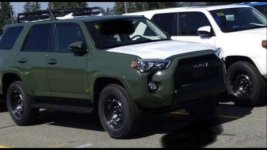
Yes. Really true. Or at least it used to be true. Originally they all left the factory as Trail Editions without the sunroof and all the TRD Pro stuff was added at port other than paint colors. Wheels, skids, and suspension along with swapping interior floor mats etc that were installed at the factory and replace at the port. They normally come on black steel wheels to the port and get replaced there with the TRD Pro wheels.

If you ever wondered why the TRD Pro grill cross bar is a double sided tape stick on overlay - now you know. :)

I can't find an old picture, but I think IIRC up until around 2018 they were not shipped with the TRD Pro grill installed. I just don't remember for sure. A member here used to occasionally post photos from the port as they were unloaded. Here's a current one at port. Not sure if it's already had the front clip swapped or it came from the factory that way.

Before that there used to be a display board at most dealer parts counters with the FJ Cruiser/4Runner Trail Teams suspension sets that then became the TRD Pro setup.

You'll also notice there's no badging on them until it's added at the port.

311149d1536512419-2019-trd-pro-4runner-pic-request-e4e0b557-6f7f-4db1-a461-0318f91461c3-jpeg


In full disclosure - there are times I wish I had gone for the Inferno TRD Pro vs KDSS Trail Premium. Inferno is the only color of TRD Pro I've really loved. But KDSS won out for me. And the sunroof is nice to have at times. It wasn't until later that the TRD Pro got the "premium" trim features like the sunroof and mirror puddle lights etc.
 

Attachments

  • 2020_toyota_4runner_trd_pro_in_army_green.jpg
    2020_toyota_4runner_trd_pro_in_army_green.jpg
    23.7 KB · Views: 671
Last edited:
Just for fun if it has any meaning. When toyota ran the Baja 1000 in a 4R, it went with KDSS. (It also rolled half way through, but still came in 2nd in class.)
22508d1258752650-running-baja-1000-a-t4rbaja1000-jpg


The builders of the suspension for the Baja talk about it a bit in this video:
From Rubicon to Baja: The Build with the 4Runner - Toyota Racing | Toyota - YouTube

I suspect today they'd take a TRD Pro model instead and not have KDSS, but it's hard to know. I think marketing drives a lot of choices.
 
Last edited:

Members online

Forum statistics

Threads
278,316
Messages
3,554,105
Members
248,016
Latest member
Advally Service

Trending content

Back
Top