A possible solution to leaking axle seals

First post.

Just wanted to say thanks to everyone for the help! I have 1999 V6 4WD 4Runner with 205k miles, both rear seals were leaking.

Dealership wanted $1,200 just for labor to replace the seals and press new bearings. I was able to find a local machine shop that pressed the new bearings onto my axles for $67/side. Went with the method recommended here; retainers were reversed and moved 2MM inboard. The original factory seal sat dead center on the retainer, grease test of the new seal design had it on the edge as shown on the photo.

I rented a seal driver set from Autozone (item 27119) and a rubber mallet to set the new seals.

Purchased Toyota OEM for the seals, aftermarket for the ABS ring, NSK bearings (still Japanese) and aftermarket retainers.

Only thing I noticed were on two of the four aftermarket retainers, the machined surface was so rough it would have chewed up the new seals, ended up using them to retain the bearings. Other two were fine, same finish and diameter as OEM. Got the whole set off eBay $105.

Total DIY cost was just shy of $300.

Attached a photo that I gave to the machine shop in case anyone else wants to use it.

Only 1,000 miles so far but no leak.

Thanks again.

Thanks for this pic, going to take my axles to a shop today to get them pressed and will show them this. Hope my grease test shows all is well!
 
Dude, what you need to do is take your truck back to them and insist they do the grease test right in front of you. This is what I did when my local Toyota dealership screwed up the job and I was leaking on my driver side in less than 5000 miles. The tech who did the job on my truck did not even know what a f#cking grease test was. So, another tech watching the whole show told him what he had to do. When he pulled the axle back out the grease test showed the lip of the seal was barely riding on the polished surface on the retainer, right on the edge of the bevel. At one point, one of the many techs watching what was going on told the tech that did the job on my truck that I just schooled him. This goes to show that a DIY mechanic can often know more than a paid mechanic because of forums like this that share information.

[MENTION=102606]infamousRNR[/MENTION], [MENTION=148218]JZiggy[/MENTION] and I recently did an axle seal job on [MENTION=148218]JZiggy[/MENTION] non-abs rearend. We confirmed without a doubt that following [MENTION=78997]Drcoffee[/MENTION] suggestion of flipping the retainer around was absolutely necessary to get the lip of the seal riding in the center of the polished part of the seal retainer.

What many techs still don't understand is they can't follow the FSM specs for the placement of the retainer anymore. Toyota redesigned the axle seal at some point in the past and now the lip of the seal sits 2mm more inboard than before. If you follow the FSM spec, the lip of the seal will be barely riding on the polished part of the retainer.

With the Non-ABS rearend, you have to press the retainer all the way against the bearing to get the retaining clip in place so you can't adjust the retainer position to get a better mating with the seal. The only choice we saw was to flip the retainer.

With the ABS rearends, you have a second inner retainer and an ABS gear. The inner retainer is what connects with the axle seal. This retainer in it's original orientation can be moved a little more inboard to mate up with the seal better but then it comes very close to rubbing the inside of the axle housing. Flipping the retainer again seems like the best choice to get a better mating of the seal and retainer and keep the retainer from rubbing the axle housing.

We filmed the Non-ABS job and we're going to hopefully film an ABS one soon. We missed filming an important part of the pressing procedure so we're going to wait until we film the next one so we can add that missing footage so the video will be complete and not leave people guessing how we did it.

TAKE YOUR TRUCK BACK AND TEACH THEM SOMETHING ABOUT OUR RIGS. Your efforts will hopefully avoid the next 3rd Gen owner that visits their shop for an axle seal failure from going through the same bullshit. Good luck and please report back what the result end up being.

When I inevitably get around to this, how can I assure they do it right? I mean I can't drive it to them and do the grease test myself. The grease test involves putting it back on completely and putting back in the hub right?
Also, I asked a machine shop recently over the phone about doing it this way, and they said they'd do it to the FSM specs due to liability.
 
When I inevitably get around to this, how can I assure they do it right? I mean I can't drive it to them and do the grease test myself. The grease test involves putting it back on completely and putting back in the hub right?
Also, I asked a machine shop recently over the phone about doing it this way, and they said they'd do it to the FSM specs due to liability.

What you do is bring the truck back to them and say you want them to pull the axle and do the grease test right in front of you. That's what I told the service writer at my local dealership and they did it. They botched the job so they shouldn't give you grief if you want to see something with your own eyes.

For the machine shop tell them you want and if they're not willing to do it you'll just go to another machine shop. At the very least they have to change the position of the inner retainer more inboard by a couple millimeters if they don't want to flip the orientation of the retainer. But, this puts the retainer close to hitting the inside of the axle housing. If they press on the inner retainer to FSM spec even though they know the axle seal has been redesigned with a seal lip that now sits 2mm more inboard, then they are idiots. I guarantee you are now more knowledgeable about this repair on our rigs than 95% of the paid mechanics out there. I got my local dealership to do the retainer flip for me. And, I probably prevented many more 3rd Gen 4runner owners and 1st Gen Tacoma owners from getting a screwed up axle seal repair job from them.
 
Last edited:
Hypothetically speaking....

If one were to flip the retainer and install it in exactly the same position as it was originally, would the seal likely be ok even though not perfectly centered?

I'm wondering if, with the elimination of the bevel, there would enough contact area without making 1mm shifts in position to try to make it perfectly centered.

The reason for the question is - if one were to have the complete job done at an independent shop, and would not be able to be present to verify the grease test (assuming they even did it) if you just requested the retainer be reversed perhaps that would be enough to assure no leaks. I'm not sure I'd count on them fiddling with 1mm increments to try to make if perfect. More likely they'd just press it back on the original position. Hopefully, that is.
 
Axle doesn't slide in all the way

Anyone have this issue? I'm thinking the shop didn't press everything to spec. Seems like the inboard ring is too shallow.

Thoughts?

Max
 
Nothing useful to contribute here other than seeing this thread just brought back some terrible memories from back when I did this job.

Found out that the inner spacer and ABS tone wheel do NOT get fully seated against each other... AFTER the fact :sobbing:

Ended up spending another $60 and half a day making a stupid tool to gently pull the tone wheel back without ruining it :rant:

Sure seems to me like this whole BS arrangement is very not Toyota-like.
 
Sorry for the late response. I had an ongoing intermittent vibration that I could not pinpoint. Finally someone had mentioned bent axle can cause that. Sure enough, mine was out by 10thou if i remember correctly. Checked the runout with a dial indicator, per the FSM. Replaced axle with a junkyard unit.

If you think about the BS excuse that axle is bent, ask how this would create the vibration. The axle is supported by the splined end at the pumpkin and the hub by the bearing. A little bend isnt going to give you that kind of vibration at the speeds the axle is spinning. 10 thousands out is frickin imperceptible. Dont waste your money.
 
I think measuring from the "polished edge" is not the best idea. That isn't a set dimension from the face of the axle as far as I know - and there could be variances in how much material is polished from the factory, not to mention aftermarket manufacturers. Measuring from here is taking a chance... you might get lucky... you might not.

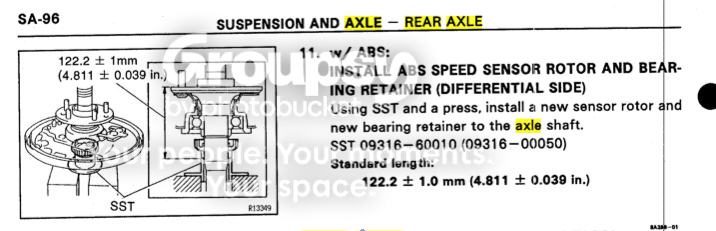
The Toyota FSM shows where the ring needs to be measured from the face of the axle.

Measuring this way is fine. My meaaurements will vary from yours. That is why I stress using the grease test method. Dont assume my numbers will be the same for you. But you need a point of reference when determining how far to shift the retainer and that place is easier than any other.
 
Happy thanksgiving everyone! My seals are holding at 225,000.

I have an unused bearing puller tool for sale in the sale section if someone is looking for the press tool to do this job. You can buy this tool and a harbor freight press for less than the cost to let toyota do the job wrong.

http://www.toyota-4runner.org/sale-t4r-items/247219-fs-rear-axle-bearing-puller-tool-new-nw-indiana.html#post2849695

D'oh! I just ordered that tool new and it's en-route. Too bad you didn't post this last week!
 
Happy thanksgiving everyone! My seals are holding at 225,000.

I have an unused bearing puller tool for sale in the sale section if someone is looking for the press tool to do this job. You can buy this tool and a harbor freight press for less than the cost to let toyota do the job wrong.

http://www.toyota-4runner.org/sale-t4r-items/247219-fs-rear-axle-bearing-puller-tool-new-nw-indiana.html#post2849695

I see you liked the alteration I did to the Durasolid tool.
 
Measuring this way is fine. My meaaurements will vary from yours. That is why I stress using the grease test method. Dont assume my numbers will be the same for you. But you need a point of reference when determining how far to shift the retainer and that place is easier than any other.

I've done this rear axle seal job 4 times now on ABS rearends and I've found 5mm of polished axle showing above the retainer (with the retainer flipped) is pretty much perfect.

The inner retainer from the factory is pressed onto the axle shaft with approximately 5mm of polished axle showing above it. We know the new axle seal design has the lip of the seal now sitting 2mm more inboard. When you flip the orientation of the retainer (bevel facing the tone ring) you gain back that 2mm because you no longer have to first push past that bevel, which happens to be 2mm wide.

So, by simply flipping the retainer orientation, you can keep the retainer in it's original spot on the axle shaft and have the seal lip riding dead center in the middle of the 10mm polished shoulder of the retainer.
 
Same problem-leaky seals

I have had the same problem and was starting to think along the same lines as your post. I have new bearings and a working breather but oil was still pouring out and I replaced the seal twice. This has to be the reason. I think the mechanic who pressed on the retainer pushed it on too far so the seal barely makes contact. I'm going to do it right.
Since my bearings are "new" I may just replace the retainer and be very mindful of how far I press it on so proper contact with the seal is made.
 
If you think about the BS excuse that axle is bent, ask how this would create the vibration. The axle is supported by the splined end at the pumpkin and the hub by the bearing. A little bend isnt going to give you that kind of vibration at the speeds the axle is spinning. 10 thousands out is frickin imperceptible. Dont waste your money.

Did you really just ask how a bent axle would create vibration?

You may not have realized that I had already fixed this issue prior to my first post regarding it. The flange runout was 10 thou outside of the limit per the FSM. That was the problem.
 
Last edited:
What kind of vibration specifically? I have vibration and steering issues and an alignment shop told me it's my rear end. So I'm curious what your truck's symptoms were

I had what felt like a wheel vibration that would become more or less pronounced at different times above approx 50 mph. For example I could drive maybe 5 Minutes on the highway with no vibe, then it would just start up for awhile, then smooth out again later. At first it was seemingly random, but after paying closer attention I noticed that going around a bend or turn could affect it either more or less (to varying degrees). I should note that there was never any steering wheel shanking, so I always figured the problem was not up front. additionally, this happened for the course of a few years, and during that time I had numerous tire balances, rotations, as well as different rims and tires completely.

It is not imperceptible to think of one axle flange (that has brake drum and wheel/tire bolted to it) not turning 100% perpendicular that a vibration could be induced. And that perhaps when one wheel position changes (rotationally) in relation to the wheel on the opposite side (like when going through a turn) that the induced vibration could be more pronounced or canceled out by the minor vibrations on the opposite side.

Bottom line, I read the FSM, measured the axle runout, found it was out of spec, changed the axle and fixed the issue.
 
Measuring this way is fine. My meaaurements will vary from yours. That is why I stress using the grease test method. Dont assume my numbers will be the same for you. But you need a point of reference when determining how far to shift the retainer and that place is easier than any other.

The point of reference is given. It’s printed in the FSM, it’s accurate, and it works. No grease test needed. :)
 
Last edited:
Did you really just ask how a bent axle would create vibration?

You may not have realized that I had already fixed this issue prior to my first post regarding it. The flange runout was 10 thou outside of the limit per the FSM. That was the problem.

If the flange is bent, it will cause a vibration. But not cause an oil leak. UNLESS, the oil seal is sitting right at the edge of the bevel of the retainer. I was referring to the axle shaft. Hey, there is nothing wrong with sticking your head in the sand and holding the FSM up as the bible with a faithful reliance that all will be well. But for the rest of us who want to make sure the seal is properly position, the grease test is the GOLD standard.

Have you pulled out your ABS sensors to check for leaking yet? Check back when you do.
 
Last edited:
If the flange is bent, it will cause a vibration. But not cause an oil leak....UNLESS, the oil seal is sitting right at the edge of the bevel of the retainer. I was referring to the axle shaft.

Just to clarify, I never indicated the bent axle caused an oil leak. See post 122 (posted again below)

Hey, there is nothing wrong with sticking your head in the sand and holding the FSM up as the bible with a faithful reliance that all will be well. But for the rest of us who want to make sure the seal is properly position, the grease test is the GOLD standard.

I just re-did the seals for the forth time in 3 months.
Feel free to share your thoughts.
My thoughts: Hey there's nothing wrong with ignoring the FSM and doing a job 4 times to try and get it right (on your own car, of course). But really, this entire thread is dedicated to you figuring something out that Toyota had posted probably when they designed the rear ABS axle... I'm guessing sometime in the 90's??

Do you always scoff at factory published specs before you even read or try them? You did it twice when I mentioned them for two different jobs in this thread.

rear%20bearing%20retainer.png~original


Have you pulled out your ABS sensors to check for leaking yet? Check back when you do.

By now you should know my method for doing this job (per FSM), which is the way I did it last year and also in 2008. From my post #122 in this thread:

Actually, its 2mm. Per the FSM.

Interesting thread.

FWIW: I replaced my bearings and seals on 06-24-08 at 154,500. I took it apart today to investigate for a bent axle shaft (and it is!), but thankfully still no leaks. Current mileage is 234,028... so 79,528 leak free miles.

Factory measurement still works --> http://www.toyota-4runner.org/2152324-post29.html

There is more than one way to skin a cat, and ultimately the goal is to get the ring in the correct location and prevent an axle seal leak. And while an axle leak is definitely a PITA, it typically isn't a show stopper.

But my issue here now is that you're encouraging others to "stick their head in the sand" (to use your words) when it comes to the FSM. Service manuals are there for a reason - so you don't have the do the same job 4 times. I strongly encourage people (I'm referring to non-technicians, pro-techs already will) to reference the proper materials any time they're doing a job for the first time, rather than rely solely on "procedures" posted by "forum experts" (that goes for crap I post too, hahahaha).

:focus:
 
Last edited:

Members online

Forum statistics

Threads
278,312
Messages
3,554,086
Members
248,016
Latest member
Advally Service

Trending content

Back
Top
