Nor was that my question to you. I asked if 'you believe that an entire industry transitioned from static to dynamic balancing (with all the associated retooling and equipment costs) on a whim, driven by the sales pitch of equipment manufacturers?' - my question being driven by your post (which I quoted):
I don't think we have any disagreements, although I'm more cynical on "industry trends" than you are since you seem to think that the industry is more altruistic than they may really be.
Take the customer service industry for example, which has moved toward the trend of robot representatives.
It used to be that when you called customer service, a real human answered the phone.
The trend is certainly toward robots, but that isn't necessarily a trend that benefits consumers, does it?
Anyway, fact is that tires were balanced statically until dynamic balance machines came into being.
The trend went from static to dynamic to road force (and there will be more styles as more money needs to be made and computerized machines made to do other tests).
The "industry" has to follow trends, particularly customer trends, where, the marketing people for the industry have the explicit job of *making* those trends. Witness iPhone trends, for example, where M-A-R-K-E-T-I-N-G has the role of defending as "chic" the lack of portable bluetooth file transfer and headphone jacks (just as two examples).
The vast majority of people are fools (when it comes to technology). The industry follows the fools (witness high-octane fuel trends, for example, or brake disc rotor-warp idiocy which abounds even here on this forum). For every fool out there, the industry will follow with a product (e.g., thicker beefier rotors & high-octane fuel).
The industry follows the trends, or they don't get customers.
There was a "tire warranty" trend, for example, before the days of the UTQG system.
Just because the industry has a trend, doesn't mean the consumer benefits greatly from that trend.
Witness ripped jeans, just as one minor example. They make them that way at the factory, right? Are they better jeans? No way. The industry is simply following the trends that the consumer expects.
Plus, the industry is trying to have dumber and dumber techs operate more and more sophisticated equipment. Does that get you a better balance? Nope. It just makes more money for the industry as it takes a less-skilled worker less time so that they can get more cars in and out the door.
That reason alone would be a great reason for the industry to use automated equipment. It's the reason Eli Whitney's cotton gin revolutionized the south. It didn't separate cotton fiber from the seeds any better than human hands, but it did it faster and with unskilled labor.
So, *any* machine that allows a dumber tech to do the job faster and with fewer returns (which is another critical metric) is something that is going to take over the industry, whether or not it results in better balanced tires.
What MARKETING does is take the good stuff and convince people they want that, and it ignores ALL the bad stuff (it's what all marketing people do).
For example,
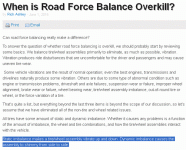
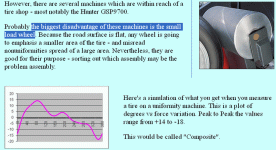
Hunter's job is to convince everyone that they need "road force" balancing (even though the wheel is actually too small to be realistic - which they don't mention).
Do you need road force balancing?
Hell if I know.
That's not what I'm saying.
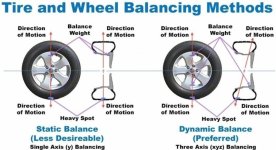
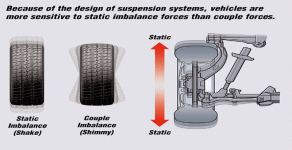
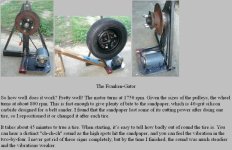
I'm just saying I can mount and balance at home, but that balance is a static balance.
Therefore, my plan is simple.
- Balance the wheels statically
- If the vehicle vibrates, then dynamically balance
- If the vehicle still vibrates, then road-force balance
- (I'm gonna skip tire shaving and rim corrections.)
The only question that matters, given that plan, is whether the plan makes technical sense (
i.e., we ignore costs for the purpose of that plan).
I haven't followed this thread closely, but based on your most recent posts I understand that you believe that you have better control over the quality of the balance by doing a static balance at home, as indicated by your opinion of professional installers, but you don't separate quality of work when you attempt to make a comparison of the quality of processes. You seem to want to compare a competently performed static balance (which were all but over when I worked at garages in high school) to an incompetently executed modern balance.
I didn't set out to deprecate the tire-mounting business.
I only said two things, both born of experience:
- I should be able to mount & (statically) balance at home, and,
- I have never seen a tire mounted & balanced correctly at a tire shop
What you inferred I didn't imply, at least not consciously.
- If I could do a dynamic balance at home, I'd do it.
- If I could do a road-force balance at home, I'd do it.
However, neither is practical. So I don't do them at home.
So I'm not deprecating dynamic or road-force balancing.
I'm just asking if I can do without it.
I'm still curious about why you think the industry moved on from static balancing?
I am not an industry trend expert.
However, I read a bunch of the Hunter PDFs and white papers, where Hunter seemed to be really (
really really really really) trying to
convince tire shops that they
needed their fancy equipment.
For example,
all these are on this one page by Hunter: (EDIT: See graphic below.)
- Perform a Road Force® test and balance as fast as a traditional balance!
- Saves time
- Intuitive interface
- Quickly train new technicians
- True "self-calibration"
- No operator input required
- Speeds operations
- Minimizes weight usage
- Maximizes productivity
- Simplify training
Read the PDF I posted prior for example. Read the references I already quoted. They all try to convince the tire shops that they can get more cars out the door with fewer callbacks with dumber techs using the fancy equipment. (It's the same argument for fancy tire-alignment racks.)
Fancier equipment run by dumber techs may or may not result in a better balanced wheel.
I'm not arguing that point (either way).
My only point is that I can do certain things at home, and there are certain things I can't do.
So my plan is simple:
- Mount and balance the tires
- Test drive the vehicle
- If it vibrates - then go to plan B
The only question that this plan hinges upon is whether the wheels/tires must be dynamically (or road-force) balanced if they don't cause any perceptible vibration/shimmy?