Another trailer / boat towing question

When you pulled the boat and had scary surgr brake situations. Can you elaborate on what occurred there?

Thanks so much for the reply. Have not done any pulling so this is very helpful.

Sent from my SM-N910V using Tapatalk

Scary situations can include people cutting in front of you not giving a lot of space to react, going down a mountain pass is another situation that I'd like to have control over my brakes in... Those surge brakes rely on you forward momentum of your boat to engage those brakes and may be able to lock up possibly getting squirrely.
 
Oh, and I use proportional electric brakes (Curt controller). I was following someone who decided to slow down for merging traffic (freeway onramp). The incoming car also slowed down, and they both almost came to a stop!

Trailer braked strait, strongly and effectively.

My underwear didn't fare as well....

;)
 
FWIW- the trailer sway formula that predicts stability is a function both of tongue weight and weight distribution within the trailer. More wight closer to center = less propensity to sway. A boat like yours with the weight basically out at the ends (motor in the rear) is on the bad side of sway probability so you may want a bit more in the tongue weight category to compensate. However - if it's a trailer built for that boat, it should be engineered properly.

The biggest mistake I see on a regular basis is having the wrong trailer hitch. If your ball is too high on a single axle trailer - it moves the COG back and changes the effective tongue weight making for a potentially unbalanced trailer. On a dual axle trailer, it actually adds tongue weight most of the time because you're now putting more load on the rear axle and moving the effective center of the pair of axles. Typically trailer brakes are on the front axle in a tandem axle setup, so you're now removing weight from the axle with the brakes and increasing the likelihood of lockup and reducing effective brake force. Plus if the trailer tongue is not level it's going to want to lift the rear of your tow vehicle also reducing braking ability. Ideally a slight downward slope of the trailer frame should exist or at least get it level. The correct drop hitch is pretty easy to sort out most times and shouldn't cost an arm and a leg either.


I'd guess that wind resistance will be significantly more of an issue than weight. Wind resistance is a square function of speed, so... drive slower and it'll reduce your resistance a lot and you'll get better mileage. Even with my small teardrop trailer 80mph is 13mpg and 65mph is more like 16-17mpg. 13mpg and a 20 gallon tank results in a lot of stops for gas.
 
Last edited:
All,

There is a decent amount out there om this topic but a lot of it conflicts or is different than my situation.

My situation:
2016 4Runner limited all stock

Will pull an older 24ft pontoon rated at 1700# dry weight with motor. So lets round that to 2,000# actual.

750# float type trailer (pontoon sits on rails/guides) has surge brakes. No sway or wds.

So assume total weight of 2,750#

Questions

1. Anyone out there who ACTUALLY pulled something similar that you could share your experience? How stable is this setup? Should I expect trouble?


2. It appears that with surge trailers you cannot use sway control bars. Does this sound accurate?

3. The manual says to not use a weight distribution system as it can damage the frame. Assuming that is out, correct?

4. Being new to this any steps I should take or special equipment to install?

Any thoughts appreciated!

Sent from my SM-N910V using Tapatalk

FWIW, your 4Runner already has electronic sway control...

:)
 
Stability control- yes.

Sway control- no. At least not how it applies to trailer stability in this thread.

I read it in my owners manual. Sway control for towing....

Quote:
"Trailer Sway Control
Helps the driver to control trailer sway by selectively applying brake
pressure for individual wheels and reducing engine torque when
trailer sway is detected.
Trailer Sway Control is part of the VSC system and will not operate
if VSC is turned off or experiences a malfunction.

Pg 259

Source (for doubters):
2016 Toyota 4Runner Owner's Manual - JustGiveMeTheDamnManual.com

Of course, heavier and longer trailers may require an external sway controller. The friction-bar type are pretty effective...

;)
 
I think you'll be just fine.
 

Attachments

  • image.jpeg
    image.jpeg
    17.5 KB · Views: 579
I read it in my owners manual. Sway control for towing....

Quote:
"Trailer Sway Control
Helps the driver to control trailer sway by selectively applying brake
pressure for individual wheels and reducing engine torque when
trailer sway is detected.
Trailer Sway Control is part of the VSC system and will not operate
if VSC is turned off or experiences a malfunction.

Pg 259

Source (for doubters):
2016 Toyota 4Runner Owner's Manual - JustGiveMeTheDamnManual.com

Of course, heavier and longer trailers may require an external sway controller. The friction-bar type are pretty effective...

;)


Huh- I never heard that before for our 4runners..
 
I suspect it's one of those things that the marketing department added later. The VSC doesn't have a clue as to whether your vehicle is rotating around the yaw axis because of trailer sway or because it's skidding on ice. It'll react to either one. The marketing types likely just decided "hey, a feature we didn't know we had - put it in the manual!" How well it actually works is anybody's guess, since I suspect the engineering department was concentrating more on slick road stability.
 
If your total trailer weight is 2750 lbs, I really don't think you need to worry about sway control, special hitches, etc. You are only at half the rated tow capacity. I tow my utility trailer at ~3000 lbs loaded all the time without any brakes at all. My boat & trailer is 4000+ lbs (tandem axles, surge brakes). The 4Runner can handle it without a problem. Here is my advice:

- the way surge brakes work they can be a little rough (literally). it might take some time before you are used to them but they sure are helpful. Make sure the safety brake cable is attached to your vehicle.
- personally I like to keep my speed at or under 60 mph on the highway. Yes the truck will happily go a lot faster than that but it is more about reaction time and braking distance.
- towing a big boat one of the things that is most unpleasant/scary is the huge amount of surface area for crosswind. If you are going over a bridge/overpass and get a good gust of wind it can shake the whole rig pretty hard

So basically the truck will be totally fine. The big challenge will be maneuvering such a large trailer. If this is your first time towing a trailer it will be quite a new experience. With a 24' pontoon boat you are going to have a very long and wide trailer. Take your turns wide. Backing up a trailer is an art and IMO somewhat difficult to explain, you can watch youtube videos but really you just have to wrap your head around the way the vehicles move together and then practice a lot.

REMEMBER TO CHECK YOUR WHEELS AND BEARINGS. GREASE YOUR BEARINGS WITH MARINE-GRADE GREASE. ALL THE TIME. Check your bearings after you have been driving for a few minutes to make sure they are not getting hot to the touch. You do not want to lose a wheel on the highway.
 
If your total trailer weight is 2750 lbs, I really don't think you need to worry about sway control, special hitches, etc. You are only at half the rated tow capacity. I tow my utility trailer at ~3000 lbs loaded all the time without any brakes at all. My boat & trailer is 4000+ lbs (tandem axles, surge brakes). The 4Runner can handle it without a problem. Here is my advice:

- the way surge brakes work they can be a little rough (literally). it might take some time before you are used to them but they sure are helpful. Make sure the safety brake cable is attached to your vehicle.
- personally I like to keep my speed at or under 60 mph on the highway. Yes the truck will happily go a lot faster than that but it is more about reaction time and braking distance.
- towing a big boat one of the things that is most unpleasant/scary is the huge amount of surface area for crosswind. If you are going over a bridge/overpass and get a good gust of wind it can shake the whole rig pretty hard

So basically the truck will be totally fine. The big challenge will be maneuvering such a large trailer. If this is your first time towing a trailer it will be quite a new experience. With a 24' pontoon boat you are going to have a very long and wide trailer. Take your turns wide. Backing up a trailer is an art and IMO somewhat difficult to explain, you can watch youtube videos but really you just have to wrap your head around the way the vehicles move together and then practice a lot.

REMEMBER TO CHECK YOUR WHEELS AND BEARINGS. GREASE YOUR BEARINGS WITH MARINE-GRADE GREASE. ALL THE TIME. Check your bearings after you have been driving for a few minutes to make sure they are not getting hot to the touch. You do not want to lose a wheel on the highway.
This is excellent advice. Thank you!

Sent from my SM-N910V using Tapatalk
 
1. Anyone out there who ACTUALLY pulled something similar that you could share your experience? How stable is this setup? Should I expect trouble?
I tow my boat A LOT with my 2016 SR5. Probably 2k miles a year. All OEM except for tires. The boat is a Sea Ray 185 that weighs #3500+ with non-functioning surge brakes. I've never had any trouble with swaying, accelerating, or stopping. The load you're talking about is well below the max tow rating. I'd be willing to bet parts on your trailer will wear out before it causes wear and tear on the 4Runner.

2. It appears that with surge trailers you cannot use sway control bars. Does this sound accurate?
You don't need sway control. Just make sure you have about 55/45 front/rear weight bias on the trailer and it will track straight just fine.

3. The manual says to not use a weight distribution system as it can damage the frame. Assuming that is out, correct?
You don't need it.

4. Being new to this any steps I should take or special equipment to install?
Your truck is more than capable. Take it slow. Tow in S4 instead of D. Take turns wide. Anticipate your braking. Don't clog up traffic. Grease trailer bearings. Unplug trailer lights before you back into the water. Practice backing the trailer before you get to the boat ramp. Train your significant other to pilot either the boat or the 4Runner at the launch ramp (it speeds up the process significantly). Remember, it's probably a drive-on trailer, not a winch-on trailer.
Enjoy your new boat!
 
Last edited:
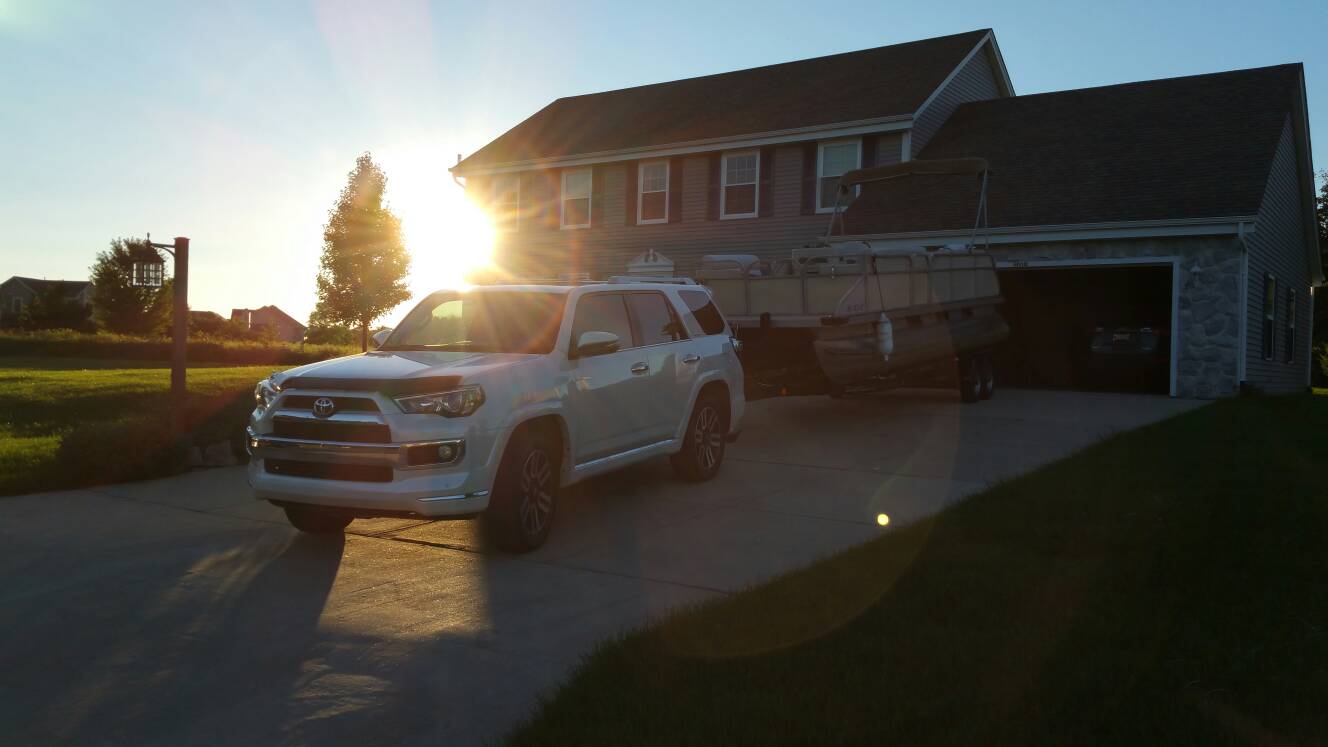
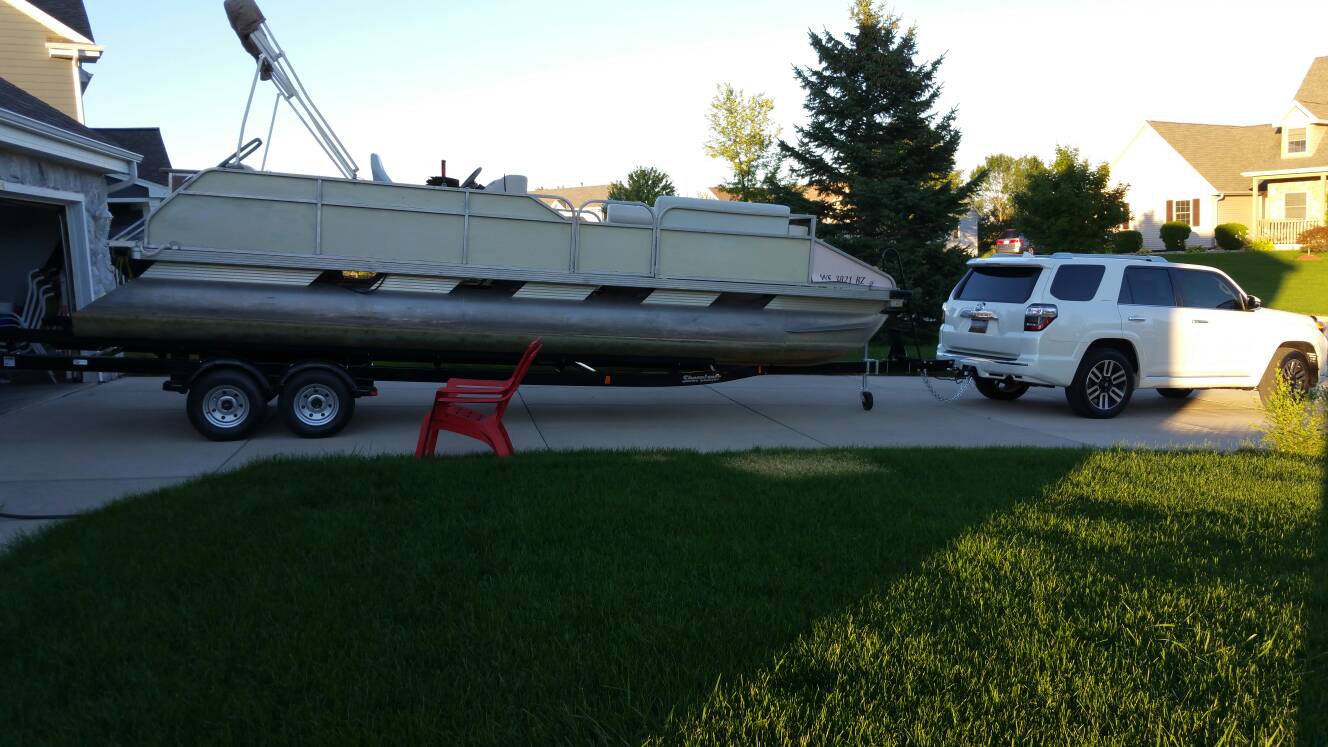
Towed the pontoon today for about 30 miles and went great. The 4runner handled the trailer and boat like a champ. Have a long trip on Monday which will include freeway driving.

Some pictures.

50bcdc4e55235c92341d8ace2dcbc372.jpg
3fc1fea03f0305d5ff4a97d29a5bbc15.jpg


Sent from my SM-N910V using Tapatalk
 
Towed the pontoon today for about 30 miles and went great. The 4runner handled the trailer and boat like a champ. Have a long trip on Monday which will include freeway driving.

Some pictures.

50bcdc4e55235c92341d8ace2dcbc372.jpg
3fc1fea03f0305d5ff4a97d29a5bbc15.jpg


Sent from my SM-N910V using Tapatalk

How good can you see directly behind you, for instance a cop close behind you with his lights on?
 
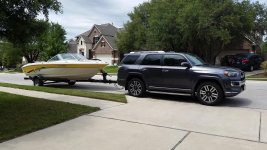
So my setup wet is in the 4,000+ lb range and it does fine. Will downshift a bit around the Austin hills coming and going to the lake but that's about it.

19 foot boat, 4.6 Mercury inboard/outboard, and the trailer has surge brakes and I've tested them once or twice locking them up. (stupid Austin drivers). No trouble stopping.

4Runner has stock suspension, brakes, etc... (for now)
 

Attachments

  • 13131676_10206176845328468_4434240357641562277_o.jpg
    13131676_10206176845328468_4434240357641562277_o.jpg
    141.2 KB · Views: 2,119
Towed the pontoon today for about 30 miles and went great. The 4runner handled the trailer and boat like a champ. Have a long trip on Monday which will include freeway driving.

Some pictures.

50bcdc4e55235c92341d8ace2dcbc372.jpg
3fc1fea03f0305d5ff4a97d29a5bbc15.jpg


Sent from my SM-N910V using Tapatalk


You might want to check the tongue weight on that. Maximum tongue weight is 500 lbs. on your 4Runner with OEM hitch.


Sent using my thumbs!
 
I suspect it's one of those things that the marketing department added later. The VSC doesn't have a clue as to whether your vehicle is rotating around the yaw axis because of trailer sway or because it's skidding on ice. It'll react to either one. The marketing types likely just decided "hey, a feature we didn't know we had - put it in the manual!" How well it actually works is anybody's guess, since I suspect the engineering department was concentrating more on slick road stability.


I think there is a lot more to it than that. Sway from a trailer looks nothing like sliding on ice to the computer. Basically the tail is wagging the dog. It is a back and forth motion. VSC uses braking to stop that wiggle or sway. And I'm pretty sure that if you have a trailer with electronic breaks and are connected through the wiring harness correctly with an electronic brake controller, VSC braking applies to the trailer brakes as well.


Sent using my thumbs!
 
Towed the pontoon today for about 30 miles and went great. The 4runner handled the trailer and boat like a champ. Have a long trip on Monday which will include freeway driving.

Some pictures.


I'm not an expert on pontoon boats and their trailers, but are you sure that trailer is adjusted correctly? It looks like the boat may be too far forward on the trailer.
 

Members online

Forum statistics

Threads
278,312
Messages
3,554,085
Members
248,016
Latest member
Advally Service

Trending content

Back
Top