Auto Ventshade Bugflector II mod (and warning!)

GrantK

New member
When I was installing my AV bug deflector I noticed that there are two extra holes near the middle of the hood that didn't have matching holes in the bug deflector. Being an engineer, I decided that using them would improve the deflector mounting. So I went to the local NAPA and found the hood inserts and matching screws. I had the nylon washers in my misc parts bin. Next I applied some masking tape to the deflector and carefully measured and marked where the new holes needed to go. I then drilled a small (1/16") pilot hole and then went for full size. Here's where I screwed up and the warning!!! I used a standard twist drill which as it started going through it got a good bite into the polycarbonate and cracked the deflector. Not visible and not enough to harm things but enough to really make me mad at myself. The new mounts work (even with the crack) and seem to make the deflector a little sturdier.

If anyone else tries this, do NOT use a standard twist drill bit. Either make the holes with a Dremel tool or maybe a Fostner bit. Fostner bits are used for making flat bottom holes and unlike regular twist drills, don't pull themselves into the work the same way.

I haven't decided if I'm going to replace the deflector since my screwup isn't visible and it doesn't really hurt things. It's just that I know it's wrong and that makes it like an itch I can't reach, which means I probably will replace it and do the job correctly on the new one.
 
Register to hide this ad
:worthless:

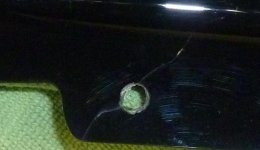
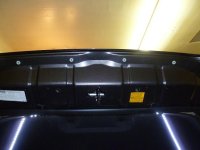
I thought that was coming so I went out and took some pics. The two middle white nylon inserts are the ones I added. In the other pic you can see the crack running from lower left to upper right.
 

Attachments

  • BugDeflector-hood.JPG
    BugDeflector-hood.JPG
    43.2 KB · Views: 711
  • BugDeflector-holes.JPG
    BugDeflector-holes.JPG
    36.2 KB · Views: 654
Just an FYI - When drilling through thin walled plastic with a standard drill bit, I've found that if you run the drill in reverse, you reduce the risk of cracking the part.
 
Grant,

Maybe this might help scratch your itch. My experience suggests that cracks like these tend to get bigger over time due to vibration. Not saying it will happen, but...

Since the crack is not visible yet, I would dismount the shield, get some clear finger nail polish and coat both sides of the crack. Super glue should also work. Others may have better suggestions. At least you might be able to stop the crack from getting bigger and in time, the itch will go away....it always does. Be safe.
 
Just an FYI - When drilling through thin walled plastic with a standard drill bit, I've found that if you run the drill in reverse, you reduce the risk of cracking the part.

Or start with the very smallest bit in the set and work your way up one by one. It might take a while but you greatly reduce the risk as well.
 
Speaking of small bit, another way to keep the crack from growing is to drill a very small hole at the ends of the crack. Then if you wish, fill those holes with glue. Crack should not travel after that.

Be safe.
 
Grant,


Since the crack is not visible yet, I would dismount the shield, get some clear finger nail polish and coat both sides of the crack. Super glue should also work. Others may have better suggestions. At least you might be able to stop the crack from getting bigger and in time, the itch will go away....it always does. Be safe.


Sorry that cracked Grant- good intentions though!

I have worked with poly a lot and agree- a Dremel is probably the best. Also drilling at very high speed helps as it melts the plastic a bit.

Super glue or nail polish won't do anything to prevent that from cracking more, not on Lexan (sorry Jtraskell).

The easiest way to prevent the crack from spreading is to plastic weld it back together with a soldering iron. Melt the plastic together over the crack and it will not spread any further. It won't look pretty, but first time you get a load of melting snow/ice on your hood that crack will want to travel!

Good luck to you.
 
Sorry that cracked Grant- good intentions though!

I have worked with poly a lot and agree- a Dremel is probably the best. Also drilling at very high speed helps as it melts the plastic a bit.

Super glue or nail polish won't do anything to prevent that from cracking more, not on Lexan (sorry Jtraskell).

The easiest way to prevent the crack from spreading is to plastic weld it back together with a soldering iron. Melt the plastic together over the crack and it will not spread any further. It won't look pretty, but first time you get a load of melting snow/ice on your hood that crack will want to travel!

Good luck to you.

I have also cracked more Lexan and polycarbonate by drilling than I care to admit. I have found, like Antman, that drill tip speed is the key to success. That or a reamer bit.
 
Like bill said run it in reverse, this is mostly a boaters trick! That's the only way you can drill in gel coated fiberglass.
 
Sorry that cracked Grant- good intentions though!

I have worked with poly a lot and agree- a Dremel is probably the best. Also drilling at very high speed helps as it melts the plastic a bit.

Super glue or nail polish won't do anything to prevent that from cracking more, not on Lexan (sorry Jtraskell).

The easiest way to prevent the crack from spreading is to plastic weld it back together with a soldering iron. Melt the plastic together over the crack and it will not spread any further. It won't look pretty, but first time you get a load of melting snow/ice on your hood that crack will want to travel!

Good luck to you.

I think your right Antman, good catch. This trick has worked for me in the past, but I do not think it was Lexan. It was most likely some other plastic. When a piece of (what I now think was Leaxan) cracked and my attempts to stop it did not work, that is when somebody suggested the small whole fix and that stopped the crack from traveling.....now I know why. Thanks almighty sage.....lol. Be safe.
 

Members online

Forum statistics

Threads
278,309
Messages
3,554,071
Members
248,016
Latest member
Advally Service

Trending content

Back
Top